
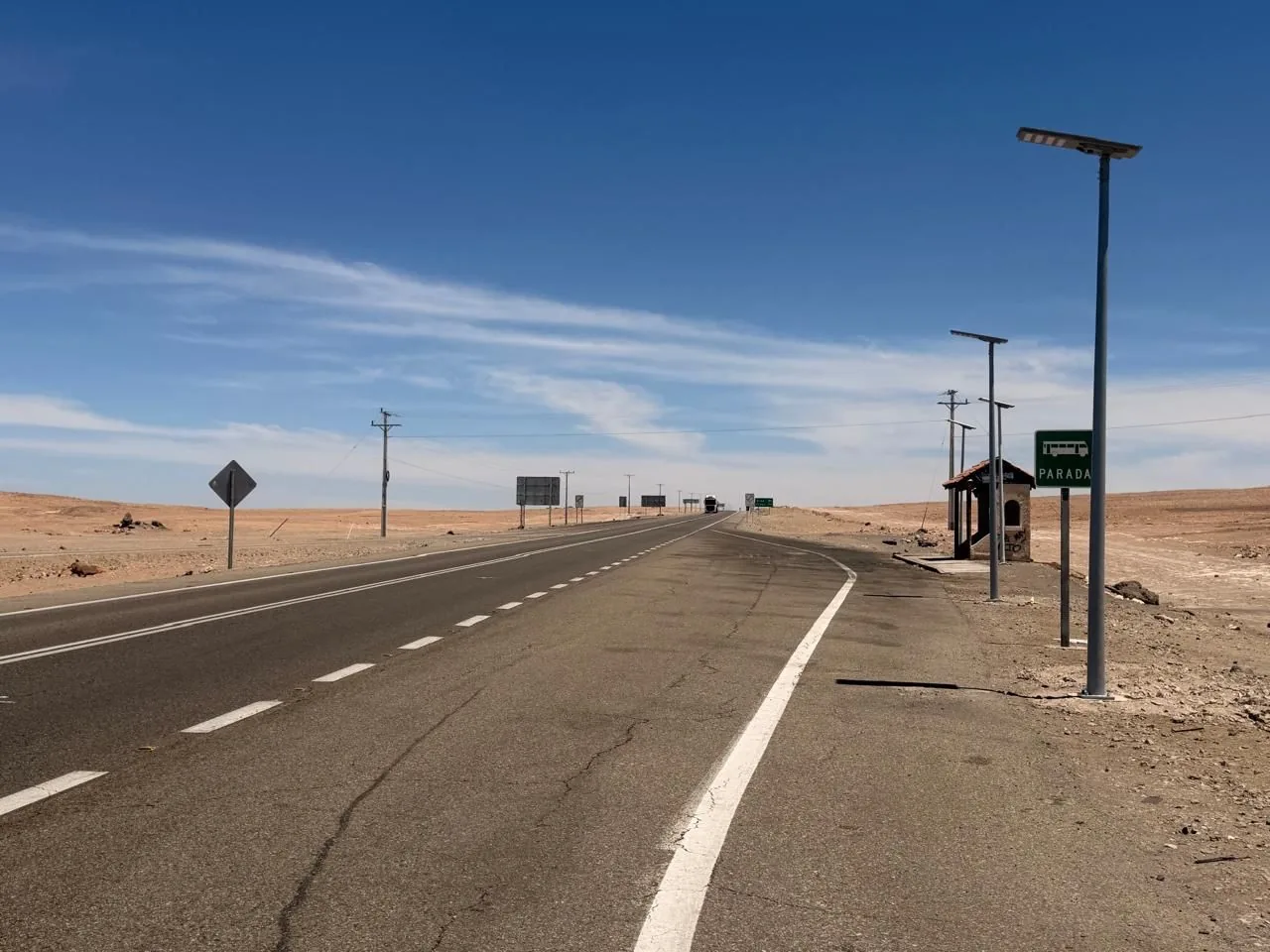
How do solar street lights work? One pole, five parts, no cable.
That is the whole idea, and the rest of this page is the detail behind it: what each part does, what happens between sunrise and midnight, and the four assumptions that quietly cost buyers money.
There are five parts, and only one of them is the lamp. When a project fails in year two, the lamp is almost never the part that failed.
A monocrystalline panel converts daylight into direct current, and it does that under a grey sky too, at a fraction of its rated output. The panel is the only part whose size you can judge from the ground, which is why it gets blamed for problems that belong to the battery.
Everything lit after sunset is energy that was stored earlier in the day. Our packs are LiFePO4, rated 3,000 cycles at 80% state of health, which works out at roughly 8–10 years of one cycle a night. A lead-acid pack in the same housing gives 2–4 years in a hot climate, and that gap is most of the price difference you are quoted.
Of the five, this is the part nobody photographs and the part that sets service life. It has four jobs:
Charging is where the label matters less than the method. MPPT harvests more of what the panel produces in low light, and low light is the normal condition on most rural roads.
Efficacy decides how much battery you have to buy. At 150 lm/W a 60 W head gives 9,000 lm. At 220 lm/W the same light needs 41 W, and the pack, the panel and the freight all shrink with it.
The unglamorous part sets the failure rate. A housing that seals on a bench and loses its gland on a pole is a leaking light by year three. Ask what the gasket is made of, not only what the IP number is.
daylight   →   panel   →   controller   →   battery
night → battery → controller → LED headFour phases, and only one of them is visible from the road.
The panel starts producing mid-morning and the controller holds the pack at absorption voltage until the current tapers. A pack that is full by two in the afternoon is not waste. It is the reserve for a grey week.
A light sensor reads the sky, not the clock, so switch-on follows the season without anyone editing a schedule. Most controllers add a short delay, usually 30–60 seconds, so a passing cloud or a car headlight does not trigger them.
Full output for twelve hours is the most expensive way to light a road. The common profile is full output through the evening traffic, then 30–50% until dawn, with a motion boost on top. Same battery, two more hours of light.
The lamp goes off, the controller returns to charging, and the cycle starts again. There is no switch to throw and no timer to reset.
A grid street light needs a trench, conduit, a connection point and a monthly bill. A solar light needs none of the four, and that is why it wins wherever the trench costs more than the hardware.
Where it stops being an advantage: a highway interchange, a city arterial at 12 m mounting height, a site with a reliable grid and heavy traffic. The five-year cost comparison runs both sides of that arithmetic, and on some sites the grid still wins. We sell solar lights, and that does not make solar the right answer everywhere.
Same physics, different packaging. The choice is mostly about power and about who climbs the pole.
| All-in-one | Split | |
|---|---|---|
| Power | 30–150 W | 60–300 W |
| Installation | One unit, mounted in under an hour | Panel, battery box and head rigged separately |
| Battery size | Limited by the housing volume | Sized to the autonomy you ask for |
| Service | Swap a module | Swap one part, keep the rest |
| Fits | Village roads, footpaths, gardens | Arterials, industrial yards, long rainy seasons |
There is no better type. There is only a type that fits the site. The expensive mistake is buying the cheap one for a site that needed the other.
Four sentences that arrive in almost every enquiry, and what each one actually costs.
It can, and the number that decides it is autonomy, meaning how many consecutive grey days the pack covers at the output you asked for. Ours ship at 3–5 days. A site with a two-week wet season needs a bigger pack than a site with a dry season, and no datasheet can average that for you.
Watts are what the head draws. Lumens are what reaches the road. A 60 W head at 220 lm/W beats a 90 W head at 130 lm/W and draws two thirds of the current. Read the lumen figure and the beam angle together, because light spread over a wide road at a low mounting height lands dimmer than a narrower beam at the right height.
An oversized panel with an undersized pack wastes the extra harvest, and an oversized pack with a small panel never fills. Four numbers have to match: head wattage, local peak sun hours, nightly run time and the autonomy you want. Sizing is arithmetic, not generosity.
It is less work than a grid light, not zero work. Panel soiling, a loose gland, a base that settled, a pack that has lost a fifth of its capacity by year six. Four checks a year catch all of them.
Five questions, and none of them is about price.
One enquiry arrives as "100 W, five-year warranty, best price". The other arrives as "40 W, 6 m mounting height, 300 m of road, 11 hours a night, four grey days, replaceable pack". The second one gets a quotation you can compare line by line. The first gets a number, and a hope.
Do solar street lights work in winter? They work, at lower output. Shorter days cut the harvest and the pack carries more of the load, so a winter-critical site is sized on December sun hours rather than the annual average.
How many hours can one run on a full charge? At full output, typically 10–12 hours on a pack sized for 3–5 grey days. Dimming to 30–50% after midnight roughly doubles that without adding battery.
What happens on a cloudy day? The panel still produces, at perhaps a tenth to a third of its rated output, so the pack charges slowly rather than not at all. Autonomy exists for the days when it produces nothing useful.
How long does the battery last? Our LiFePO4 packs are rated 3,000 cycles at 80% state of health, which is 8–10 years of nightly cycling. After that the capacity is still there, only smaller, and the runtime drops before the light stops.
Can I add a solar light to an existing grid street? Yes, as a standalone pole, and that is often how a first installation gets approved. It cannot share the grid circuit, because there is nothing to share once the panel and the pack are on the pole.
If the site is not chosen yet, start with the Latin America hub and the country picture. If the numbers are the open question, the seven-step procurement guide does the autonomy arithmetic line by line. If you are deciding between motion sensing and a fixed schedule, timer versus motion sensor covers the trade-off. If the question is how to read the sheet in front of you, how to audit a solar street light datasheet is the checklist. And if the site has no grid at all, off-grid villages is the closest case study.
Our 25-engineer team provides free project consultation and fast, accurate quotations.
Get a Quote