
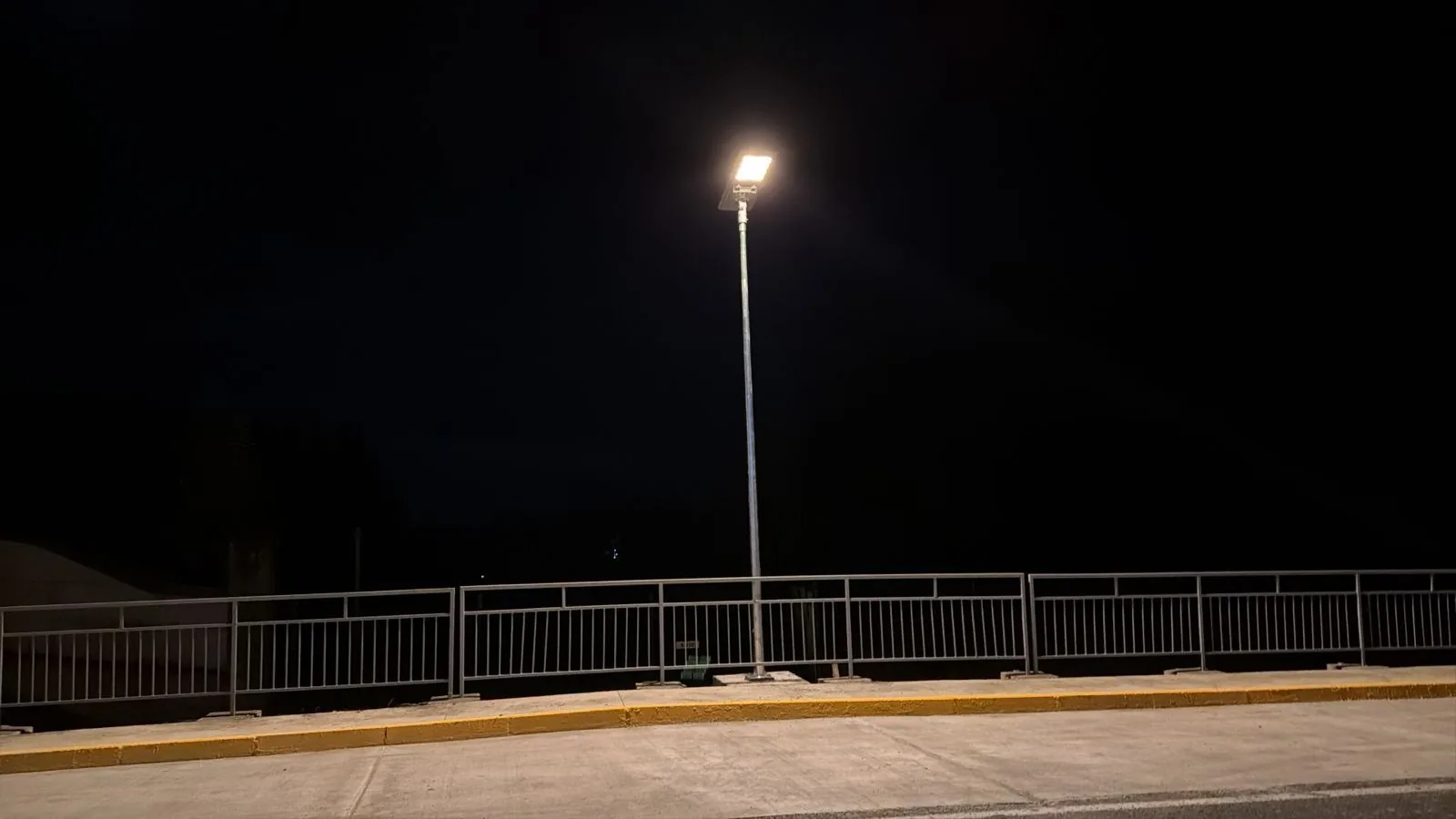
For municipal works, EPC contractors, importers and off-grid project buyers.
No spec-dumping, no concept-peddling. Just how to buy the right light, buy it to last, and buy it so maintenance stays affordable.
The mistake that kills a solar street light project in South America is rarely "the light isn't bright enough." It is the lamp going dark in the rainy season, a battery fading after one year, salt-air corrosion, a certificate that fails customs, or a supplier that cannot deliver a DIALux file.
This guide breaks procurement into seven steps: fix the scenario → size the configuration → choose the structure → verify the core components → clear certification → screen the supplier → write the RFQ.
South America is not a single market. Bogotá is rainy, Santiago is clear, the Brazilian coast is humid, the Andes are high-altitude with strong ultraviolet. The same light can fail within eighteen months in a different country.
Scenario tier matters ten times more than the wattage on the label:
| Scenario | Typical buyer | Core risk | Recommended structure |
|---|---|---|---|
| Rural off-grid / community road | Government, NGO, cooperative | Blackout in rainy season, battery fade | All-in-one, 3-5 days autonomy |
| Municipal collector / arterial road | City government, public works | Illuminance short of standard, poor uniformity | Split-type + DIALux simulation |
| Coast / port / seafront promenade | Port authority, tourism board | Salt corrosion, seal failure | Split-type + C5-M coating + IP67 |
| Mine / industrial zone | EPC, plant operator | Vibration, dust, vandalism | Split-type + lockable battery bay + IK10 |
| Resort / scenic area | Hotel, landscape contractor | Mixed colour temperature, light-pollution complaints | All-in-one or split + shielded optics + single bin per batch |
Practical rule: in Latin American municipal tenders, a split system is usually more reliable than a "do-everything all-in-one" — the panel angle is adjustable and heat is isolated.
Consecutive overcast days are the life-or-death line for South American projects, especially in the rainy seasons of Colombia, Brazil and Peru.
The basic calculation:
C (Ah) = P (W) × T (h) × D (days) × K (safety factor)
        ─────────────────────────────────────────────────
        V (system voltage) × η (system efficiency) × DOD (depth of discharge)
Parameter reference:
Worked example (for illustration only): 30 W light, 12 V system, 8 h per night, 5 overcast days, K = 1.3, η = 0.85, DOD = 0.8
→ daily draw 240 Wh → total need 1,560 Wh → battery about 152 Ah @ 12 V (add real margin when specifying)
| Dimension | All-in-One | Split-Type |
|---|---|---|
| Installation | Fast, low labour | Slightly more complex |
| Panel angle | Fixed, limited by the housing | Independently optimised, 15-25% more charge |
| Battery service | Hard to replace (except our AIOX series) | Replaceable on site |
| Heat | Concentrated in one body | Battery and controller dissipate separately |
| Best fit | Villages, compounds, paths | Municipal, industrial, coastal, rainy regions |
Conclusion: large municipal batches and rainy cities (such as Bogotá, Belo Horizonte) should prefer split-type; rural off-grid small projects can use all-in-one.
Thresholds differ by country. Verify the latest regulation version before tendering:
| Country | Key certification | Notes |
|---|---|---|
| Colombia | RETILAP (2026 new version active) | Mandatory safety + energy efficiency + photometry + EMC + IP salt spray; local importer must hold the certificate; old-version certificates are phasing out |
| Brazil | INMETRO + ANATEL (for wireless) | Certificate holder must be the Brazilian importer; street lights use Ordinance 62; annual audit + factory inspection |
| Peru | NTP (national standard) + COC + energy label | Customs does not force safety-certificate inspection, but Peruvian municipal and highway tenders and large EPC purchases require it |
| Argentina | S-Mark + IRAM | Local agent required to hold the DOC |
| Chile | DS 01 / DS 43 (blue-light / dark-sky protection) | Must meet SEC electrical safety certification; the dark-sky regulation (Decreto Supremo 01/43) strictly limits blue-light radiation |
| Ecuador | Electrical safety + energy efficiency + local standards | INEN 069 under revision; solar street lights partially exempt but components still need reports |
Red line: a "CE sticker" does not equal South American customs clearance. Require the original report number, laboratory name, battery IEC 62133, panel IEC 61215, luminaire IEC 60598.
Ask these eight questions before the quote:
If they cannot answer, eliminate them.
Tender-grade technical document pack (required with the RFQ):
Project type: ________________ (municipal / rural / coastal / mine / scenic)
Country / city: ________________
Road width: ______ m   Pole height: ______ m   Pole spacing: ______ m
Target illuminance: ______ lux   Uniformity requirement: U0 ≥ ______
Hours per night: ______   Consecutive overcast autonomy: ______ days
Structure preference: [ ] all-in-one  [ ] split  [ ] adjustable angle
Battery: LiFePO4 ______ V ______ Ah, ______ cycles @ 80% SOH
Panel: monocrystalline ______ Wp, efficiency ≥ 21%
Controller: MPPT, surge protection ______ kV
Ingress: luminaire IP ______, battery bay IP ______, IK ______
Certification required: [ ] RETILAP  [ ] INMETRO  [ ] COC  [ ] other ______
Delivery: ____ units, lead time ____ weeks, terms: FOB / CIF / DDU
To be supplied: IES + DIALux + salt spray report + certificates + warranty letterHidden costs of a low bid:
TCO formula:
Total cost of ownership = equipment price + freight and insurance + installation
                        + battery replacements × unit price
                        + maintenance labour + fault inspection
                        + outage complaints and rework
                        − electricity saved
A quality system costs 10-20% more up front but can save 2-3× in maintenance over ten years.
How many days of battery autonomy do I need for a long rainy season in South America? Colombia, coastal Brazil and the Amazon basin suggest 3-5 days; high-humidity rainy areas 5-7 days. Smart dimming adds another 1.5-2 nights.
Is IP65 enough? IP65 works for dry inland projects. Coastal, port and high-humidity areas need IP66 luminaires + IP68 battery bay, and check the test report, not the label.
LiFePO4 or lead-acid? Tropical and high-cycle scenarios: LiFePO4 only. Lead-acid fades within 2-4 years above 30 °C, meaning 2-3 replacements over ten years.
Is a DIALux simulation necessary? Yes for municipal tenders. Without an IES file, uniformity and illuminance are guesswork.
Which is harder, Brazil or Colombia certification? Colombia RETILAP has a longer document chain (photometry + energy efficiency + EMC + salt spray); Brazil INMETRO needs a local importer as certificate holder plus factory inspection. Both need 2-3 months of lead time.
How do I tell if a supplier is inflating specs? Ask for actual input power, total luminous flux, the IES file, the battery cell brand and the physical panel dimensions. A "300 W model" with no test file means pass.
South American solar street light procurement is not "buying a light." It is buying a system that can survive the rainy season, the salt air, the audit and ten years of maintenance.
Get the configuration wrong, miss one certificate, or use the wrong battery cells, and the cost becomes a bottomless pit.
Our 25-engineer team provides free project consultation and fast, accurate quotations.
Get a Quote