01
Zero uplight
A shielded optic with a flat glass and no tilt sends nothing above the horizontal. That single decision keeps the property inside a dark-sky ordinance and keeps insects away from the terrace.

Solar lighting for eco resorts and hotels cannot light a path the way a road is lit. The guest needs to see the step, not the source, so the specification is low glare, warm colour, zero uplight and a body that disappears into the planting by day. In practice that means 2200 to 3000 K, a shielded optic, radar dimming to a 30% baseline and a dark-sky compliant housing, with illuminance kept to what the path actually needs. Most of this work we have done in the lakes district of Chile, where the night sky is part of what the guest paid for.
Guests notice glare before they notice anything else, and a dark-sky authority notices uplight before anything else. Both are solved in the optic, not in the wattage.
A shielded optic with a flat glass and no tilt sends nothing above the horizontal. That single decision keeps the property inside a dark-sky ordinance and keeps insects away from the terrace.
2200 K for paths and 2700 to 3000 K for terraces. Blue-rich light scatters more in the eye and in the air, so a warmer source reads as calmer and lights the same step with less power.
Bollards and poles are specified in a matte finish that reads as part of the planting, and the solar body removes the cable trench that would otherwise cut through a garden.
These are design targets rather than a standard: the standard is DS N°01 in Chile or the municipal ordinance where the property sits, and the targets below sit comfortably inside both. Uniformity matters more than level on a path, because a bright patch followed by a dark one reads as unsafe.
| Parameter | Garden path | Terrace or deck | Car park | Service road |
|---|---|---|---|---|
| Horizontal illuminance | 5–10 lx | 20–30 lx | 15–20 lx | 20–30 lx |
| Colour temperature | 2200–2700 K | 2700–3000 K | 3000 K | 3000–4000 K |
| Uplight | 0% | 0% | 0% | 0% |
| Dimming baseline | 30% | 50% | 50% | 30% |
A guest remembers that the path was easy to walk. Nobody remembers the luminaire, and that is the point.
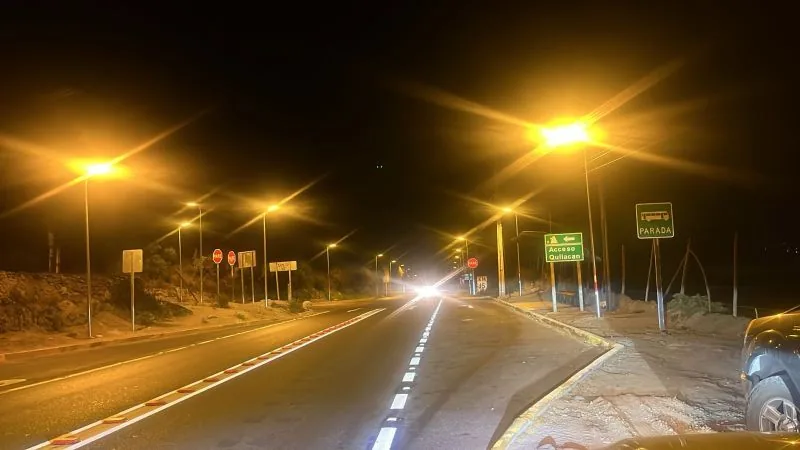
Our DS01 project was specified at 2200 K to meet a dark-sky requirement without turning the paths into a dark corridor. The warmer source kept the sky clean, and the radar sensor carried the load: a 30% baseline with a return to full output on movement, which is also what makes the battery last through a cloudy week.
Send the site plan and the protected-area status. We return a layout with uplight at zero, a colour temperature per zone and a model list.
Request a lighting plan