01
No grid, no trench
Each pole needs a foundation and nothing else. No conductor to pull, no transformer to energise, no permit for a line that crosses someone else's land.

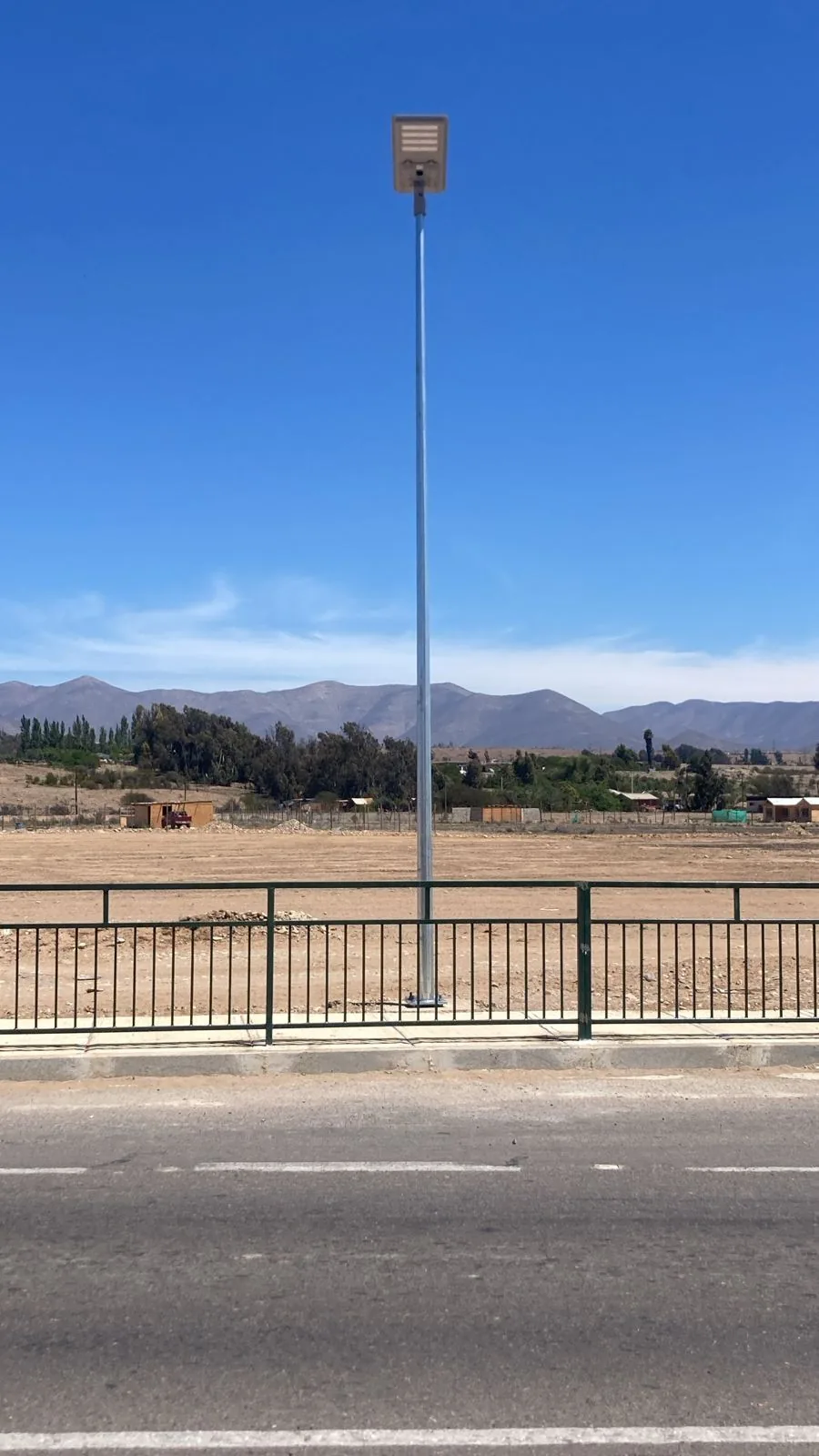
Rural electrification with solar street lights is a power-system job, not a luminaire purchase: where the grid will not arrive, the pole carries generation, storage and control on its own. Plan for three to five days of autonomy, a body light enough for two people to lift without a crane, and a battery rated for 3,000 cycles, then document it the way the programme requires. Rural electrification schemes in Chile and Colombia have used exactly this configuration on roads where a transformer and a kilometre of conductor would have cost more than the lighting itself.
A grid-connected solar light can lean on the grid after a bad week. A road with no grid has only its battery, so every decision moves to the worst case.
Each pole needs a foundation and nothing else. No conductor to pull, no transformer to energise, no permit for a line that crosses someone else's land.
Three days is the floor for a road that must stay lit, five is what we recommend where the rainy season is one long block. The number comes from the worst month at the coordinates, not from a template.
The luminaire arrives assembled, at a weight two people can raise on a pole without a crane. One technician with a ladder and a torque wrench can finish a pole in under an hour.
The table is the rule we apply when a programme fixes the autonomy in the terms of reference: what changes in the battery and the panel as the worst month gets darker. Percentages are relative to the three-day base case at 5.5 sun hours.
| Worst-month sun | 3 days of autonomy | 5 days of autonomy | Typical site |
|---|---|---|---|
| 5.5 h per day | Base case | Plus 35% battery, plus 10% panel | Dry coast and valleys |
| 4.5 h per day | Plus 10% battery | Plus 45% battery, plus 15% panel | Most of the Andes |
| 3.5 h per day | Plus 25% battery, plus 10% panel | Plus 70% battery, plus 30% panel | Long rainy seasons |
In a village with no grid, a cloudy week is not an inconvenience. It is the design case.
Electrification programmes are audited after delivery, not before, so the pack has to be complete on day one: photometric files, certificates for the market, the autonomy calculation with the source of the sun data, a bill of materials per pole and a maintenance sheet the local operator can follow.
We also quote spare batteries and controllers as a line item. A programme that buys no spares ends up with dark poles in year six for the sake of a component that costs a fraction of the luminaire.
Send the coordinates and the number of poles. We return the autonomy calculation, the model and the documentation pack for the tender.
Request a programme quote