
Every solar street light has two jobs. The first is to put light on the ground. The second is to decide when to put light on the ground — and that second job is where most projects quietly fail, because it is the one nobody puts in the specification.
A timer is the oldest answer and still the most common. It is also the one that ignores the two things that actually decide whether the light is there at 5 a.m.: the season, and the weather.
On paper a timer is the controllable option: you decide the hours, you can shorten them to save battery, and there is no sensor to fail. In a tender document it also reads well, because "operating hours 18:30 to 06:00" is a number an evaluator can tick.
The problem is that the number is a guess about the future. It assumes the sun sets at the same time every night, that the panel produces the same energy every day, and that the controller's clock keeps running for years without being checked. None of those three assumptions holds.
Day length is almost constant on the equator and swings violently further south. Set one schedule for a project in the Andes or in southern Chile and Brazil, and it is wrong for half the year.
| City and latitude | Sunset in June | Sunset in December | What a fixed 18:30–06:00 timer does |
|---|---|---|---|
| Quito, Ecuador, 0° | about 18:15 | about 18:20 | Within minutes all year — the equator is the one place a timer works |
| São Paulo, Brazil, 23.5° S | about 17:25 | about 19:00 | Over an hour of dark road in winter, half an hour of wasted light in summer |
| Santiago, Chile, 33.5° S | about 17:45 | about 20:55 | 45 minutes of dark road in winter, 2 h 25 min of wasted light in summer |
| Ushuaia, Argentina, 55° S | about 17:00 | about 22:30 | Dark until 18:30 in winter, and more than four hours of wasted light in summer |
Read the last row again. In Ushuaia the winter evening is darker earlier and the summer evening is lighter later, and the gap between the two is five and a half hours. There is no single clock setting that serves both, and asking a maintenance crew to reprogram every pole twice a year is a plan that lasts until the first busy month.
This is not a small inefficiency. The winter evening is precisely when people are walking home from work, and it is precisely when the timer is still off. Fire the light on a clock, and every winter you hand the most dangerous half hour of the day to darkness.
A solar street light is an energy budget, and the panel is the income. On a heavy overcast day the panel can produce a small fraction of its clear-sky output, and in a rainy season you can get five or six of those days in a row.
The timer does not know. It asks for the same twelve hours at full output, night after night, on a battery that is going down. The failure is predictable and always looks the same: the light is fine in December, and in the third week of the wet season it is dark by 2 a.m., which is exactly when the complaints start and exactly when there is nobody on site to see it.
Worse, the way the pack empties matters. A battery that is driven to a deep discharge every rainy season loses capacity faster than one that is cycled shallowly, so the schedule that empties the pack in year one is also the schedule that shortens its life.
Most controllers keep time with an internal oscillator, not with a synchronised clock, and a cheap one drifts by minutes a month — an hour or more a year. Nobody checks it, because checking it means visiting every pole with a manual and a ladder.
Then there is the reset. When the battery reaches its low-voltage cutoff, the controller loses its reference and comes back with a default, which on most units is not the schedule you set. The light then switches on late and off early, and the symptom the client reports is "the light is weaker than the sample" — a claim about the fixture that is actually a claim about the clock.
Here is the part that a timer can never fix, no matter how well it is set. A residential path or a park road is busy for a short window after dinner and then empty for six or seven hours. A timer lights all of it at full output.
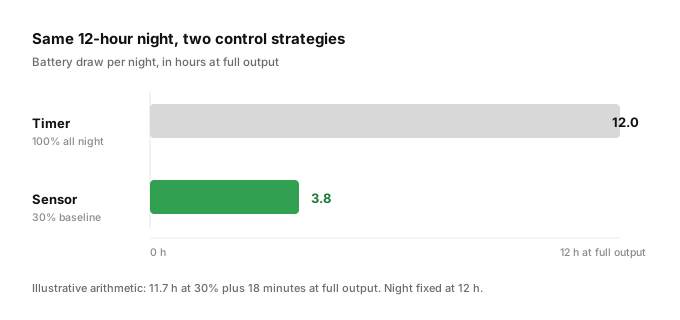
Run the arithmetic yourself, because it is the whole argument. Take a twelve-hour night. A timer asks for twelve hours at full output. A radar-sensor fixture runs a 30% baseline and lifts to full output only while somebody is inside the detection zone — say eighteen minutes of traffic across the whole night. That is 11.7 hours at 30% plus 0.3 hours at 100%, which comes to about 3.8 hours of full-output energy. Roughly a third.
For an off-grid light that third is not a saving on an electricity bill, because there is no bill. It is three things: a smaller panel and a smaller pack for the same autonomy, or the same hardware and three times the reserve for a cloudy week, or the same hardware and a much shallower cycle, which is what actually decides how many years the pack lasts.
The first upgrade most projects make is a photocell: switch on at dusk, off at dawn. That fixes problem one completely. The light follows the sun, no clock, no seasonal reprogramming, no dark half hour in June.
It does nothing about problem four. A dusk-to-dawn fixture runs at full output for twelve hours whether or not a single person walks under it, so the battery is still asked for its maximum every night, and the reserve for a cloudy week is still whatever the schedule leaves.
A photocell also adds a new failure mode if it is a cheap one: dirt, spider webs or a bird dropping over the sensor window can keep the light on all day, which flattens the pack in a week. Whatever else you specify, the sensor window has to be positioned where it sees sky and not the lamp's own light.
A microwave radar sensor inside the fixture watches for movement, not for a schedule. When somebody walks or drives into the zone, the fixture lifts to full output; when the zone is clear for fifteen seconds, it drops back to a 30% baseline. It never goes dark, so the road keeps its shape and the CCTV keeps its image, and it never runs at full output for an empty road.
The 30% baseline is the part buyers underestimate. Walking speed, distance and recognition all depend on uniformity, not on peak output, and a road held at a third of its output looks continuous rather than pooled. People notice a light that switches on as they arrive; they do not notice one that was already at a third.
The other half of the argument is reliability, and it is arithmetic again. Shallower cycles, fewer full-output hours, and a reserve that survives a bad week all point the same way: the pack is not pushed to the edge every night, so the failure that normally arrives in year two or three arrives later, or not at all.
Two sensor types get quoted, and they behave very differently in a Latin American climate.
PIR detects heat. It compares a moving warm body against the background temperature, which works well in a cold climate and badly in a hot one. On a 35 °C night the difference between a person and the pavement is small, and detection range collapses exactly when the sensor is most needed.
Microwave radar detects movement. It sends a low-power signal and reads the Doppler shift of anything that moves, so ambient heat is irrelevant. It also sees through a plastic housing, which means the antenna sits inside the fixture and nothing is exposed to rain, dust or a weed trimmer.
That is why radar is the right default for outdoor street and park lighting in this region, and why we build our sensor fixtures around it rather than around PIR.
| What decides | Timer | Microwave sensor |
|---|---|---|
| Switching on | A clock setting | The light sensor, at dusk |
| Output through the night | 100% until the clock stops it | 30% baseline, full on detection |
| A cloudy week | Same schedule, so the reserve empties | Draw follows traffic, not the calendar |
| Seasonal change | Manual re-setting, twice a year, at every pole | None |
| Battery cycles | Deepest | Shallowest |
| Empty road at 3 a.m. | Lit at full output | 30% until somebody comes |
| Typical failure | Dark before dawn, and a pack that ages early | A cheap sensor module, if it is cheap |
If you are writing or reviewing a tender, these five lines do more for the outcome than any paragraph about lumens:
The last two lines assume the fixture sits at a height that actually covers the road. If that number is still open, the pole height and spacing walkthrough works from the lighting class down to the flux to put in the tender; the sensor only decides when that flux runs.
Luxey has manufactured outdoor LED lighting in Shenzhen since 2007 and supplies distributors, contractors and municipalities in more than 76 countries, under an ISO 9001 system with our own test laboratory.
The AIOH series is the practical line: 200 lm/W across six power steps from 30 W to 120 W, SMD3030 chips, microwave radar with a 120° detection angle, full output on presence and a 30% baseline fifteen seconds after the zone is clear, LiFePO4 and controller inside the body, and three to five nights of autonomy.
The AIOAS series is the higher-output line: 220 lm/W from 30 W to 150 W, radar detection at up to 15 metres, remote control and IoT monitoring, and a five-year warranty. Both are all-in-one, both ship with pole and arm brackets, and neither needs trenching or a separate battery box.
If you tell us the road width, the mounting height, the hours the site is actually used and the worst month of your rainy season, we will size the control mode and the pack together — because those two numbers are the same decision, and a timer treats them as if they were not.
Why does my solar street light go off before dawn? Almost always because the schedule asks for more hours than the pack can deliver after a run of cloudy days. The light is not faulty; the control strategy is. Check the autonomy at the actual dimming level, not the figure quoted at full output.
Can I just shorten the timer in the rainy season? You can, and many operators do — but somebody has to visit every pole twice a year, at the right moment, and then remember to lengthen it again. A sensor does the same job continuously, without a site visit.
Do motion sensors make the road dark when nobody is there? Only if the fixture is allowed to switch off completely. Specify a dimmed baseline: at 30% the road stays visible, uniform and usable for CCTV, and the saving is still around two thirds of the energy.
Will a radar sensor trigger on trees, rain or animals? Rain and foliage are largely transparent to microwave at this power, and small animals can be excluded by the detection range at the mounting height. The setting that matters is range, and it should be commissioned at night, not left at the factory default.
Is a sensor light more expensive? The sensor module adds cost to the fixture. In an off-grid system it usually pays back in the two places that hurt: a smaller panel and pack for the same autonomy, or a pack that is cycled shallowly and lasts longer. Ask for both configurations quoted, and compare them on the same autonomy.
Get a quote or see the solar street light range.
Our 25-engineer team provides free project consultation and fast, accurate quotations.
Get a Quote