
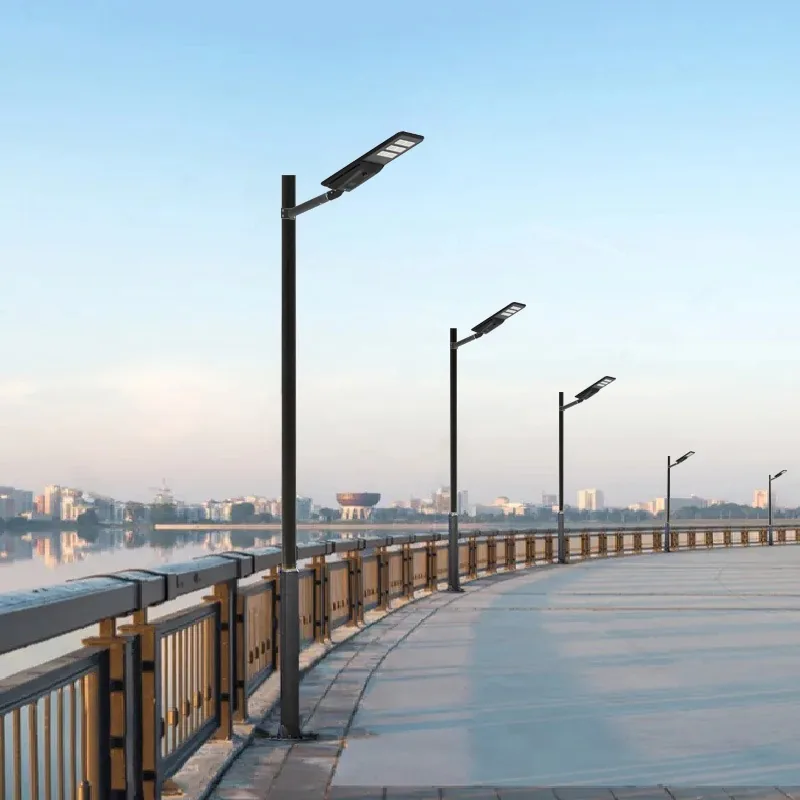
An all-in-one solar street light is usually bought on three numbers: wattage, price and warranty. None of them tells you what the road will look like in year six. What tells you is the luminous efficacy of the exact model you are buying, the chemistry and placement of the battery, and whether the controller can still recover a charge after a week of grey Andean weather.
We have manufactured solar and LED lighting in Shenzhen since 2007 and ship to 76 countries, a large share of them across Latin America. The eight checks below are the sequence we walk buyers through before a purchase order is signed — the same questions we would expect to be asked ourselves. Work through them in order and the shortlist usually shrinks from twelve suppliers to three.
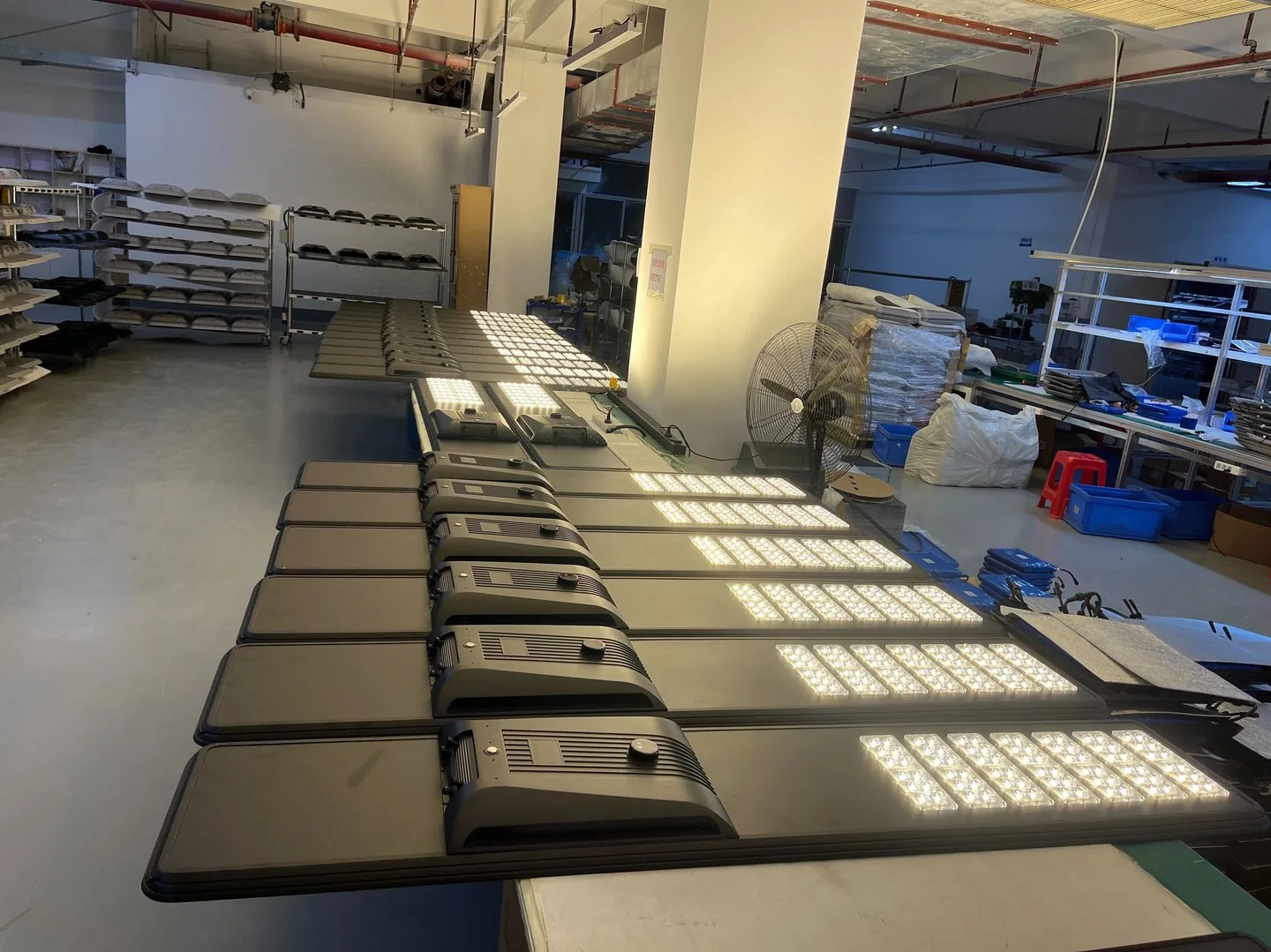
Luminaires are specified in lumens and sold in watts, and the gap between the two is where projects quietly lose money. A 100 W fitting that delivers 11,000 lumens is a 110 lm/W product wearing a bigger number on the carton.
Our AIOAS series is rated at 220 lm/W across the range, so the arithmetic closes on every model:
| Model | Rated power | Luminous flux | Flux ÷ power |
|---|---|---|---|
| LUX-AIOAS-30W | 30 W | 6,600 lm | 220 lm/W |
| LUX-AIOAS-40W | 40 W | 8,800 lm | 220 lm/W |
| LUX-AIOAS-60W | 60 W | 13,200 lm | 220 lm/W |
| LUX-AIOAS-80W | 80 W | 17,600 lm | 220 lm/W |
| LUX-AIOAS-100W | 100 W | 22,000 lm | 220 lm/W |
| LUX-AIOAS-120W | 120 W | 26,400 lm | 220 lm/W |
| LUX-AIOAS-150W | 150 W | 33,000 lm | 220 lm/W |
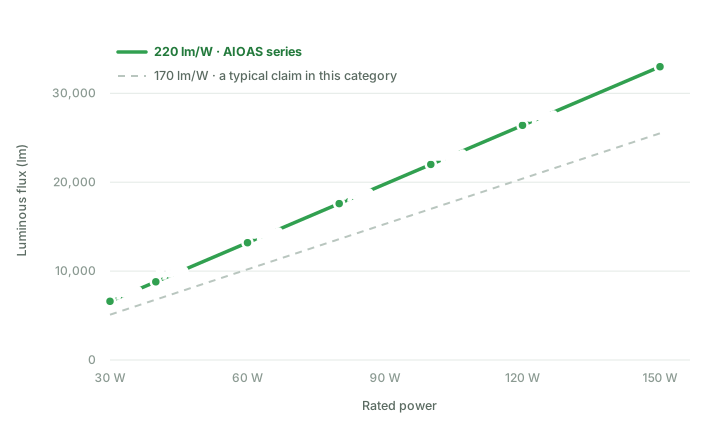
Run any row through a calculator and you get 220. If a supplier's table does not survive that test, the number on the carton is not the number on the pole. Ask for the LM-79 test report for the specific SKU — not a catalogue page, not a photograph of a lab.
A solar street light has exactly one consumable component, and it is not the LED. It is the battery. Two systems can share the same housing and the same lumen output and behave completely differently in year four, because one uses LiFePO4 cells managed at a sane depth of discharge and the other uses whatever was cheapest the month it was assembled.
Three questions expose the difference:
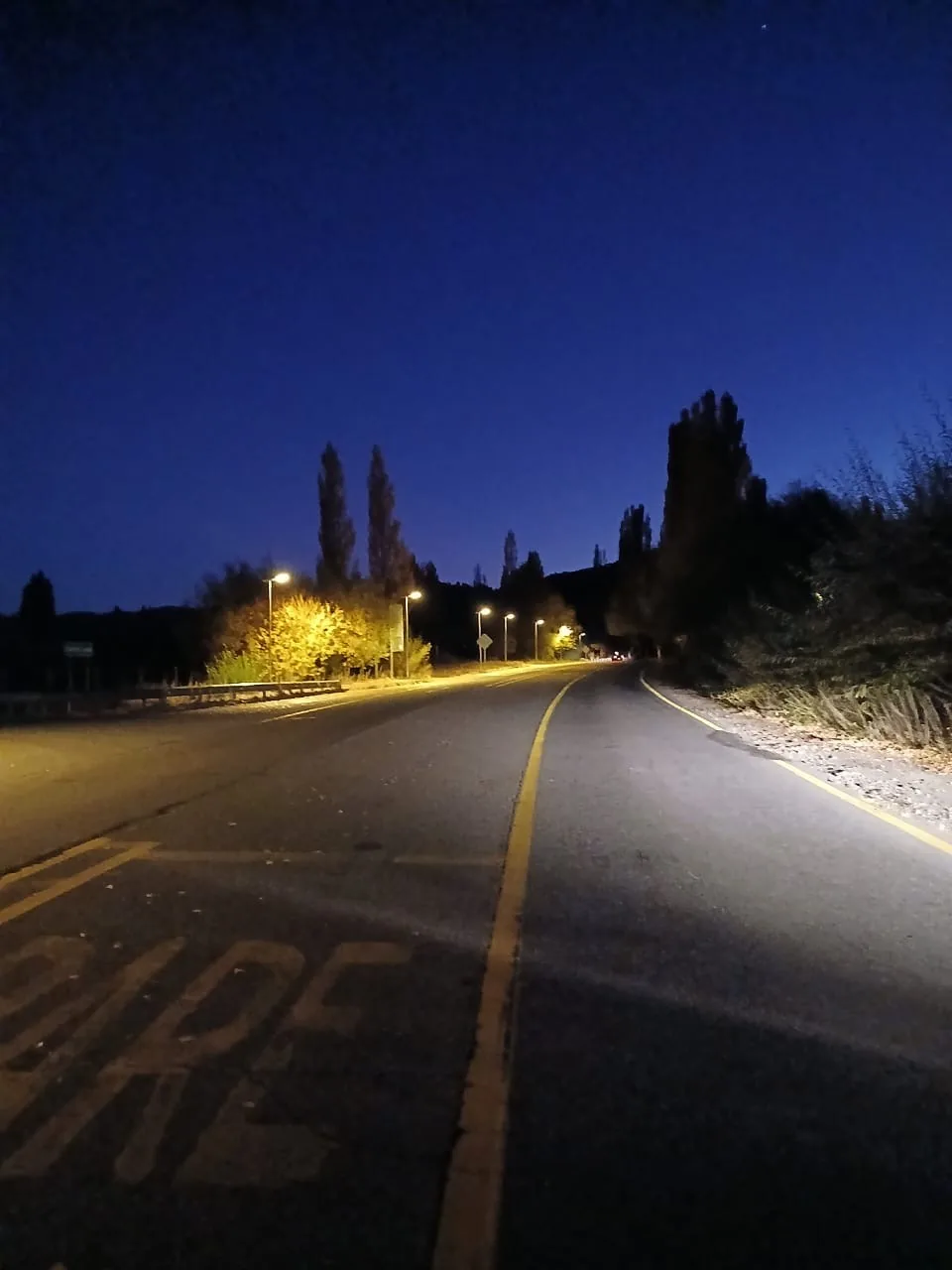
Cold is the other half of that story. In Lonquimay, in Chile's Araucanía Region, our units ran through installation at a steady −3 °C to −5 °C, which is exactly the condition where a badly specified pack loses usable capacity and the light starts dimming at 2 a.m.
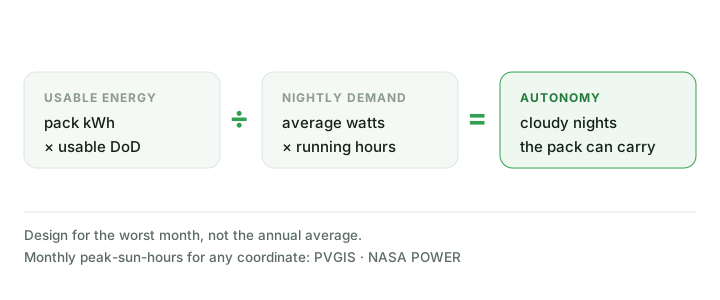
Autonomy is a local number, not a catalogue number. A pack sized for Santiago and a pack sized for a city with three months of cloud are different products, and the datasheet rarely says which one you are buying. Design for the worst month, not the annual average: pull monthly peak-sun-hour figures for the exact coordinates — PVGIS and NASA POWER are both free — then check that usable kWh of storage divided by nightly consumption clears your target autonomy. Four consecutive cloudy nights is a reasonable floor for most of the region; where the wet season is long, specify five or six and expect the panel to grow with it.
Every solar street light claims an "intelligent controller". The measurable difference is whether it tracks the maximum power point or simply clamps the panel voltage.
On a clear noon in a laboratory, PWM and MPPT look similar. At 7 a.m. on a hazy morning, or on a cold afternoon when the panel's power curve has moved, an MPPT controller recovers a meaningful share of the array's output that a PWM unit leaves on the table. The relevant standard for charge controllers in PV systems is IEC 62509, and a supplier who can reference it has usually thought about the rest of the chain too.
Pair that with the practical features that decide maintenance cost: 4G IoT control for remote dimming profiles, body sensing for roads that are empty between midnight and five, and surge protection on the DC side that matches the lightning profile of the site.
Latin America is tightening lighting regulation faster than most buyers expect, and the driver is not energy — it is the night sky.
Chile's new Norma Lumínica (Supreme Decree N° 1/2022, published 18 October 2023) extended the light-pollution standard that previously covered only the Antofagasta, Atacama and Coquimbo regions to the entire national territory, and tightened limits on blue-rich emission, with stricter rules again inside protected astronomical and biodiversity areas.
That turns optics from a technical detail into a permitting question. Full cut-off distribution, warm colour temperature, and measured blue content below 1 % are what kept our Lonquimay installation inside the Chilean limit; DS 01 certification is the paper a Chilean reviewer asks to see. If you are specifying elsewhere in the region, assume a similar rule is coming and buy optics you will not have to retrofit.
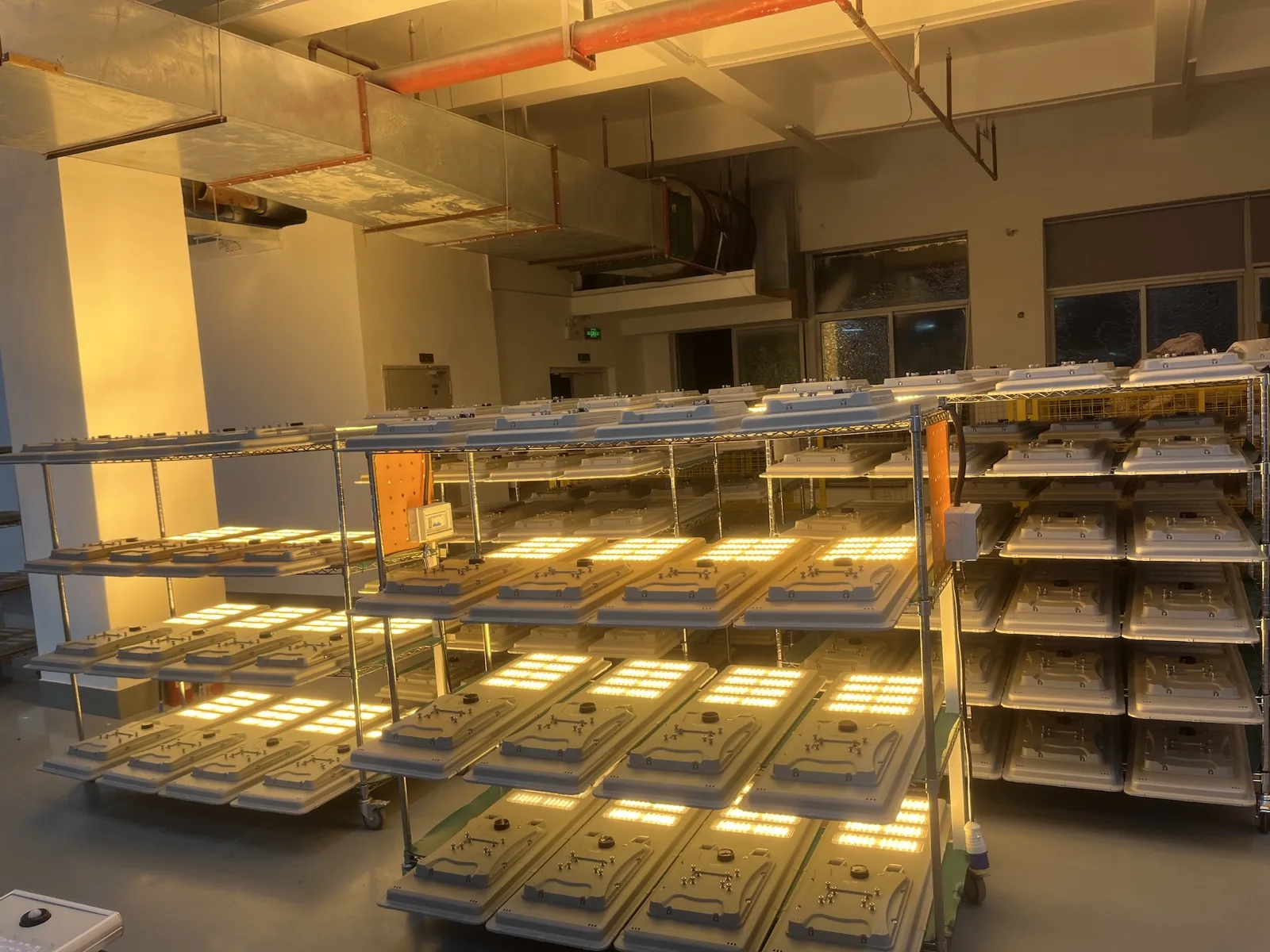
Marketing shots show the front of a luminaire. Failures happen at the back, the seams and the screws.
Certification in this industry is often quoted at company level and delivered at model level. The honest version sounds like this: our range covers CE, RoHS, TÜV, ETL and UL depending on model, manufacturing runs under ISO 9001, and DS 01 covers the Chilean market. Your job is to ask which of those applies to the code you are ordering, and to see the certificate number and issuing laboratory.
The same discipline applies to test data. We run five checks in our own Shenzhen laboratory — luminous performance, lightning surge, ESD to IEC 61000-4-2, drop testing to GB/T and IEC, and 100 % aging with voltage cycling from 85 V to 277 V for at least four cycles, more than eight hours per unit — plus a mandatory 24-hour aging test on the solar line before shipment. Ask every supplier what they run in-house and what they outsource. The answer is diagnostic.
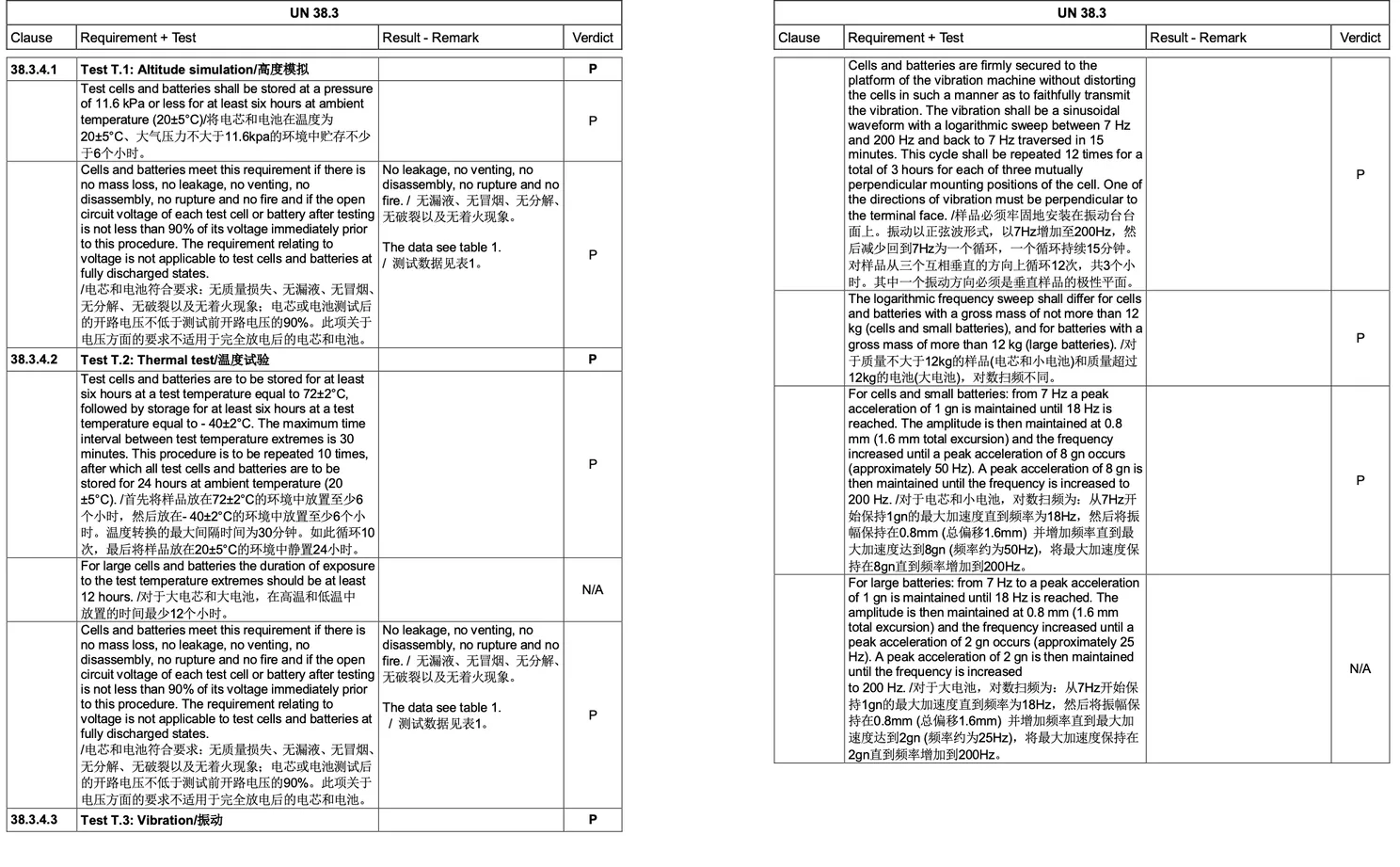
A solar street light contains a lithium pack, which makes it a Class 9 dangerous goods consignment before it is a lighting product. What has to be in place:
Budget three to five weeks for the paperwork on a first order and treat it as a schedule item, not an administrative detail. Undeclared packs get rejected at origin, and the delay lands on your installation date, not the factory's.
| Question | What a weak answer sounds like |
|---|---|
| What is the flux, in lumens, at rated power? | A wattage and a "100 W equivalent" claim |
| Which cell chemistry and usable DoD? | "Grade A lithium" with no cycle count |
| Is the battery field-replaceable? | "Our quality is very good" |
| MPPT or PWM, and at what tracking efficiency? | "Intelligent controller" |
| What is the blue-light content, measured? | "Warm white available" |
| Which certificate applies to this SKU? | A logo page from the website |
| How is the pack declared for air freight? | "We ship everywhere, no problem" |
| What is covered in year four of the warranty? | "3–5 years" with no scope |
A supplier who answers all eight in writing, with numbers, is a supplier you can put in front of a municipal client.
How many lumens does a rural road actually need? It depends on the class and the pole geometry, not on the wattage. A residential street typically sits around 10–15 lux maintained, an arterial road higher. Ask for a lighting calculation with your pole spacing rather than a recommended wattage — a 60 W unit with the right optic often beats a 120 W unit with the wrong one.
Can the system run through three cloudy days? It should, and you should see the arithmetic: battery kWh × usable depth of discharge ÷ nightly consumption. Ask for the autonomy figure in days at your latitude, and check that the panel wattage supports recharge within one good day.
Which colour temperature for a Chilean project? 2,700 K is the safe default for general roads; inside protected areas, amber-shifted options with measured blue content under 1 % are what keep a project compliant with the Norma Lumínica.
Is 220 lm/W realistic for a finished product? Yes, when it is measured at rated current with a documented LM-79 report — and it is the number that should survive the division in Section 1. Be sceptical of a figure that appears only in a headline and not in a table.
What happens if a unit fails in year four? With a removable pack, the battery is replaced on site. With the rest of the luminaire, our 3–5 year warranty covers repair or replacement of quality-related failures; the important question is the response time in your country, which is worth agreeing in writing before the order.
A solar street light is a fifteen-year decision made with a two-page datasheet. The eight checks above cost an afternoon of questions. Skipping them costs a dimming road, a crane, and a conversation with the client you would rather not have.
Send us the pole height, the road class and the latitude, and we will come back with a layout, a flux figure you can verify by division, and a battery specification with a cycle count attached. Samples ship before bulk orders, standard lead time is 7–15 days, and our engineers answer specification questions directly — including the ones you would rather hear answered honestly.
Luxey Lighting · Shenzhen, China · since 2007 · 76 countries · ISO 9001 manufacturing · in-house test laboratory
Our 25-engineer team provides free project consultation and fast, accurate quotations.
Get a Quote