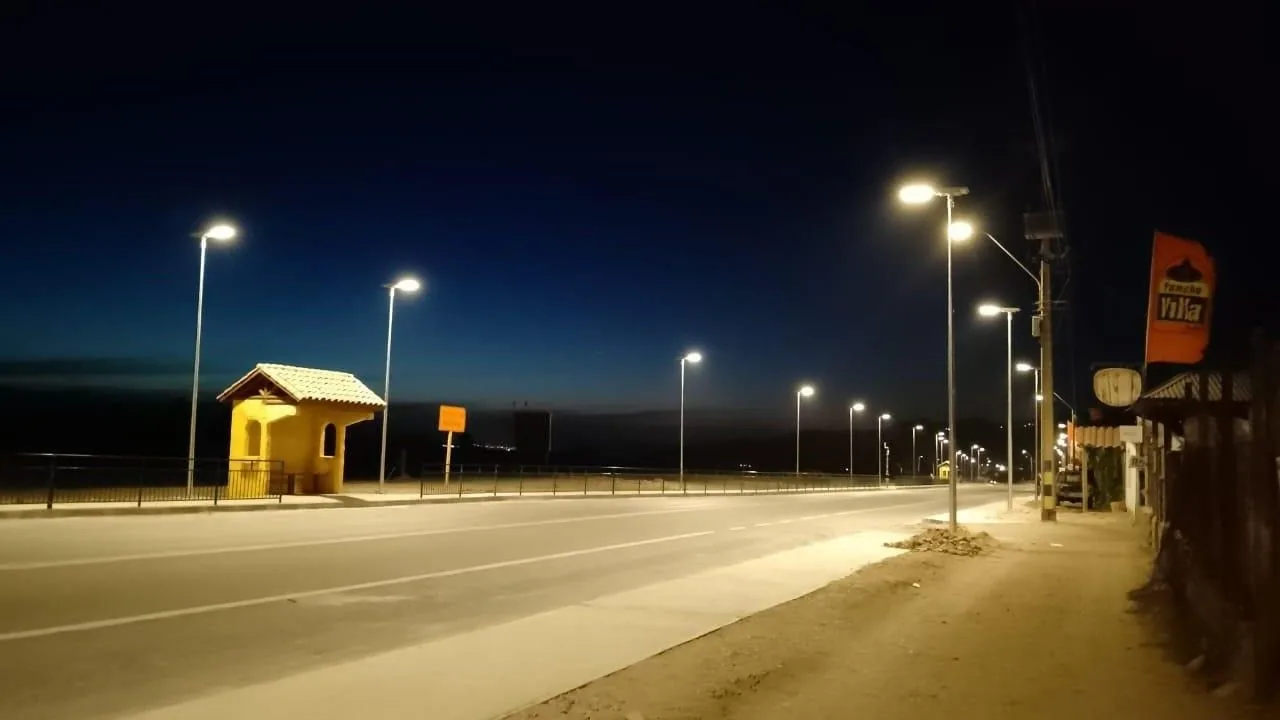
UV and heat at altitude
Above 3,500 m the UV index and the daily temperature swing both rise. Housing and lens have to be UV-stabilised, and the battery has to accept minus 20 to plus 65 degrees without the warranty quietly excluding the site.
Solar lighting for mines and industrial sites fails from the environment long before it fails from the battery: UV at altitude, abrasive dust, vibration from haul traffic and wash-down water. Specify IP66 or better, IK09 or better, a UV-stabilised housing and LiFePO4 storage rated for 3,000 cycles, then prove it with a photometric simulation of the actual yard. That is the specification we build for Chilean and Peruvian operations, and it is why we will not put a solar all-in-one inside a Zone 1 or Zone 21 area.
A camp road, a stockpile yard and a plant perimeter are three different problems. Treating them as one is how a site ends up with luminaires that are over-specified in one place and wrong in another.
Above 3,500 m the UV index and the daily temperature swing both rise. Housing and lens have to be UV-stabilised, and the battery has to accept minus 20 to plus 65 degrees without the warranty quietly excluding the site.
Haul roads put fine abrasive dust in the air all day. IP66 keeps it out of the optical chamber, and a die-cast body with vibration-proof fasteners keeps the lens seated when a loaded truck passes.
Where explosive dust or gas is present the luminaire must be certified for the zone. We supply ATEX explosion-proof fittings for Zone 1, 2, 21 and 22, and solar luminaires on the roads and camps where the zone does not apply.
IP65 is often quoted as waterproof and then fails at the wash-down point. The second digit is the one that matters: 5 is water jets, 6 is powerful water jets, 7 is temporary immersion. For a mine yard we quote IP66 as the floor and IP67 where the yard floods.
| Rating | What it actually means | Where it matters on site |
|---|---|---|
| IP65 | Dust-tight, protected against water jets | Wash-down bays, plant rooms |
| IP66 | Dust-tight, protected against powerful water jets | Mining yards, ports, coastal sites |
| IP67 | Dust-tight, protected against temporary immersion | Flood-prone yards, sumps |
| IK08 | 5 joule impact | Standard pole-mounted points |
| IK10 | 20 joule impact | Haul routes, loading bays |
A battery is not a consumable you replace when it dies. It is a line in the tender that decides whether the site buys diesel for five years.
LiFePO4 at 3,000 cycles to 80% state of health is roughly eight years of one full cycle a day. That number is what makes a solar luminaire cheaper than a diesel tower over a five-year contract; a lead-acid pack at 500 cycles is not in the same comparison.
A dust film on the lens and the panel costs twice: it blocks light and it blocks charging. In a mine yard we plan a cleaning interval of 8 to 12 weeks and size the panel with that soiling loss included, instead of assuming a clean panel all year.
Mine yards are not uniform rectangles: stockpiles, conveyors and haul roads create shadows the layout has to respect. We run the simulation on your layout with the mounting heights you actually have, and deliver illuminance and uniformity grids you can check against the site safety plan.
Mounting heights, the areas that must stay lit and the hazardous-area drawing are enough for us to return a simulation and a model list.
Request a lighting study