01
Autonomy measured in the worst month
Sizing from average sun hours is how solar municipal projects fail in their first year. We size the battery on the worst month at your coordinates, then add the autonomy days the tender asks for.

Solar street lighting for municipalities only wins a tender if the luminaire survives the worst week of the rainy season and can be audited against RETILAP or the local standard, so autonomy has to come from the worst-month sun hours, not the annual average. For most municipal roads we specify a 60 to 120 W all-in-one luminaire with three to five days of autonomy, LiFePO4 storage, radar dimming and a sealed anti-theft body, delivered with a DIALux study and a five-year TCO sheet. That is the combination that has carried public tenders in Chile and Colombia.
Three things end solar municipal projects early: a battery sized on annual average sun, a luminaire that cannot be documented for the local standard, and a battery box that gets opened at night.
Sizing from average sun hours is how solar municipal projects fail in their first year. We size the battery on the worst month at your coordinates, then add the autonomy days the tender asks for.
RETILAP in Colombia, DS N°01 in Chile, NOM in Mexico: each market audits different documents. We supply the photometric files, certificates and declarations the tender lists, before award rather than after.
Panel, battery, controller and luminaire in one sealed body mean no external battery box to open and no cable between components to cut. For a municipality that is the difference between a maintained asset and a stripped pole.
Three inputs decide the luminaire: the road class, the pole height the municipality already owns, and the worst-month sun at the site. Everything else follows from those, including the spacing, which is a photometric result and not a rule of thumb.
| Road class | Pole height | Luminaire | Autonomy | Spacing |
|---|---|---|---|---|
| Local street, one lane each way | 6–8 m | 30–60 W | 3 days | 25–30 m |
| Collector road, two lanes | 8–10 m | 60–100 W | 4 days | 30–35 m |
| Roundabout or plaza | 10–12 m | 100–120 W | 3 days | Same pole, no spacing |
| Rural municipal road, no grid | 6–8 m | 40–60 W | 5 days | 25–30 m |
A solar luminaire is not sized by the wattage on the label. It is sized by the energy the road needs between dusk and dawn, divided by the sun the site actually receives in its worst month.
A grid-connected LED is cheaper on the invoice and more expensive over five years wherever a trench has to be built. The table below is the one we hand to municipal buyers, with the cost lines that actually move.
| Cost line | Grid-connected LED | Solar all-in-one |
|---|---|---|
| Trenching, conduit and cabling | Per metre, at every pole | None |
| Transformer or connection fee | Often required | None |
| Energy for five years | Billed monthly | Zero |
| Meter reading and billing admin | Ongoing | None |
| Battery replacement in year five | Not applicable | Planned cost |
| Failure points per pole | Driver, cable, joint, meter | Battery, controller |
| Relocation if the road changes | Re-trench | Move the pole |
The battery is the honest cost of solar, and we quote it as a separate line with 3,000 cycles at 80% state of health on LiFePO4 cells. A tender that ignores the year-five battery is not comparing total cost of ownership, it is comparing invoices.
Where a municipality already has a reliable supply, we say so and quote the grid-connected LED instead. Solar is a tool for roads where the trench is the expensive part, not a default.
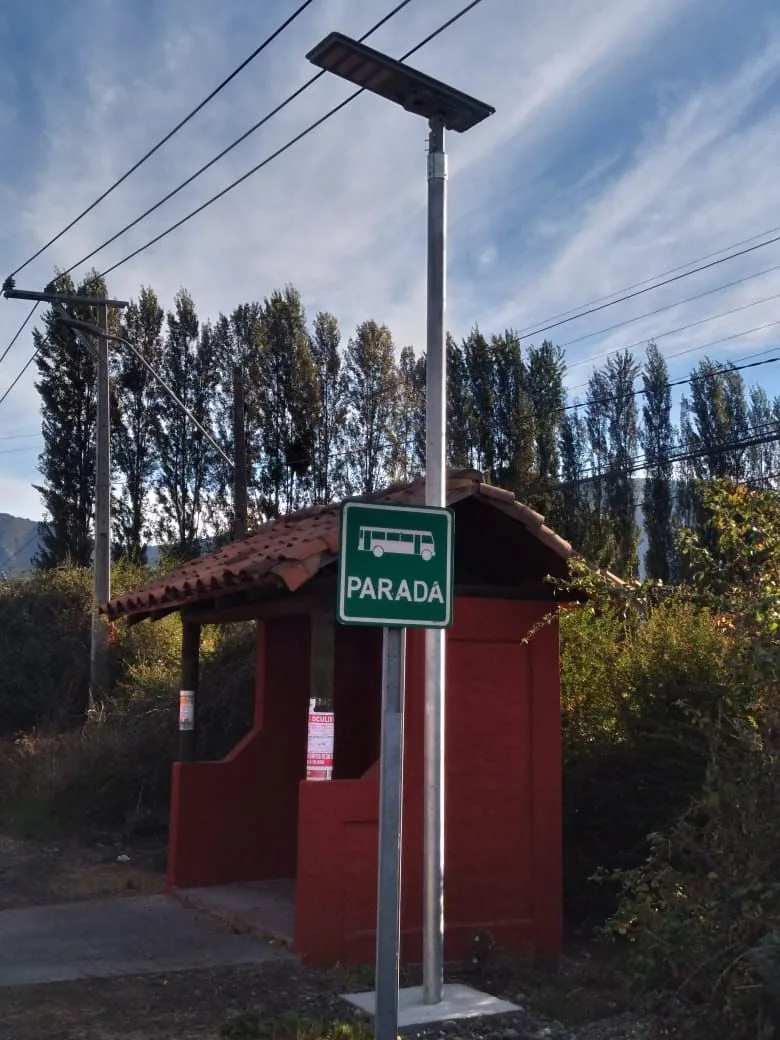
On the Curicó route in Chile the municipality needed a stretch of road lit with no grid connection and no excavation budget. The result was a row of solar luminaires sized for the worst month of the central valley, with the pole spacing set by a photometric study rather than by habit.
Send the road class, the pole height you already own and the site coordinates. We return a DIALux study, a model recommendation and a five-year TCO sheet.
Request a project quote