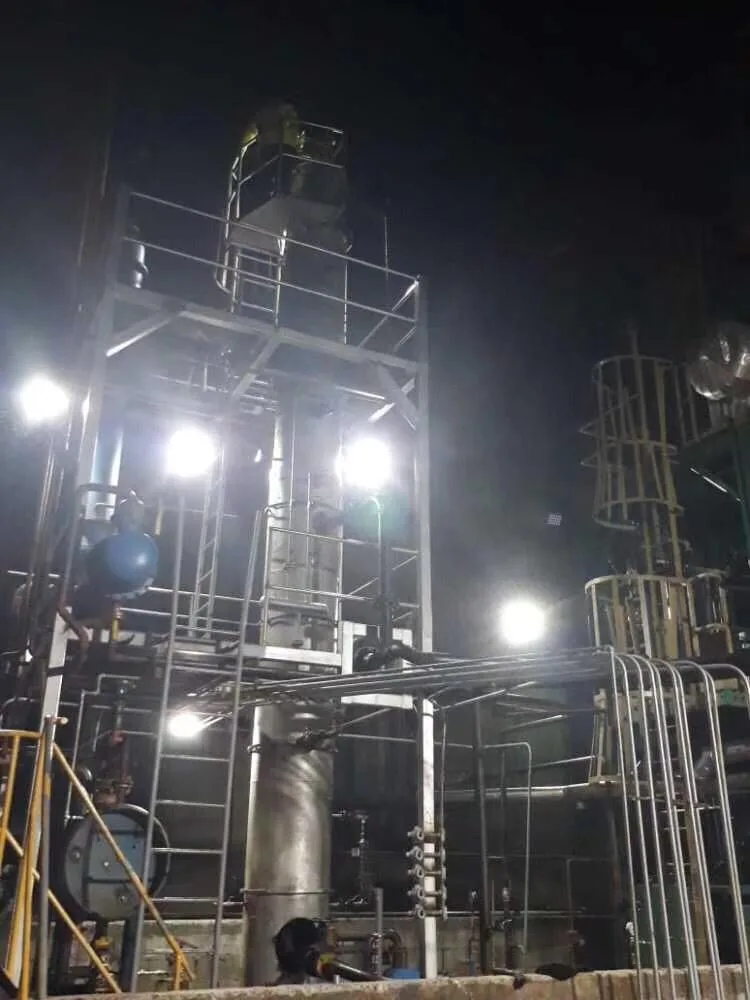
Explosion-proof lighting for refineries is a documentation exercise before it is a photometric one. The zone drawing fixes where each fixture may stand, the process fluid fixes the gas group and the temperature class, and the coastal or sour-service environment fixes the housing and the coating. Specify Ex db eb IIC T4 Gb as the default, IP66 with C5-M coating on the unit, tempered glass and a MeanWell driver, then prove the levels with a DIALux study against the maintained illuminance of each area. Most refinery packages we ship go to EPC contractors who need the certificate pack before award, so that is the order we work in.
Three inputs that decide the ATEX lighting in a refinery
A refinery is not one environment with one classification. The tank farm, the loading rack, the compressor house and the hydrogen header can carry four different markings, and buying the strictest one everywhere is as wrong as buying the cheapest.
01
The zone drawing decides first
No fixture can be chosen before the drawing exists. A refinery carries Zone 0 inside vessels, Zone 1 around pumps and sample points, Zone 2 on the fringes and dust zones in the coke and catalyst areas, all on the same plot.
02
Gas group and temperature class
Methane is group IIA with a high auto-ignition temperature, but a hydrotreater carries hydrogen, which is group IIC. Sour service brings hydrogen sulphide, whose auto-ignition temperature of about 260 degrees makes T3 the floor and T4 the safe default.
03
Corrosion, heat and vibration
A coastal refinery combines salt spray with radiant heat near the flare and continuous vibration from pumps. C5-M coating, 316 stainless fasteners and a die-cast body are not upgrades there, they are the minimum that survives the maintenance interval.
Zone and marking
Matching the marking to the unit
This is the mapping we start from on a refinery drawing. The licensor's zone drawing overrides it wherever the two disagree, and on a revamp the existing drawing is often the thing that is out of date rather than the fixture.
Unit or area
Zone
Group and class
Fixture
Tank farm and bund
Zone 2
IIA, T3
AEL 150–200 W
Loading rack
Zone 1
IIA or IIB, T3
AEL 100–150 W
Pump and compressor house
Zone 1
IIA, T3
AELL linear 40–80 W
Hydrotreater and hydrogen header
Zone 1
IIC, T4
AEL 100 W
Sour water and amine unit
Zone 1
IIB, T3
AEL 100 W
Control room and substation
Unclassified
Not applicable
Panel, 4000 K
The temperature class is not a preference. It is the number that decides whether a fixture may stand in that unit at all.
Selection
Two shapes cover a whole plant
Refinery work runs in two shapes. Floodlights go on the tank farm perimeter, the loading rack and the flare area, where the light has to travel. Linear fixtures go in the pump house, along cable trays and under mezzanines, where the ceiling is low and vapour or dust accumulates. Because both series share the driver platform, one spare driver covers both, which matters on a site where the warehouse is four hundred kilometres from the plant.
An EPC reviewer works from a checklist, not from a visit. The offer has to carry the certificate copy with the exact model and the full Ex string, the declaration of conformity naming the directive and the standards, IES and LDT files for the designer, a DIALux calculation per area with the maintenance factor stated, and the installation manual in the language of the site.
Refinery service: the housing has to survive salt, radiant heat and vibration at the same time.ATEX or IECEx for a refinery in Latin America?+
Most refinery specifications in the region quote IECEx, because it is an international scheme with a public certificate database. ATEX is the European legal route and is accepted where the EPC is European. The technical basis is the same IEC 60079 series, but the certificates are not interchangeable, so ask which one the tender accepts before the datasheet is printed.
Do I need Zone 0 fixtures?+
Almost never. Zone 0 is the inside of a tank or a vessel, where a fixture is not installed. If a drawing puts a light in Zone 0, either the drawing is wrong or the light belongs outside the vessel.
How is the photometric study delivered?+
As a DIALux file plus a PDF with the maintained illuminance grid, the uniformity ratio and the maintenance factor used. Your designer can open the file in the software the client already runs and check every assumption, including the lumen depreciation we applied.
Preparing an EPC package?
Send the hazardous-area drawing and the fluid list. We return a fixture schedule per unit, the Ex marking that matches each one and the document pack the reviewer will ask for.