01
Field roads and camp
A field road, a camp street and a gate are unclassified: no gas, no dust cloud, no reason to pay for a certified fixture. This is where a solar pole replaces a generator, a fuel run or a kilometre of conductor.

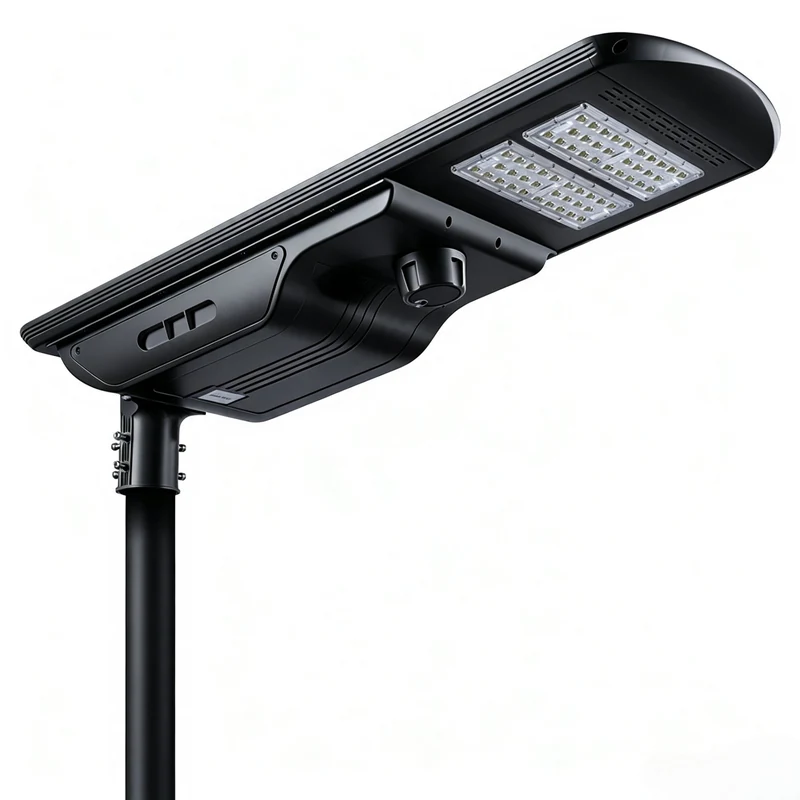
Off-grid solar lighting for oil field roads, camps and perimeters works because nothing on the pole needs the grid: panel, battery and controller travel with the fixture, and a road no utility will ever reach is lit in a week. Size it for three to five days of autonomy, IP66 against dust, and a battery a technician can swap from a ladder, because the nearest workshop is two hours of gravel away. What it cannot do is enter the classified zone: at the wellhead, the separator battery and the tank farm the area drawing governs, and there we supply Ex-rated fixtures instead.
An oil field is not one lighting problem. A field road, a camp street and a tank farm sit on the same lease and answer to three different documents: the road profile, the camp standard and the area classification drawing.
A field road, a camp street and a gate are unclassified: no gas, no dust cloud, no reason to pay for a certified fixture. This is where a solar pole replaces a generator, a fuel run or a kilometre of conductor.
A fence line is the other natural fit: the pole stands alone, the radar sensor brings the light up when something moves, and nothing depends on a signal the lease does not have.
At the wellhead, the separator battery, the tank farm and the loading rack the area drawing decides. A solar all-in-one carries no Ex certificate, so we supply ATEX floodlights and linear fixtures on a conventional supply there.
The table is the starting point we use on a field layout. Autonomy runs longer than on a municipal road because nobody notices a dark pole until an incident report is written, and because the cleaning interval is set by the road, not by a maintenance crew.
| Point | Night profile | Autonomy | Model |
|---|---|---|---|
| Access road | 12 h at 30%, radar to 100% | 4–5 days | AIOAS 60–120 W |
| Camp street | 6 h at 100%, then 50% | 3 days | AIOAS 60–100 W |
| Perimeter and fence | 12 h at 30%, radar to 100% | 5 days | AIOX 60–100 W |
| Gate and checkpoint | 12 h at 100% | 3 days | AIOX 60 W |
| Classified area | 12 h at 100% | Supply, not solar | AEL or AELL Ex |
The nearest workshop is two hours of gravel. That is a battery specification, not a service note.
Dust costs twice on a field: a film on the panel costs charging and a film on the lens costs light. On a road that is graded or gravel, we plan a cleaning interval of 8 to 12 weeks and size the panel with that soiling loss included, instead of assuming a clean panel all year.
Vibration from pumping units and haul traffic is the second one. A die-cast body with vibration-proof fasteners keeps the lens seated and the gasket compressed; a plastic housing that rattles open at year three is how a luminaire loses its IP rating with nobody noticing.
LiFePO4 at 3,000 cycles to 80% state of health is roughly eight years of one full cycle a night, longer than most service contracts. The day it does end, the question is not the chemistry but the access: on the AIOX the battery and the controller sit behind a side cover, so a technician on a ladder changes them without taking the luminaire off the pole and without a crane on a lease road.
Quote spares with the project. A field that buys no spare battery ends up with a dark pole in year six for the sake of a component that costs a fraction of the luminaire, and the trip to change it costs more than the part.
This is the table we use to split a lease into two purchases. The licensor's drawing governs, and on an operating field it is often older than the equipment standing under it, so it is the first document we ask for.
| Area | Zone | What we supply |
|---|---|---|
| Wellhead and christmas tree | Zone 1 | AEL Ex floodlight |
| Separator battery | Zone 1 | AEL or AELL Ex |
| Tank farm and loading rack | Zone 1–2 | AEL 100–150 W |
| Flowlines and manifolds | Zone 2 | AELL linear |
| Field road, camp and gate | Unclassified | Solar AIOAS or AIOX |
A luminaire is cheap next to the incident report. Where the drawing says Zone 1, the answer is an Ex fixture, not a solar one.
A field offer carries four documents: the photometric study on your layout, the autonomy calculation with the source of the sun data, a bill of materials per pole, and the maintenance sheet in Spanish for the crew that will actually clean the panels. Where the lease has a classified area, add the marking per area and the certificate pack, because that is what the operator's auditor reads first.
Coordinates, the length of road and the areas that must stay lit are enough. We return the autonomy calculation, the model and the boundary where solar has to stop.
Request a field quote