01
Dust zones, not gas zones
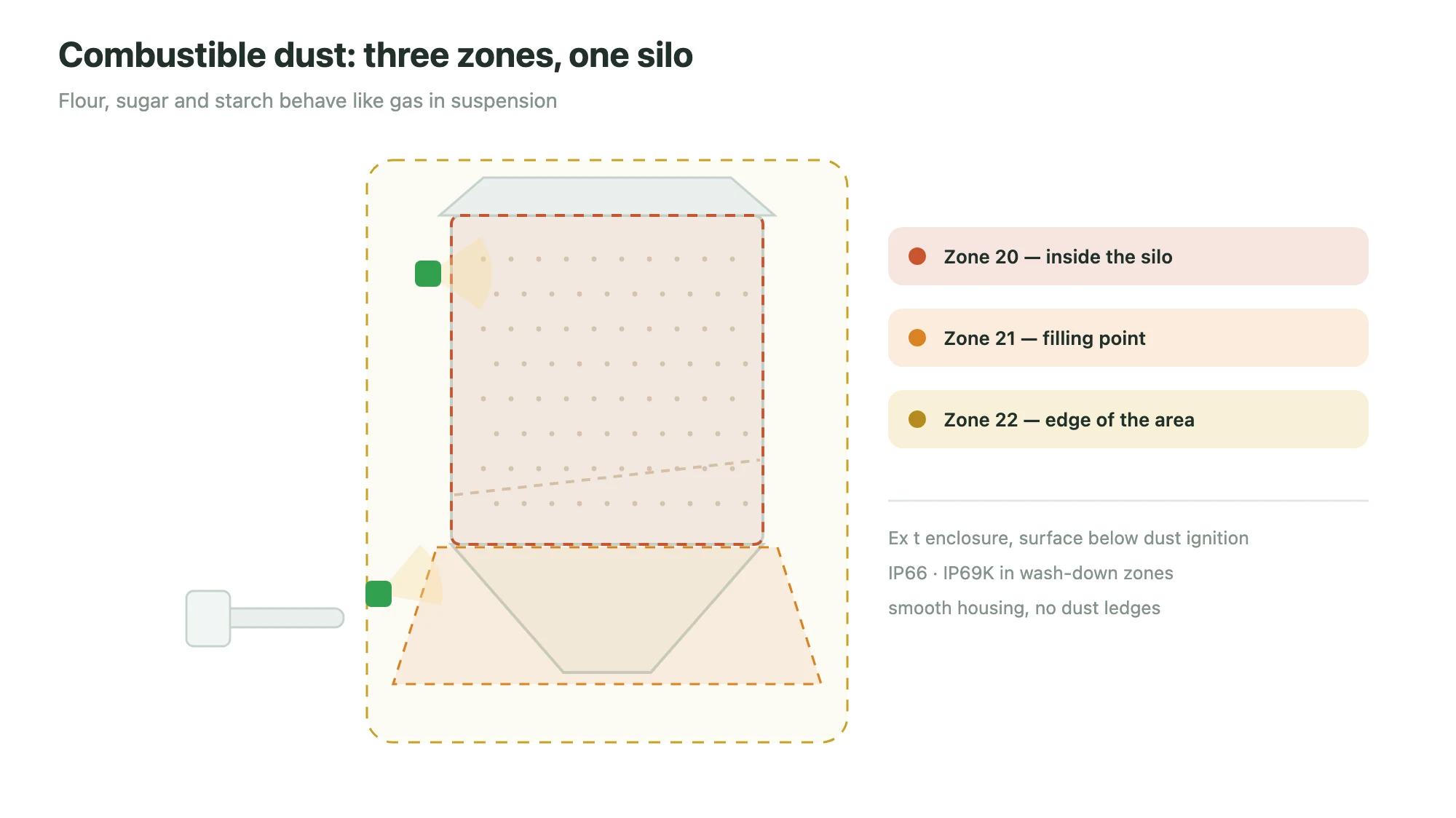
Zone 20 is inside the equipment, Zone 21 is where dust is released in normal operation, Zone 22 is where it can form a cloud only in a fault. A fixture marked only for gas cannot be used in any of them.

ATEX lighting for the food industry is about dust, not gas. Flour, sugar, starch, cocoa, milk powder and feed dust all form explosive atmospheres, and the zone is set by where the dust settles and where it is released: inside a silo or a mill it is Zone 20, within a metre of a filling point it is Zone 21, and the rest of the hall is normally Zone 22. The fixture then has to satisfy a second master, the hygiene plan, which means IP6X, smooth surfaces, no crevices that hold product and a lens that survives caustic wash-down. Linear fixtures over the line and floodlights on the silo top cover most plants we quote.
In a food plant the risk is not a vapour cloud, it is a layer of product on a hot surface and a cloud of the same product in the air. That makes two temperatures matter, and they are not the same number.
Zone 20 is inside the equipment, Zone 21 is where dust is released in normal operation, Zone 22 is where it can form a cloud only in a fault. A fixture marked only for gas cannot be used in any of them.
Dust settled on a hot luminaire insulates it and ignites at a lower temperature than the cloud in the air. The marking has to be read against the layer ignition temperature at 5 mm, which for organic dusts is often 200 to 300 degrees, not against the cloud figure.
A fixture that fails the hygiene plan is a non-conformity even if it is certified. Smooth surfaces, no exposed screw heads holding product, a lens that resists caustic foam and a gasket that stays flexible after a thousand cycles.
The dust study is usually done by the plant's own safety engineer, and it follows the same logic as a gas study: release sources, ventilation and the geometry of the building. The table below is the mapping we see most often, and it is the one we quote from when a plant has no drawing yet.
| Area | Zone | Dust group and class | Fixture |
|---|---|---|---|
| Inside silo, mill or mixer | Zone 20 | IIIC, T4 | AELL linear 20–40 W |
| Filling and bagging point | Zone 21 | IIIC, T4 | AEL 50–100 W |
| Production hall, general | Zone 22 | IIIC, T4 | AELL linear 40–80 W |
| Packaging and palletising | Zone 22 or unclassified | Depends on the study | Tri-proof IP65 |
| Cold store | Unclassified | Not applicable | Tri-proof, rated to −25 °C |
A dust certificate read against the cloud temperature instead of the layer temperature is the most common specification error we see in food plants.
Two numbers decide the light on a food line: the illuminance on the inspection point and the colour rendering. Inspection tables and quality gates want 300 to 500 lux at 80 CRI or better, while circulation aisles are fine at 100 to 150 lux. A 4000 K linear fixture over the line reads as neutral white, which is what a quality team wants when it judges colour, and it keeps the plant out of the warm-white look that makes a clean room feel like a warehouse.
A food safety audit asks three questions about lighting: is it shatterproof over exposed product, can it be cleaned, and is it certified for the zone. The answer to all three has to be in the file, with the certificate for the exact model and a cleaning instruction the plant can actually follow at the interval it runs.
Send the dust study and the hygiene plan. We return the zone mapping, a fixture per area and the lens material that survives your wash-down chemicals.
Request a plant quote