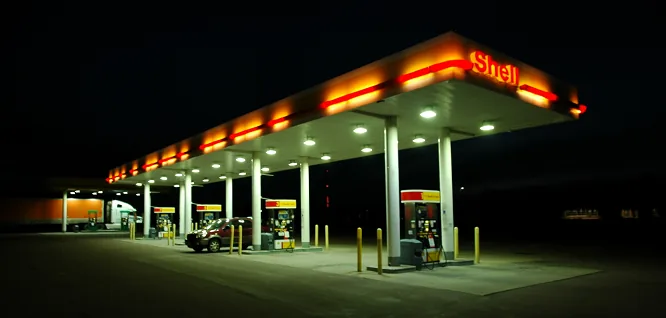
Explosion-proof lighting for gas stations is decided by the zone map around the dispensers, not by the wattage. The canopy over the islands is normally Zone 1 close to the dispenser and Zone 2 at the forecourt edge, so the fixture above the pump must carry the worse of the two: Ex db eb IIC T4 Gb on the nameplate, IP66 against rain and wash-down, and a driver that still delivers at 45 degrees under the canopy. Then size for 50 to 100 lux on the island at 70 CRI. That is what we ship for forecourts in Panama, Mexico and Chile.
Three things that decide the ATEX luminaire on a gas station
A forecourt is not one zone. The dispenser island, the canopy edge and the shop entrance sit in different classifications, and using one fixture everywhere is how a station passes inspection on paper and fails it on site.
01
The zone map, not the catalogue
The space within about 1.5 m of a dispenser vent, and the canopy above it, is normally Zone 1. Beyond that the forecourt is Zone 2. A fixture certified only for Zone 2 cannot sit over the island, however good its photometrics are.
02
Heat under the canopy
A canopy traps hot air and radiates it back at the fixture. Ambient at the mounting point reaches 45 to 55 degrees in the afternoon, which derates the driver long before the LED reaches end of life. Ask for the driver temperature curve, not only the brand.
03
Vapour, wash-down and insects
Petrol vapour plus a pressure washer is the daily reality of a forecourt. IP66 with a tempered glass lens and sealed cable entries is the floor; a polycarbonate lens that yellows in two years is not a saving, it is a re-lamping in year three.
Zone and marking
What goes where on a forecourt
The table is the mapping we use on a forecourt drawing. It is a starting point, not a substitute for the study: the operator's own hazardous-area drawing, made to IEC 60079-10-1 or to NFPA 497, is what the insurer and the fire authority will read, and a specific layout can widen a zone.
Area
Zone
What we supply
Marking
Dispenser island, under the canopy
Zone 1
AEL floodlight, 50–150 W
Ex db eb IIC T4 Gb
Canopy edge and forecourt
Zone 2
AEL floodlight, 100–200 W
Same series, wider optic
Tank vent and fill point
Zone 1
AEL floodlight, 50 W
Check the zone drawing
Air, water and vacuum bay
Zone 2 at the vent
AELL linear, 20–40 W
Linear shape follows the bay
Shop, office and restrooms
Unclassified
Tri-proof or panel, 4000 K
IP65 is enough here
A Zone 2 certificate over a dispenser island is not a paperwork detail. It is the finding that closes the station.
Selection
Floodlight or linear, and how much light
Two shapes cover almost every forecourt. The floodlight throws light down and forward from the canopy or a pole, which is what an island needs. The linear fixture spreads light along a wall, a walkway or a rack, which is what the air bay, the shop facade and the tank farm perimeter need. Both series share the same driver platform and the same 50,000-hour rating, so a mixed order keeps the spares list short on a site that is far from any warehouse.
A forecourt file is cleared by someone who never visits the station, so the pack has to be complete at the first submission: the certificate copy with the exact model and the Ex marking, the declaration of conformity, the IP and impact ratings, the photometric files, and a drawing that shows each fixture against the zone map. Where the market adds its own mark, such as NOM in Mexico or RETIE in Colombia, say so at the RFQ stage, because a local registration is a separate file from ATEX and it moves the delivery date.
A 120 W ATEX floodlight over an island: the canopy is where heat and the zone both concentrate.Can I use a Zone 2 fixture under the canopy?+
Only if the hazardous-area drawing classifies that exact point as Zone 2. Above an island the space under the canopy is normally Zone 1 because vapour accumulates there, so the answer is usually no, and it is the first thing an inspector checks.
What temperature class do I need for petrol?+
Petrol vapour ignites at roughly 280 degrees, so T3 is the minimum and T4 gives margin. T4 caps the surface at 135 degrees, which is what we ship as standard because it also covers ethanol blends and the solvents handled on the same site.
Does the whole station need explosion-proof fixtures?+
No. The shop, the office and the restrooms are normally unclassified and a tri-proof IP65 fixture is the right answer there. Over-specifying the shop raises the price of the project without improving safety.
Opening or refitting a forecourt?
Send the site plan with the dispenser positions and the canopy height. We return the zone map, a fixture schedule per area and the certificate pack for your insurer.