
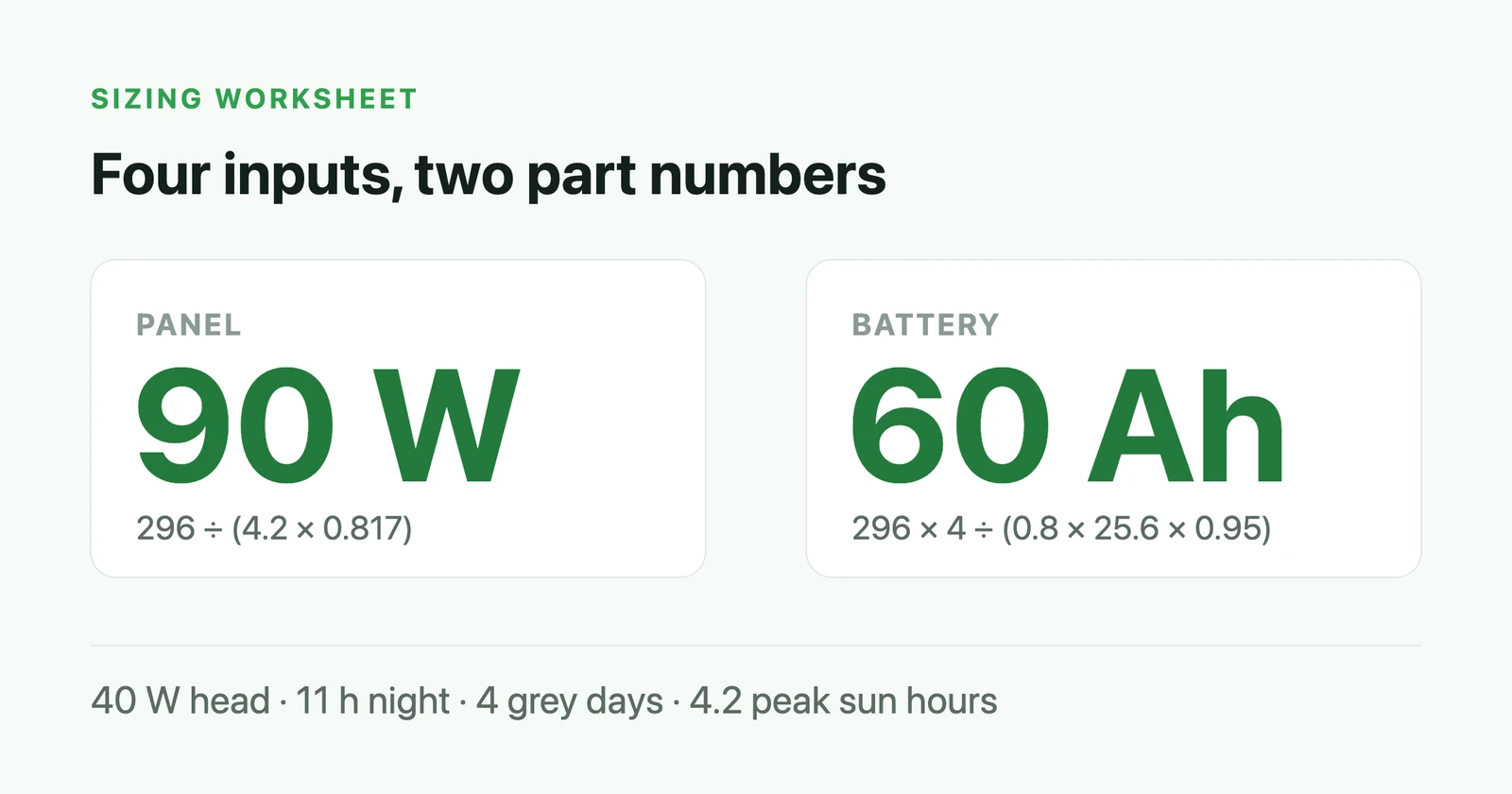
Sizing a solar street light is four numbers and two divisions. The panel wattage, the battery amp-hours and the rainy-day promise in a quotation all come out of them, and you can check every one on a pocket calculator in about two minutes.
Most sizing arguments start because the buyer and the supplier are counting different things. One is asking for a 40 W light, the other is pricing a panel, a pack and a controller that have to carry that light through a wet week. This page is the arithmetic that connects the two, with a worked example per step so you can follow it with your own site numbers.
Four inputs decide the hardware, and only the first comes from the customer.
| Input | Where it comes from | Example |
|---|---|---|
| Nightly energy | head watts × hours, profile by profile | 296 Wh |
| Peak sun hours | the site's coordinates, worst month | 4.2 h |
| Autonomy | the longest run of grey days the site sees | 4 days |
| System losses | soiling, wiring, charging, ageing | 18.3% |
Notice what is not on that list: pole height, warranty length, and price. All three matter, and none of them changes how big the panel has to be. Where the layout is still open the order is reversed: the flux comes first, and pole height, spacing and lumens works the other half of the arithmetic, from the lighting class down to a fixture flux you can specify.
Multiply the head wattage by the hours, but do it profile by profile. A 40 W head that runs at full output until midnight and drops to 40% afterwards does not draw 40 W × 11 h = 440 Wh. It draws 296 Wh, a third less, for the same 11 hours of light on the road.
| Hours | Output | Draw | Energy |
|---|---|---|---|
| 5 h | 100% | 40 W | 200 Wh |
| 6 h | 40% | 16 W | 96 Wh |
| 11 h | mixed | — | 296 Wh |
That gap is the cheapest capacity a project will ever buy. Dimming the small hours cuts the panel, the pack and the freight together, and the road is empty at 3 a.m. in almost every village.
Divide the nightly energy by the peak sun hours at the site's worst month, then divide again by the losses between the panel and the battery.
panel W = nightly Wh ÷ (PSH × 0.86 × 0.95)
System loss is everything between the panel's nameplate and the energy that reaches the pack. NREL's PVWatts model uses 14% as its default for soiling, shading, mismatch, wiring, connections, light-induced degradation, nameplate tolerance and availability (NREL, PVWatts documentation, retrieved 2026-11-06). That figure is worth borrowing rather than inventing a flattering one: it is the 0.86 in the formula. The 0.95 is the charge path: MPPT tracking plus the round trip into the pack.
Peak sun hours is a site's daily solar energy expressed as hours at 1,000 W/m², so 4.2 means the day delivers 4.2 kWh on every square metre.
At 4.2 peak sun hours the same 296 Wh needs 296 ÷ (4.2 × 0.817) = 86 W, so 90 W from the standard sizes. That is a panel-to-load ratio of about 2.2:1, and it is a result, not a rule. A site at 5.8 sun hours lands near 1.6:1; a site at 3.0 needs 3:1 plus a bigger pack.
Two corrections belong in this step. Panels are rated at 25 °C cell temperature, and on a hot roof or a hot pole the cell sits 30–35 K higher, which costs around 10% at the −0.30%/°C coefficient NREL lists for premium modules (NREL, Improvements to PVWatts, 2019). And a panel sized on the annual average instead of the worst month will look adequate for ten months and fail in the eleventh. A third correction lands on the pole rather than the panel: going from 90 W to 200 W roughly doubles the module area, and on an all-in-one head that area sits at the top of the mast where it produces the largest bending moment. The wind load check is where the section, the wall thickness and the foundation are sized against the local design wind speed.
The pack is sized on autonomy, not on the panel, and the depth of discharge is what most quotations quietly get wrong.
battery Ah = nightly Wh × autonomy days ÷ (DoD × pack V × 0.95)
Depth of discharge is the share of the pack you use before it recharges, and the rest is reserve. Use 80% for LiFePO4, not 100%. The last fifth of the pack is the reserve that carries a cell imbalance or a cold morning, and cycling to the floor is what turns a 3,000-cycle pack into a 1,200-cycle one.
For the same 40 W light over four grey days at 25.6 V: 296 × 4 ÷ (0.8 × 25.6 × 0.95) = 61 Ah, so a 60 Ah pack. Check what that actually delivers: 1,536 Wh × 0.8 × 0.95 = 1,167 Wh, which is 3.9 nights at 296 Wh. Round up if the site's wet season runs longer.
One check before accepting a pack that small. A 90 W panel into 25.6 V is 3.5 A, about C/17 on a 60 Ah pack, which is gentle and takes a full day of sun to replace a night. That is normal for street lighting and it is why the panel is sized on daily watt-hours rather than on charge rate.
Annual average sun hours are the most common way a solar street light ends up undersized. The average is a real number and it describes a year that never happens.
Take a site with 4.2 peak sun hours annually. December may be 3.2 and July 5.4. Size on 3.2 and the July surplus costs a little panel area; size on 5.4 and the light is dark by 10 p.m. every Christmas. The same logic applies to autonomy: four days is a temperate default, six to seven is what a two-week wet season actually asks for.
| Site | Load | Worst-month PSH | Panel | Pack |
|---|---|---|---|---|
| Village road, 40 W, 11 h | 296 Wh | 4.2 | 90 W | 60 Ah at 25.6 V |
| Arterial, 100 W, 12 h | 900 Wh | 3.6 | 310 W | 100 Ah at 51.2 V |
| Highland, 60 W, 11 h, −20 °C | 444 Wh | 5.6 | 100 W | 120 Ah at 25.6 V |
The arterial column is why split systems exist. A 310 W panel and a 5 kWh pack do not fit in one housing on top of a pole, and pretending otherwise is how an all-in-one gets sold into a job it cannot do.
Three hundred metres of village road, twelve poles, 6 m mounting height, 30 m spacing, 40 W heads, 11 hours a night, four grey days, a site at 4.2 peak sun hours.
Now change one input. The wet season there runs seven days instead of four. The panel stays at 90 W, because the panel answers a daily question and the pack answers a weekly one. The pack goes to 296 × 7 ÷ (0.8 × 25.6 × 0.95) = 107 Ah, so 110 Ah. Same light, same panel, 83% more battery, and the quotation finally matches the weather.
That is the single most useful thing to understand about sizing: panels and batteries are not scaled together. The panel covers the worst ordinary day, the battery covers the worst ordinary week.
The panel is matched to the lamp, not to the energy. A 40 W light paired with a 40 W panel is a 1:1 ratio that appears in a lot of cheap offers, and it works only above about 6 sun hours with a 6-hour night. Two of those four numbers are usually missing.
The pack is quoted at 100% depth of discharge at 25 °C. Both are laboratory conditions. At 80% DoD and −10 °C the same pack delivers roughly 70% of the quoted energy, and by year eight it holds about 80% of its original capacity. Size for year eight, not for the datasheet.
Autonomy is promised without naming the month. "Three to five rainy days" is not a specification until someone says which weeks those are. Ask for the design month and the design autonomy in writing, then compare quotations on those two numbers.
Three patterns, from the enquiries that reach our inbox.
Each line below removes one assumption from the supplier's side of the table.
| Field | What to write |
|---|---|
| Mounting height and spacing | 6 m, 30 m apart |
| Surface | 5 m asphalt village road, mixed pedestrians |
| Hours and profile | 11 h: full to midnight, 40% after |
| Worst month, peak sun hours | December, 3.2 h |
| Autonomy | 7 consecutive days |
| Minimum temperature | −5 °C, occasional −12 °C |
A request written like that comes back as a quotation you can audit line by line. The alternative — "40 W, five-year warranty, best price" — comes back as a number, and then the sizing happens after the money is committed.
What size panel do I need for a 40 W solar street light? About 90 W at 4.2 peak sun hours and an 11-hour night with dimming, or roughly 2.2 times the head wattage. Below 4 sun hours the ratio rises towards 3:1, and above 5.5 it falls towards 1.7:1.
How many days of autonomy should I ask for? Three to five days covers most temperate and semi-arid sites. A site with a two-week wet season needs six to seven, and the battery grows by roughly 75% for those extra three nights while the panel does not change.
Can I add battery capacity later? On a split system, yes: the pack sits in its own enclosure and a second string can be added. On an all-in-one, the housing volume is the limit, so the pack you buy at order time is the pack you keep.
Why does one quotation specify 120 W for a 40 W light? Either the site has low winter sun, a long night, or no dimming profile. A 120 W panel is correct for a 40 W head at 3.2 sun hours over 12 hours at full output; it is oversized for an 11-hour dimmed night at 4.2.
Does cold weather change the panel or the battery? The panel, slightly for the better, and the battery, clearly for the worse. LiFePO4 loses roughly a fifth of its usable energy at −10 °C and a third at −20 °C, so a cold site needs an insulated compartment, a self-heating pack, or a pack sized 20–30% larger.
If you would rather hand the four numbers to someone, send the site coordinates, the road width, the mounting height and the hours you need, and we will return the panel, the pack and the design month behind both — tell us about the project. For the parts those numbers describe, start with how a solar street light works, and for the money side of the same decision, the five-year cost comparison runs both options.
Our 25-engineer team provides free project consultation and fast, accurate quotations.
Get a Quote