
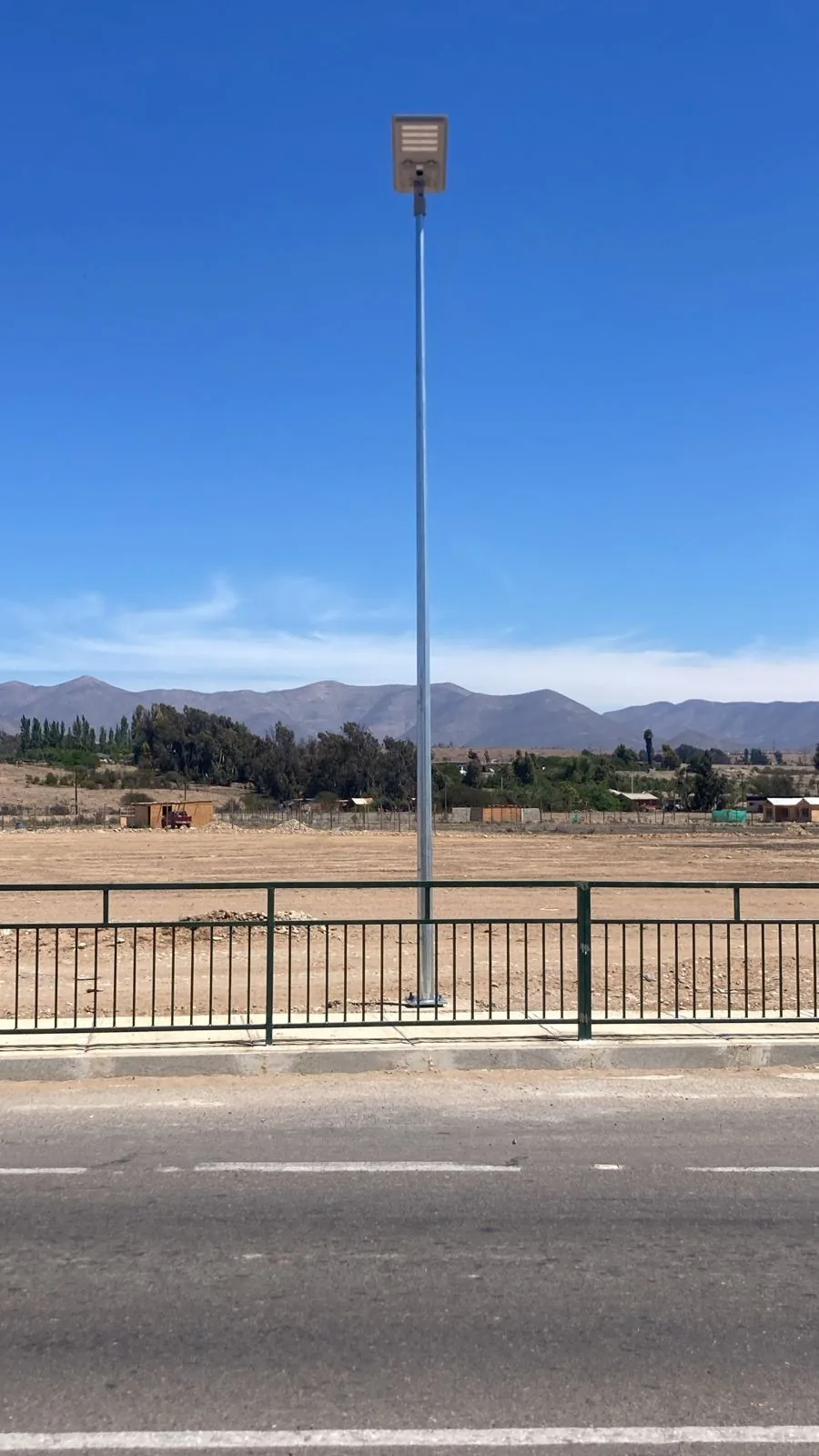
On paper the Andes are the best place on earth to run a solar street light, and one of the hardest places to keep one working past its third year. Above 3,500 m the sun is stronger, the air is thinner, the nights are colder and the road to the pole is longer. Three of those four help the lamp. The fourth is the one that decides whether it is still lit in year five.
This is not an article about cold. Cold has its own piece — can a solar street light work at -5 °C in snow covers the battery, the snow load and the tilt mechanics. What is specific to a solar light installation at high altitude in the Andes is a different list: ultraviolet, air pressure, dust and ash, and access.
Five parameters move, and only one of them moves in your favour.
| Parameter | At sea level | At 4,000 m | What it decides |
|---|---|---|---|
| UV radiation | baseline | roughly 45% higher | Lens, coating, cable jacket |
| Barometric pressure | 101 kPa | 62 kPa | Cooling and electrical clearance |
| Day–night swing | 8–10 K | 20–25 K | Condensation and thermal cycling |
| Peak sun hours | 4.0–5.0 | 5.5–6.5 | Panel size goes down |
| Site access | truck to the pole | 4×4, then hands | Foundation method, pole length |
The panel row is the only line item a quotation will mention. The other four are the ones that come back as a warranty claim.
The WHO rule of thumb is that ultraviolet rises about 10% for every 1,000 m of elevation. Compounded, 4,000 m sits roughly 45% above sea level. That is not a cosmetic problem, and it does not show up in the first year.
What to ask for is not a UV claim but the material: UV-stabilised polycarbonate with a documented additive, polyester powder coating at 60–80 µm or more, a UV-resistant cable jacket rather than plain PVC, and a named gasket compound with an exposure report behind it.
The obvious one is cooling. At 4,000 m the barometric pressure is 62 kPa, about 61% of sea level, and convective heat transfer from the housing falls by roughly the same proportion. The colder ambient partly compensates, but on a clear midday in the altiplano the housing sits under more than 1,000 W/m² with 40% less air to shed heat into. The number that matters is the driver case temperature measured on site at noon, not the ambient temperature printed in the brochure. Ask for an altitude derating statement. A supplier who has never sold above 2,000 m will not have one.
The other consequence is electrical. Lower pressure means air breaks down over a shorter distance, which is why IEC 60664-1 Table A.2 gives clearance correction factors: 2,000 m is 1.00, 3,000 m is 1.14, 4,000 m is 1.29, and 5,000 m is 1.48. A luminaire whose internal clearances are correct for a 6 kV impulse at sea level needs 29% more clearance at 4,000 m, or a declared lower impulse rating, or a Type 2 surge protective device in the loop.
Then do something most buyers never do: read the altitude on the certificate. A large share of LED luminaire certificates are validated to 2,000 m, and the datasheet will not say so. Above that line the certificate describes a different product from the one on your pole.
Andean wet seasons bring high lightning flash density, and on a rural road the pole is usually the tallest object for a kilometre. A standalone solar light is not tied to the grid, so the surge path is the panel loop and the pole rather than the service entrance, and the earthing advice you would copy from a grid-connected street light does not apply. Bond the module frame to the pole, give the controller a defined surge reference, and treat the whole assembly as a floating system that still has to survive a nearby strike.
Near the equator — Ecuador, Peru, southern Colombia, the Bolivian altiplano — the latitude tilt is between 0° and 15°, and a panel sitting at 5° never self-cleans. At altitude there are three soiling sources and they behave differently.
The working rule: 10° minimum anywhere, 15° in a dusty basin, 30–45° where snow lies through winter. Tilting to 15° instead of the theoretical 5° costs 1–3% of annual yield and saves several cleanings a year, which is a trade worth making every time.
Hail belongs in the same conversation. Ask for the IEC 61215 impact test, 25 mm at 23 m/s, because altiplano summer storms deliver exactly that.
Our specification states an operating range of -20 °C to +65 °C. In the altiplano, June and August nights reach -20 °C at 4,000 m. That is not a margin, it is the edge, and it deserves a straight answer rather than a reassuring one.
There are two mechanisms, not one. On discharge, a LiFePO4 pack at -20 °C gives up roughly a third of its rated energy. On charge, charging below 0 °C plates lithium and loses capacity permanently, so the BMS has to block it — and the block has to hold through the three hours after sunrise when the panel is already producing and the pack is still cold.
The options, cheapest first: insulate the battery compartment and keep it out of the open night sky, since radiant loss is what makes a pack colder than the air around it; specify a self-heating pack; oversize the pack by 20–30%; or move to LTO chemistry if the site runs at -30 °C.
There is also a cycling problem that no capacity figure captures. The same sealed housing sees full sun at 4,000 m and can pass 55 °C at midday, then -15 °C before dawn. Sixty kelvin a day, 365 times a year. That is a gasket, MOSFET and solder-joint problem rather than an energy problem, and it is why a high-altitude site ages faster than a cold site with the same average temperature.
In much of the cordillera, rock sits 0.3–0.8 m below the surface. An excavated concrete pad is the wrong detail there; a resin-anchored base plate or a rock-anchored bracket is the right one. Have the installer probe the ground before the drawings are frozen — it is a five-minute test that avoids a redesign.
Concrete is its own trap. Below 5 °C, cement hydration slows sharply and effectively stops, so a pour at dawn in July can end up at half strength. Use an accelerator and heated water, cure under a cover, or move the pour to midday.
Frost heave is the third. In the puna, water in the base and the backfill freezes and lifts, which is why the base plate should sit above grade, the drainage should lead away from the footing, and the soil collar should be left off.
Wind matters more than the average suggests, because mountain passes funnel it. Ask for the design wind speed the pole is rated to, and check that the foundation drawing assumes the soil you actually have rather than the soil in the catalogue.
Then there is the crew. Working at 4,000 m reduces what a person can lift and how long they can lift it, and crews need rotation. A 6 m one-piece pole on a hillside with no crane access is a different job from the same pole in a town. Decide at the quotation stage whether you ship 6 m poles or 3 m sections with a joint, because that choice changes freight, installation labour and the structural detail of the base.
Six lines, and the answer to each one is a document rather than an adjective.
| Line in the RFQ | Answer that holds up |
|---|---|
| Rated installation altitude | A derating or clearance statement citing IEC 60664-1, or a certificate that names 4,000 m |
| UV exposure | Polycarbonate grade, coating thickness in µm, and a QUV or ISO 4892-2 report |
| Driver thermal behaviour at altitude | Case temperature at 1,000 W/m² and the site ambient, or an explicit derating curve |
| Battery low-temperature behaviour | Charge cut-off set point, heating yes or no, and capacity at -20 °C |
| Panel tilt and hail | Minimum tilt offered and the IEC 61215 hail result |
| Foundation and pole | Base detail for rock, and pole sections sized for manual handling |
A supplier who answers five of those six in writing is worth a few percent more on price. A supplier who answers none of them is selling a product designed for a 1,200 m city.
If the site is not yet chosen, start with the Latin America hub and the country certification picture. If the numbers are the open question, the seven-step procurement guide does the autonomy arithmetic line by line. If the site is cold as well as high, the snow and cold case picks up where this article stops. And if the question is how to read the sheet in front of you, how to audit a solar street light datasheet is the checklist.
Can a solar street light run at 4,000 m? Yes, and it will do it with a smaller panel than at sea level, because peak sun hours are higher. What changes is not whether the lamp works but how long the parts last: UV, pressure and thermal cycling set the service life, not the energy balance.
Does thin air make the LED driver overheat? It removes cooling capacity, so the driver runs hotter than the same housing at sea level even though the air is colder. Ask for the case temperature measured at altitude rather than assumed, and derate the driver if the site is above 3,000 m and the midday sun is strong.
Do I need a special battery for the altiplano? You need one whose charge is blocked below 0 °C and whose compartment is insulated. A standard LiFePO4 pack works; it simply delivers less on a -20 °C night, so oversize it by 20–30% or specify a heated pack.
What tilt should I use near the equator? Ten degrees minimum, fifteen in a dusty basin, even though the yield optimum is flatter. Above 3,500 m a flat panel collects ash and dust that never washes off, and the cleaning cost is larger than the yield difference.
Does a CE certificate cover use at altitude? Often not. Many luminaire certificates are validated to 2,000 m, and the altitude is written in the standard reference rather than in the headline. Check that line before the container ships.
Our 25-engineer team provides free project consultation and fast, accurate quotations.
Get a Quote