
Every winter an importer in southern Chile asks us the same question, in a slightly different way: the panel gets buried for three days, the night temperature is -5 °C, will the light still be on at six in the morning?
The honest answer is that temperature is the smallest of the four things that decide it. Cold is not what breaks a solar street light. Snow on the panel, a panel pointed the wrong way, a shallow tilt and a charger that ignores the thermometer are what break it — and three of those four are settled on the day of installation, months before the first snowfall.
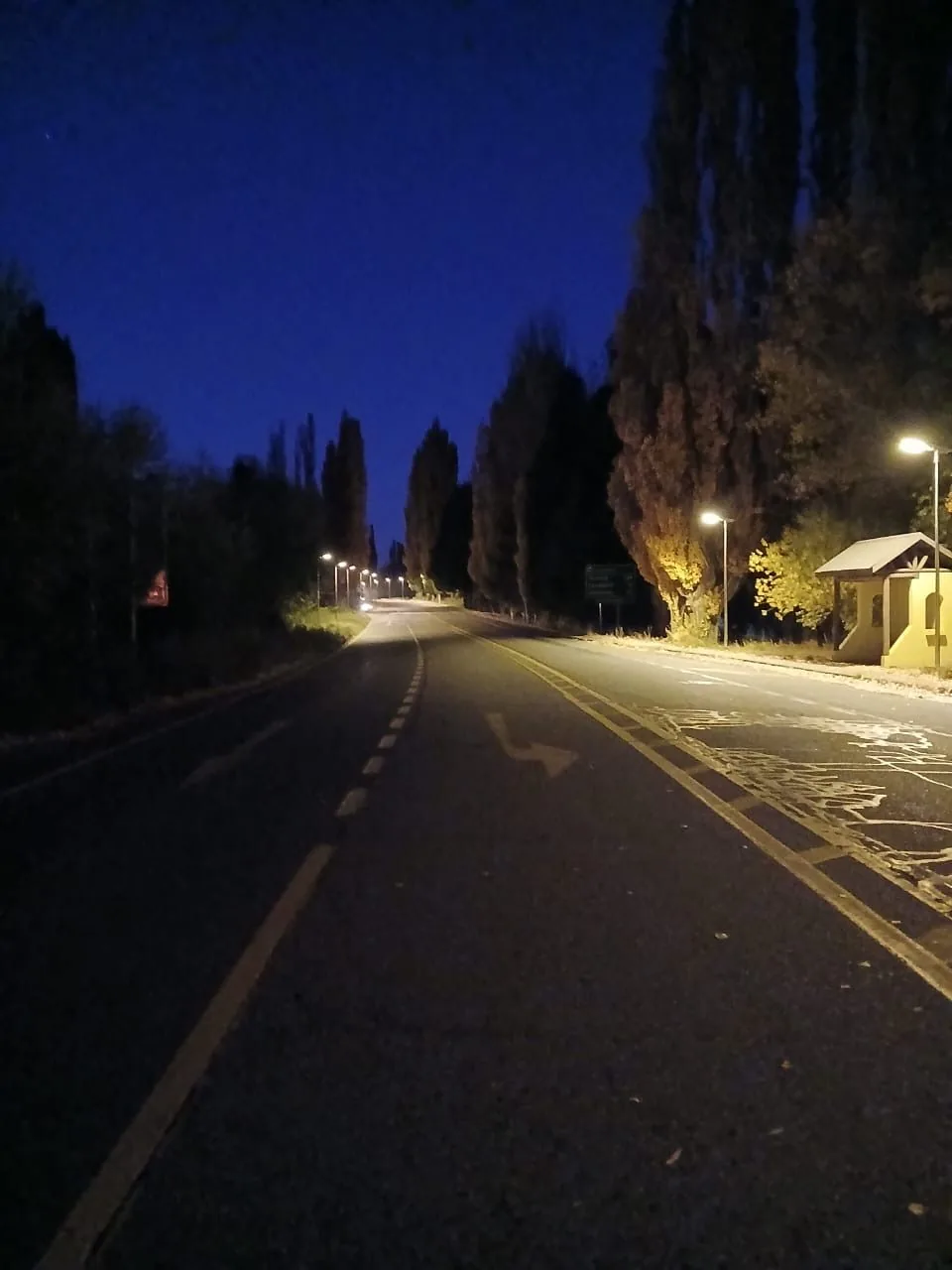
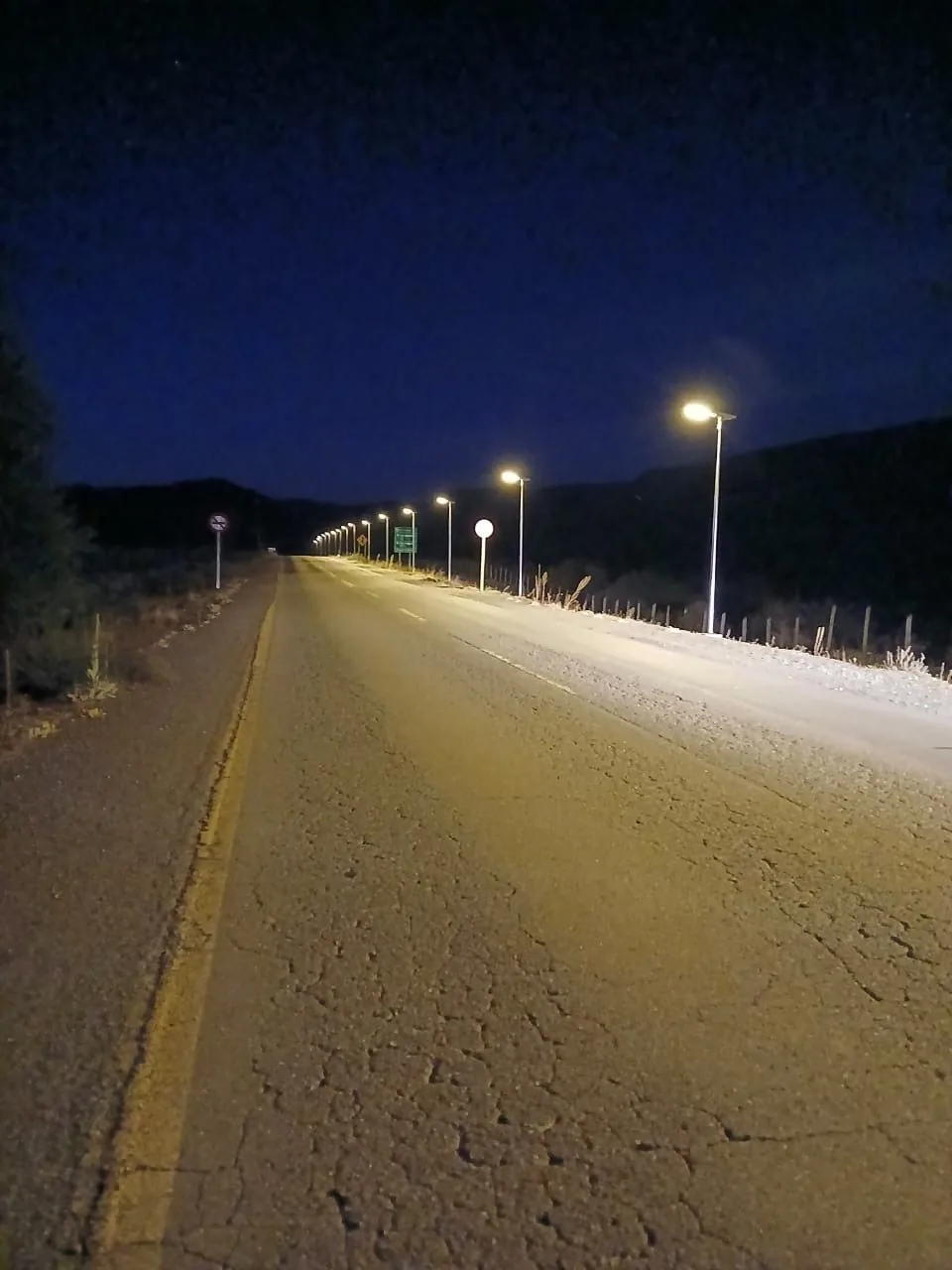
Our coldest commissioned site is in Lonquimay, in Chile's Araucanía Region, where installation ran at a steady -3 °C to -5 °C. The fixtures have been lit every night since.
Very little of what happens at -5 °C is dramatic. It is a set of small shifts, and only one of them is dangerous.
| Part | At -5 °C | What it means for the buyer |
|---|---|---|
| Solar panel | A cold cell is a slightly more efficient cell, so output edges up on a clear day | Cold is not the panel's problem; snow cover is |
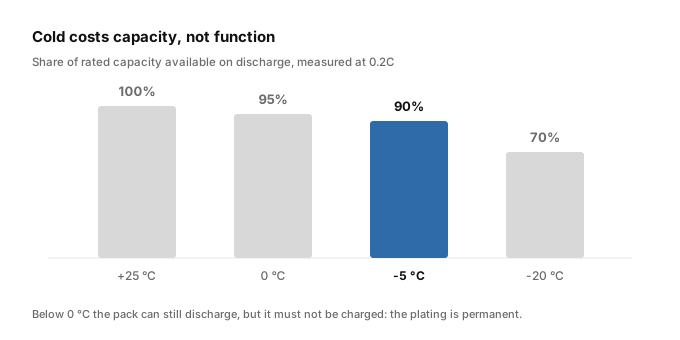
| LiFePO4 battery | Discharge continues, usable capacity drops by about a tenth, charge must be blocked below 0 °C | Size for the derating, and demand low-temperature charge protection |
| LED engine | Runs cooler than in summer, with marginally better efficacy | No action needed |
| Radar sensor | Detection does not depend on ambient temperature | Unaffected by cold, but it is not what switches the lamp on |
| Light sensor | A dark snowstorm looks exactly like night | The controller, not the sensor, has to prevent a daytime switch-on |
The only row that can end a project is the second one, and it is a design question rather than a weather question.
A LiFePO4 pack does not freeze at -5 °C — the electrolyte freezes far below -30 °C — but it does get sluggish. Internal resistance rises, the voltage sags a little further under load, and the energy available on discharge falls by roughly a tenth.
Run that through a real design. A pack sized for three nights of autonomy at 25 °C is a pack sized for two and a half nights at -5 °C. On a site with a clear winter that is invisible. On a site that takes four overcast days in a row in July, it is the difference between a dim morning and a dark one.
The second-order effect is the one that generates support tickets. On the coldest morning of the year a pack at 60% state of charge can still trip a low-voltage cutoff, because cold cells sag under load and the controller reads voltage, not energy. The lamp goes dark at four in the morning with most of its energy still inside. If your supplier cannot tell you whether the cutoff is temperature-compensated, treat that silence as the answer.
Charging a lithium cell below 0 °C plates metallic lithium onto the anode instead of intercalating it. The plating is not reversible: every cold charge takes capacity away for good, and enough of them turn a three-night pack into a one-night pack.
That is why a cold-climate pack needs a BMS with a temperature sensor on the cells and a charge cut-off at or just above 0 °C. The behaviour you want is boring. On a -5 °C morning the controller refuses to charge, the panel sits in the sun, the housing warms, and an hour or two after sunrise the cells are above zero and charging starts. You lose part of a short winter day, not the battery.
This is also where the all-in-one format stops being a compromise. In an integrated fixture the cells live in the same body as the LED engine, so the heat the LEDs shed overnight and the sun on the housing keep the pack warmer than it would be in a separate enclosure buried at the foot of the pole. In a cold climate that is not a trade-off; it is the better architecture.
One centimetre of wet snow on a module blocks essentially all of it. A snowy day is therefore a zero-production day, and the fixture spends it drawing down the reserve you sized for the rainy season. That is why autonomy in nights matters more in a cold region than any temperature figure on a datasheet.
Tilt is the part you can still change. On a smooth glass module snow begins to slide somewhere above 25–30°, once the sun warms the glass; at the 10–15° that many flat-mounting brackets default to, it stays where it lands. So set the panel steeper than the default if the site sees snow, and accept the trade: a steeper panel catches more wind and reads more visibly from the road.
What you should not do is send a crew up with a metal scraper or a bucket of hot water. A scraper marks the glass and the anti-reflective coating, and hot water on a -5 °C module is a thermal shock that the seal, not the glass, usually pays for.
Most mounting instructions in this industry are written for China, Europe or the United States, where the panel faces south. Every country in South America south of the equator — Chile, Argentina, Peru, Bolivia, Paraguay, Uruguay, southern Brazil — needs the panel facing north, because that is where the winter sun sits.
The penalty for getting it wrong is not marginal. In Santiago, at 33.5° south, the June sun never climbs far above the northern horizon, so a south-facing panel spends most of the shortest days of the year pointing away from the only light it has. A crew that follows an imported manual and faces the panel south will still see a lit lamp in March and a dark one in July.
Direction and tilt are one decision. The starting point for winter performance is latitude plus 10–15°: around 45° in central Chile, and 55–65° in Patagonia at 50–60° south, which is also the range that sheds snow well.
A photocell switches the lamp on when the light level falls, and a heavy snowstorm drops the light level to something close to night. The lamp then runs at full output in the middle of the day, on a panel that is producing nothing, and empties in a few hours a reserve that took a week to build.
The fix lives in the controller, not in the sensor: a dusk-confirmation delay, so the lamp only switches on after darkness has lasted several minutes, plus a time window that forbids switching on during the hours when it should be off. It is a two-line setting and almost nobody asks for it.
Luxey has built outdoor LED lighting in Shenzhen since 2007 and supplies distributors, contractors and municipalities in more than 76 countries, under an ISO 9001 system with our own test laboratory. The AIOH and AIOAS series share one LiFePO4 platform rated for 3,000 cycles at 80% of original capacity, and every unit runs a 24-hour aging test before it ships.
For a cold site we work through four decisions in order: the azimuth and tilt, the autonomy at the dimmed baseline rather than at full output, the low-temperature charge profile, and the dusk-confirmation setting. The first two decide whether the lamp survives a winter; the last two decide whether the battery survives five.
At what temperature does a solar street light stop working? Below the rated range on its datasheet, which for our AIOAS and AIOX series is -20 °C. At -5 °C nothing stops: the lamp runs, the pack simply holds less energy, and the panel produces a little less because the winter day is short and the sun is low.
Will a solar street light charge on a cloudy or snowy day? It will produce something on a cloudy day, perhaps a fifth to a third of clear-sky output, and almost nothing on a day when snow is lying on the glass. That is the day the battery is asked to carry, which is why a cold-region site should be sized on autonomy in nights rather than on panel watts.
Does cold damage the battery? Discharging in the cold does not damage a LiFePO4 pack, it only reduces what you can take out. Charging below 0 °C does damage it, permanently, which is why the charge cut-off is the specification that matters most and the one least often quoted.
Do I need a bigger battery for a cold climate? Usually a little, for two reasons that stack: roughly a tenth of the capacity is unavailable at -5 °C, and the winter day is shorter, so there is less time to put energy back. Size on the worst month, not the average one.
Can snow break the panel or the fixture? The glass and the housing are not the weak point; the seal and the mounting are. Ice that builds up and then expands, and wind loading on a steeply tilted panel, are what a cold-region installation has to be checked for.
Do the lights still come on when the panel is covered with snow? Yes, and that is the intended behaviour: the lamp has a charged pack and the road still needs light. The failure to watch for is the opposite one, a lamp that switches on during a dark snowstorm and burns its reserve before evening.
Get a quote or see the solar street light range.
Our 25-engineer team provides free project consultation and fast, accurate quotations.
Get a Quote