
Three years ago, a solar street light was still the thing you specified when the grid could not be reached. In 2026 it is ordinary infrastructure — municipal roads, resort perimeters, mine haul routes, logistics yards and village lanes.
The buyer has changed with it. Procurement is no longer dominated by aid-funded rural programmes; it is increasingly a facilities or public-works manager with a five-year budget line and a tender document to defend.
This article lays out the landscape in four layers: how large the market actually is, how it divides by region, how the supply chain is organised, and where the openings sit for buyers and contractors.
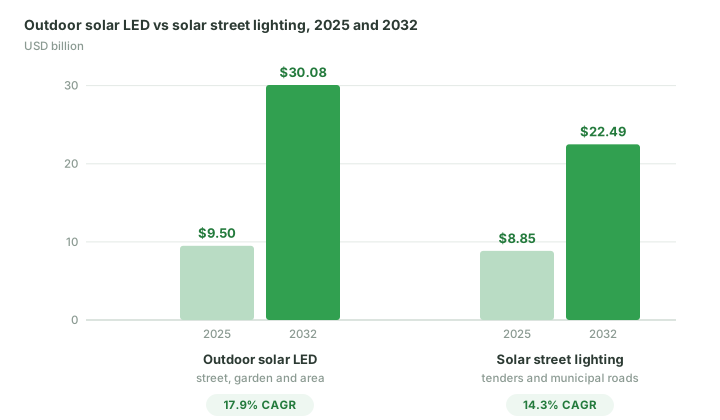
One caution before the numbers. Research houses scope this category differently, and the differences are large enough to matter. Two segments are kept strictly separate throughout: outdoor solar LED as a whole, and solar street lighting on its own. Added together, they produce the kind of headline figure that does not survive a spreadsheet.
The wider category is outdoor solar LED — street lights, garden and bollard lights, area and flood lighting. The narrower one is solar street lighting alone, the segment that shows up in municipal tenders.
| Segment | 2025 | 2032 | CAGR |
|---|---|---|---|
| Outdoor solar LED — street, garden and area lighting | $9.50 bn | $30.08 bn | 17.9% |
| Solar street lighting only | $8.85 bn | $22.49 bn | 14.3% |
Both curves point up, but they are not driven by the same demand. Outdoor LED grows on broad-spectrum volume: gardens, commercial frontage, security and emergency lighting, where the purchase is small and the decision is fast. Solar street lighting grows on procurement cycles — a municipality or a mining operator replacing a stretch of road, one tender at a time.
The application split is where the practical consequences appear. On the street lighting side, roads and highways take about half of the volume, rural public space roughly a quarter, commercial parking around one in seven, and parks and industrial areas the remainder.
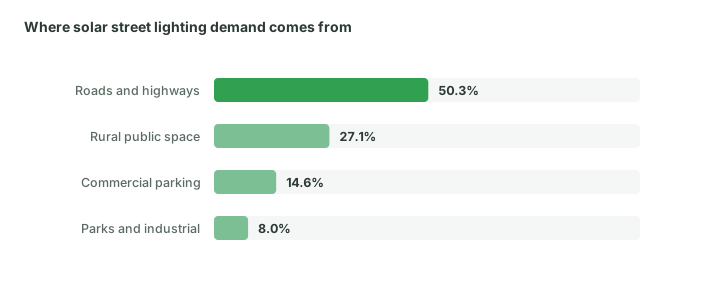
Read that first slice carefully. Half the market is road-standard work, which means photometric files, glare classification and warranty terms decide the order — not the price per watt on the quotation. A supplier who cannot produce a DIALux study is not competing for that half at all.
The regional split is uneven, and the unevenness is the opportunity.
| Region | Solar street lighting, 2025 | Share |
|---|---|---|
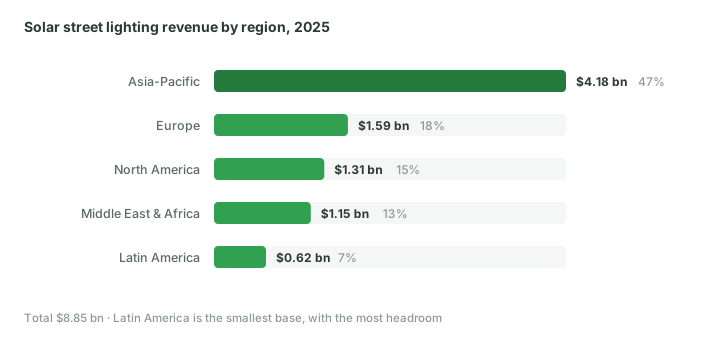
| Asia-Pacific | $4.18 bn | 47% |
| Europe | $1.59 bn | 18% |
| North America | $1.31 bn | 15% |
| Middle East & Africa | $1.15 bn | 13% |
| Latin America | $0.62 bn | 7% |
Asia-Pacific is the only region that is both. Chinese plants supply an estimated 70–80% of the world's solar lighting components and finished systems, and the same country buys back a large share of what it makes.
India is the other volume engine: rural electrification programmes have historically deployed solar street lights at a rate of one to two million units a year, and the specification habit formed there now sets expectations across South Asia. Vietnam, Indonesia and the Philippines are moving faster on a simpler argument — where the grid is absent or unreliable, an off-grid pole wins on installation cost alone.
Around 600 million people in sub-Saharan Africa still lack reliable grid access. For a large share of them, a solar light is not a retrofit — it is the first light on the street.
Development finance keeps this segment funded in a way commercial markets are not: World Bank and African Development Bank programmes underwrite deployment, and the pay-as-you-go model has made consumer and small-commercial solar a working business rather than a donation channel. In the Gulf, the same product goes into hospitality and tourism master plans, where the brief is aesthetic as much as electrical.
Europe buys on regulation, not on sunlight. Green public procurement rules, dark-sky ordinances and municipal climate plans have turned the luminaire into a compliance document. Buyers here ask for CE and RoHS first, then recyclable lithium chemistry, then upward light output ratio — in that order. Connected luminaires are reported to make up more than 40% of regional volume, which is why a driver without a dimming protocol is hard to sell into a European tender.
The United States buys differently. Tribal and remote communities, parking lots and highway rest areas make up a steady base, and lighting-as-a-service has become a standard structure — reported to cover roughly a third of municipal procurement. The pitch shifts from selling hardware to selling guaranteed illumination for a fixed monthly fee. Canada adds a seasonal pattern: northern communities deploy in the short construction window and expect the system to survive a winter with almost no solar yield.
Latin America is the smallest of the five regions at $0.62 bn, and the least contested per dollar of demand.
Brazil's Luz para Todos programme has pushed universal access to the point where the remaining work is off-grid, which is solar by definition. Chile combines three conditions that rarely appear together: extreme solar resource in the north, electricity prices high enough to make self-generation rational, and a mining sector that builds roads where no distribution line will ever be run. Colombia and Peru are moving on two tracks at once — municipal procurement in provincial capitals, and tourism and hospitality projects on the coast and in the highlands. A lakeside resort in Los Lagos is one documented case.
Almost every solar light sold anywhere was assembled, tested or at least component-sourced in one of three Chinese clusters. Knowing which cluster owns which part of the job tells you a great deal about a supplier before you visit the factory.
| Cluster | Strength | Typical buyer |
|---|---|---|
| Zhongshan, Guangdong | LED assembly, die-casting, OEM and ODM tooling | Brands, distributors, private label |
| Yangzhou, Jiangsu | Pole and PV integration, large municipal packages | EPC contractors, government tenders |
| Shenzhen, Guangdong | Drivers, MPPT controllers, IoT modules | Smart-city projects, electronics buyers |
Zhongshan is where a luminaire becomes a product: casting, finishing, assembly, private label. Yangzhou is where a project becomes a package — pole, foundation, panel array, transport, and the logistics of shipping a 9-metre mast to a site with no crane. Shenzhen is where the failure modes are decided, because the controller and the driver sit behind most of the warranty claims in this category.
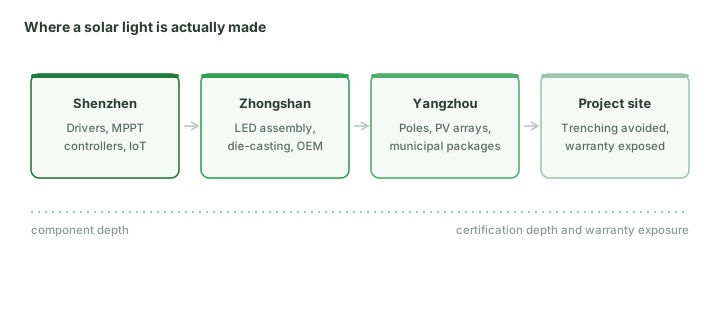
The commercial consequence is the widening gap in the middle of the market. Entry-level product prices fall about 3–5% a year, driven by panel and cell oversupply. Certified, controlled, high-autonomy systems hold their price. The spread between the two has gone from roughly two times to three or four.
That gap is not a temporary inefficiency. It is the market telling you that the two ends are selling different things: one sells a luminaire, the other sells a lighting outcome with a warranty attached.
Specification priorities have moved. In 2026, buyers ask fewer questions about wattage and lumens and more about the following five.
One-piece or two-piece. All-in-one units hold 62.9% of the solar street lighting market on installation speed and theft resistance. Split systems stay dominant above 100 W and in hot climates, because thermal separation between panel and battery is still the cheapest way to protect cycle life.
Lead-acid to LiFePO4. The chemistry shift is essentially complete in the segment that matters. LiFePO4 gives eight to ten years of cycle life, and it tolerates the temperature extremes that used to end a project in year three — provided the pack has real thermal design, not just a datasheet claim.
Control as standard. Microwave radar sensing, time-profile dimming, and LoRaWAN or NB-IoT telemetry. A tender that omits the word smart is now unusual in municipal work, and a luminaire without a dimming profile is priced as a component, not as a system.
Dark-sky compliance. Upward light output ratio near zero, and blue content capped by zone — Chile's MMA standard, for example, sets Zone A below 1% and Zone B below 7% in the blue band. Astronomical observatories, ecological reserves and premium resorts all enforce a version of this, and it disqualifies most entry-level product regardless of price. The retrofit we documented in Lonquimay, in southern Chile, is a worked example.
Scenario engineering. Desert mine sites need UV resistance, wind loading and high-temperature discharge. Lakeside hotels need warm colour temperature, low spill light and a pole that disappears into the treeline. Andean villages need cold-start capability and oversized battery reserve for a week of cloud. The same catalogue cannot serve all three, and buyers increasingly ask for evidence rather than a promise.
The map is large, but a business is built on one or two positions, not on the whole map. Five that are working now:
A market of this size is not useful until it is reduced to a specific site. When a project reaches us, it comes down to three tests.
That defines where we sit. We are not trying to be the cheapest of two thousand assembly houses. We aim to be the layer that can enter a tender, defend the payback calculation and still be on the pole in year five.
If you are working on a project in Chile, Colombia, Brazil or anywhere the grid stops short, the useful next step is not a catalogue. It is a conversation about the site.
Data note. Market figures in this article are taken from PW Consulting's 2026 outdoor solar LED and solar street lighting reports. Scope definitions differ between research houses and forecast years vary, so each figure is attributed rather than averaged, and the two segments are reported separately on purpose.
How big is the solar street lighting market? Solar street lighting alone was $8.85 bn in 2025 and is forecast to reach $22.49 bn by 2032, a 14.3% CAGR. The wider outdoor solar LED category — street, garden and area lighting — runs $9.50 bn to $30.08 bn at 17.9%. The two segments are kept separate because adding them together produces a headline that does not survive a spreadsheet. Source: PW Consulting, 2026.
Where does the demand sit by application? Roads and highways take about half of solar street lighting volume, rural public space roughly a quarter, commercial parking around one in seven, and parks and industrial areas the remainder. Half the market being road-standard work is why photometric files, glare classification and warranty terms decide the order — not the price per watt.
Which region holds the largest share, and which has the most headroom? Asia-Pacific holds 47% of solar street lighting revenue at $4.18 bn, followed by Europe 18%, North America 15%, Middle East and Africa 13% and Latin America 7% ($0.62 bn). Latin America is the smallest base with the most headroom — and the least contested per dollar of demand.
What do the three Chinese supply clusters specialise in? Zhongshan in Guangdong does LED assembly, die-casting and OEM/ODM tooling for brands and private label; Yangzhou in Jiangsu does pole and PV integration and large municipal packages for EPC contractors and government tenders; Shenzhen does drivers, MPPT controllers and IoT modules for smart-city and electronics buyers.
All-in-one or split — what does the market say? All-in-one units hold 62.9% of the solar street lighting market on installation speed and theft resistance. Split systems stay dominant above 100 W and in hot climates, because separating panel and battery thermally is still the cheapest way to protect cycle life.
Why is the price gap between entry-level and certified systems widening? Entry-level product prices fall about 3–5% a year on panel and cell oversupply, while certified, controlled, high-autonomy systems hold their price. The spread has gone from roughly two times to three or four. That gap is the market saying the two ends sell different things: one a luminaire, the other a lighting outcome with a warranty attached.
Our 25-engineer team provides free project consultation and fast, accurate quotations.
Get a Quote