
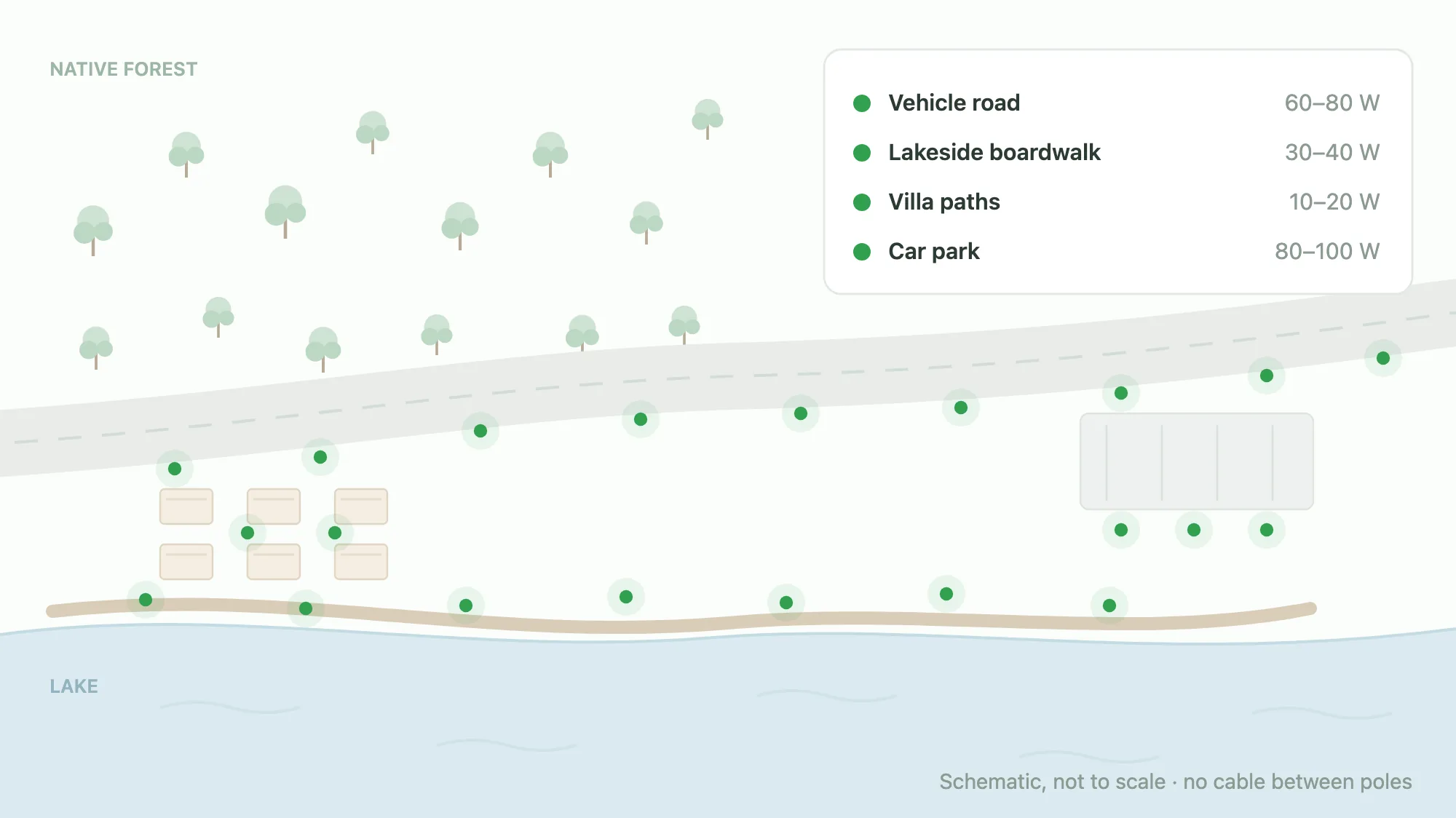
In the Los Lagos region of southern Chile, an eco-resort sits between native forest and its own stretch of lake shore. When the owners came to us, the brief was one sentence long:
"We want light at night, no cables in daylight, and no new outdoor electricity line on the bill."
That sentence names the three costs of grid lighting in one breath: you have to dig, you keep paying, and you keep maintaining. This is how we deleted all three with off-grid solar lighting.
The lake district is not a normal site. Native forest, volcanic ground and private shoreline make a cable run cost two to three times what it costs on flat farmland:
For a hotel whose product is silence and nature, the real cost is not the cable. It is the trench across the landscape guests paid to see.
For roughly forty outdoor fixtures, the conventional design would have opened several kilometres of trench through the grounds. The lights would still be off, and half the guest experience would already be gone.
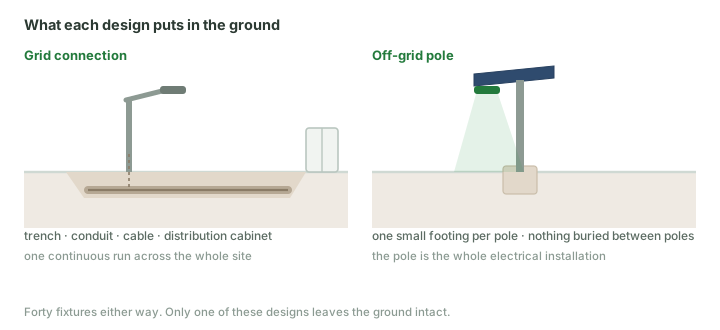
No grid connection, no cable between poles, no ground broken. Each pole generates, stores and controls its own power:
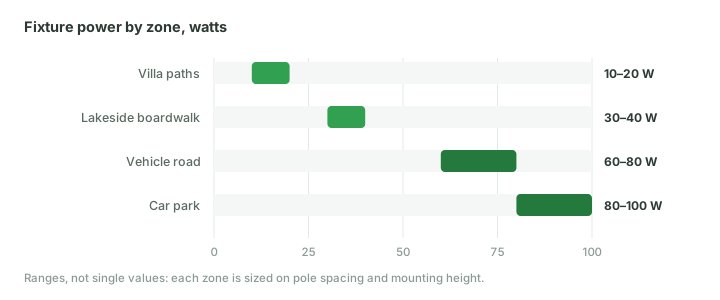
| Zone | Fixture | Power | Lighting logic |
|---|---|---|---|
| Vehicle road | All-in-one solar street light | 60–80 W | Radar dimming plus time schedule |
| Lakeside boardwalk | Arc-arm solar garden light | 30–40 W warm white | Full at dusk, 30% after midnight |
| Villa paths | Solar spike and bollard lights | 10–20 W | Motion activation, low base level |
| Car park | Solar high-mast light | 80–100 W | Full on arrival, half when idle |
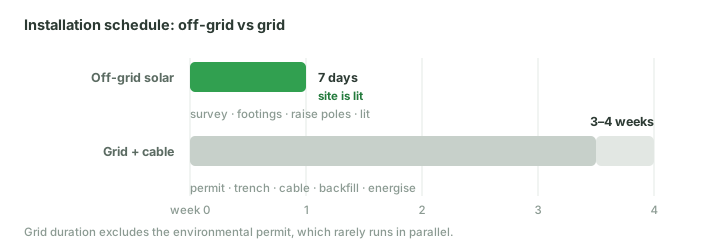
Because the foundation is precast and the pole is a single unit, the work barely feels like construction:
A grid design of the same scope would need three to four weeks plus an environmental permit. Solar turns an engineering project into an installation.
Outdoor electricity bill: zero. Every new outdoor fixture runs on its own panel. On a like-for-like grid quote, the five-year saving typically covers the equipment premium two to three times over — and the TCO calculator at the end of this article lets you check that with Chilean rates.
The cables disappeared. No conduit, no distribution box, no link between poles. By day you see a timber-toned pole among the trees; at night the light comes out of the forest instead of from a road.
Maintenance became a wipe, not a dig. There is no underground circuit to fail. A quarterly wipe of the panel and a battery-state check is the whole routine, and the battery is assessed at year five to seven rather than replaced on a calendar.
Chile is one of the fastest-moving energy transitions in Latin America, and the Energy Efficiency Law has pushed high-end hospitality toward certified sustainability. Three local conditions make off-grid lighting the obvious answer:
In these settings solar lighting is not the cheap option. It is the better engineering option.
The logic repeats whether the site is a winery trail in the Central Valley, a seafront hotel in Viña del Mar, or a stargazing camp in Atacama:
A lamp has a price tag. A lighting system has a five-year energy bill attached to it.
If you are working on a hotel, lodge, winery or campus in Chile, or anywhere trenching is expensive and the grid is far away, send us four things:
You get back a zoned configuration list, a five-year zero-bill TCO estimate, DIALux illuminance plots, and a specification you can put into a tender. Run your own figures first with the five-year TCO calculator, or read the off-grid village comparison for the wider cost picture.
Write to info@szluxey.com or visit szluxey.com.
Why was trenching the expensive part, not the lights? Because of where the resort sits. In the Los Lagos lake district, native forest, volcanic ground and private shoreline push a cable run to two to three times what it costs on flat farmland: the route has to go around root systems, moss beds and protected vegetation, and permits and environmental review come before any cable is laid. For roughly forty outdoor fixtures the conventional design would have opened several kilometres of trench.
How many nights of autonomy does each pole carry? Three to five, from a LiFePO4 pack rated −20 °C to +65 °C. The lake district has short winter days and a long rainy season, so the sizing starts from the worst month rather than the annual average — and every pole runs its own MPPT controller, which recovers more charge than a PWM unit on overcast days.
Which fixture went into each zone? Power follows the zone instead of one fixture for everything: 60–80 W all-in-one solar street lights on the vehicle road with radar dimming plus a time schedule, 30–40 W warm-white arc-arm garden lights along the lakeside boardwalk, 10–20 W solar spike and bollard lights on the villa paths, and 80–100 W solar high-mast lights over the car park.
How long did installation take with no trenching? Seven days. Days 1–2 survey and mark pole positions clear of the old trees and the vegetation core; days 3–4 pour small concrete footings with no cable trench at all; days 5–6 raise the poles, fit the heads and self-test every unit; day 7 the whole site is lit while the guests are still on site.
Does the light spill onto the shore or into the sky? No. The optics are 3000K warm white and deliberately low-spill, keeping light on the path and off the sky, and the microwave radar sensor drops each fixture to 30% after 15 seconds without movement. For a hotel whose product is silence and nature, that is the point.
Our 25-engineer team provides free project consultation and fast, accurate quotations.
Get a Quote