
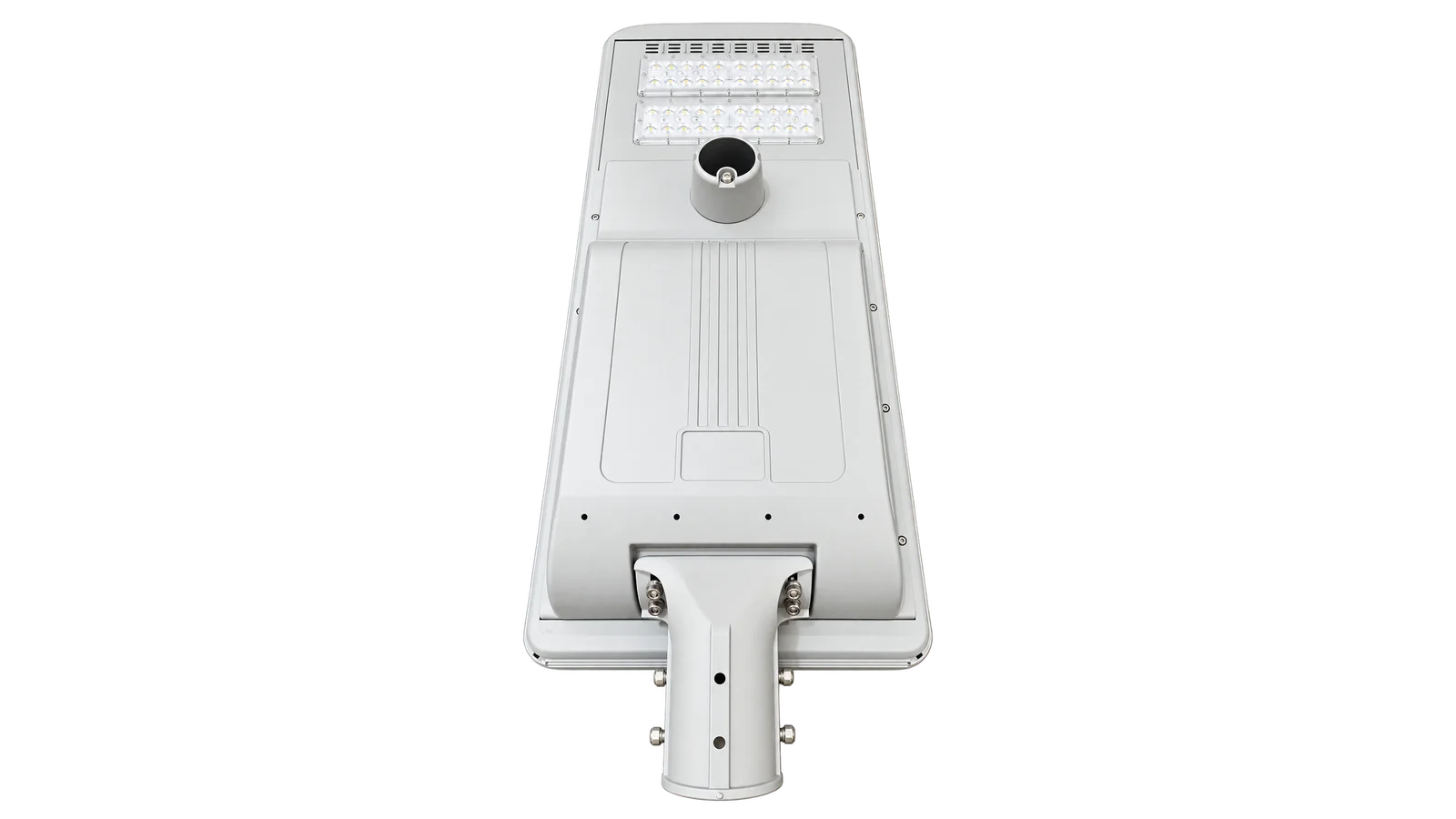
A solar street light does not fail all at once. The panel keeps working, the LEDs keep working, and the pole stays where it is. What fades is the battery's ability to hold a charge through the night, usually in year six or seven. On most all-in-one designs, reaching that battery means opening the top of the fixture on a lift, with the pole still carrying the panel and the optics.
That is a maintenance decision made years before anyone writes a service ticket. A luminaire designed with a pull-out battery drawer and an externally mounted controller can be serviced from one ladder position, with the lamp still on the pole. This guide covers how to tell when the pack really needs replacing, what to specify before ordering a spare, the swap sequence itself, and the cold-weather constraint that determines how long the new pack lasts.
Key Takeaways
- - A LiFePO4 pack is rated in cycles to a state of health, not in years: Luxey's AIOX specification is 3,000 cycles to 80% SOH. Shortening autumn nights are a capacity symptom, not automatically a battery fault.
- - Before ordering a replacement, match system voltage, capacity in Ah and Wh, BMS low-temperature cutoff, connector and polarity, enclosure rating, and the UN 38.3 test summary.
- - On a serviceable housing, the swap happens on the pole with the panel, bracket and optics untouched; on a sealed housing it does not.
- - Charging a LiFePO4 cell below 0 °C causes lithium plating, so a winter replacement should be commissioned only once the cells are inside their permitted charge window.
Start with the number the manufacturer published, not with a calendar. Luxey's AIOX series specifies a LiFePO4 pack rated at 3,000 cycles to 80% state of health, which at roughly one cycle per night is a service interval measured in years rather than months (Luxey Lighting, AIOX Series Specifications). State of health is the share of original capacity the pack still holds. Below roughly 80%, a system sized for three to five rainy days starts missing the last hours before dawn.
The symptom buyers report first is the light going dark before sunrise, or dropping to its dimmed baseline earlier than the programmed schedule. That is a capacity problem, but it is not proof the pack is dead. A shaded or dirty panel, a controller that has lost its time profile, and a motion sensor stuck at its low state produce the same complaint. Check charging current on a clear midday and read the controller's status display before condemning the battery.
| What you observe | Likely cause | What to check first |
|---|---|---|
| Light goes dark before dawn after years of service | Reduced pack capacity | Controller status, then a full charge/discharge capacity check |
| Light goes dark before dawn after a few weeks | Panel shading, soiling or a lost charge profile | Midday charging current and the controller time settings |
| Output drops to the dimmed baseline and stays there | Sensor or control profile, not the pack | Sensor trigger and the segmented time control settings |
| No light at all, controller display dead | Connection, fuse or controller fault | Connector seating and controller supply voltage |
The table is a triage order, not a diagnosis. The point is that a replacement pack ordered to fix a controller fault will be fitted, will not change the symptom, and will then sit in a spare-parts store with a shortened calendar life.
Two luminaires with the same panel, the same cells and the same MPPT charger can have completely different lifetime maintenance costs. In a conventional all-in-one body, the battery sits inside the sealed housing under the panel. Reaching it means breaking that seal at height, then re-making it well enough to keep the ingress rating. In a serviceable design, the pack lives in its own compartment that slides out sideways while the luminaire stays bolted to the pole.
The AIOX series was built around the second approach: a pull-out battery drawer, a galvanised support tray with a bracket, an inner cover with anti-collision foam to lock and cushion the pack, and an external integrated controller combining MPPT charging, a motion sensor and an LED status display (Luxey Lighting, AIOX Series Specifications). The battery and the controller can both be exchanged on the pole. Nothing about the bracket, the panel aim or the optical axis has to be disturbed.
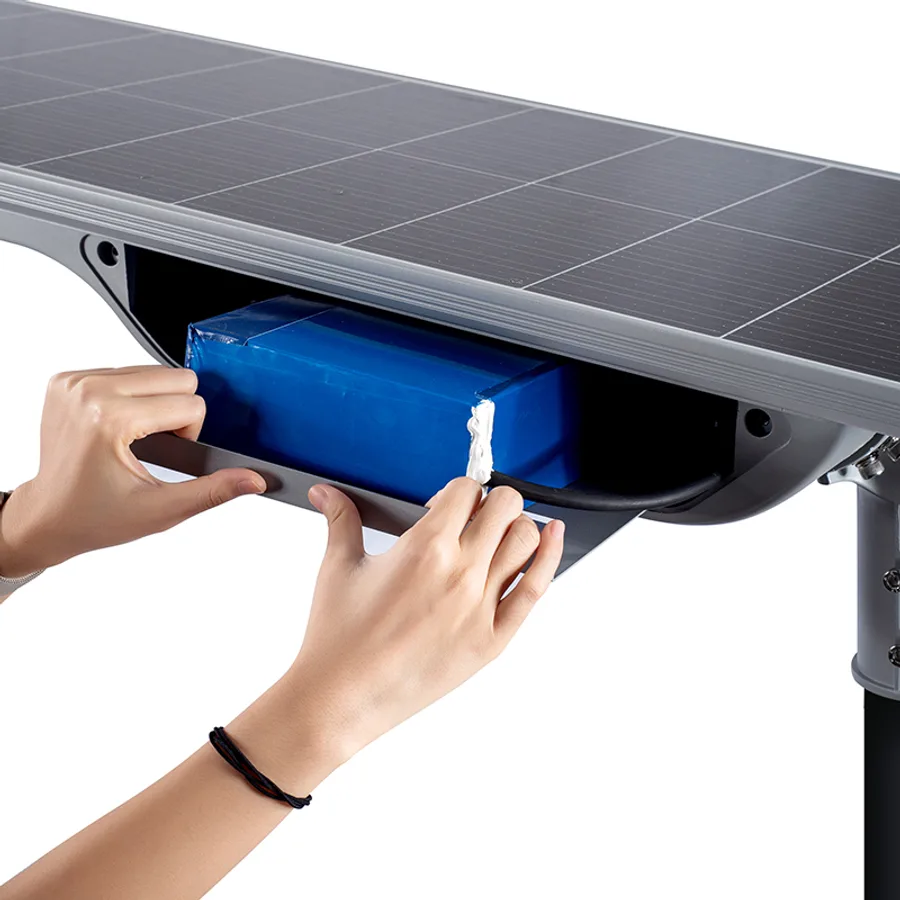
That difference shows up in the tender file as equipment cost. A service visit that needs a crane, a lane closure and two technicians costs more than the pack itself; a visit that needs one technician and a ladder is a different line item. If the project is on a highway, a port access road or a remote village, ask the supplier to state in writing whether the battery is replaceable without removing the luminaire.
A replacement pack is not a commodity part. Order it against the original electrical and mechanical specification, and ask the supplier to confirm each line in writing:
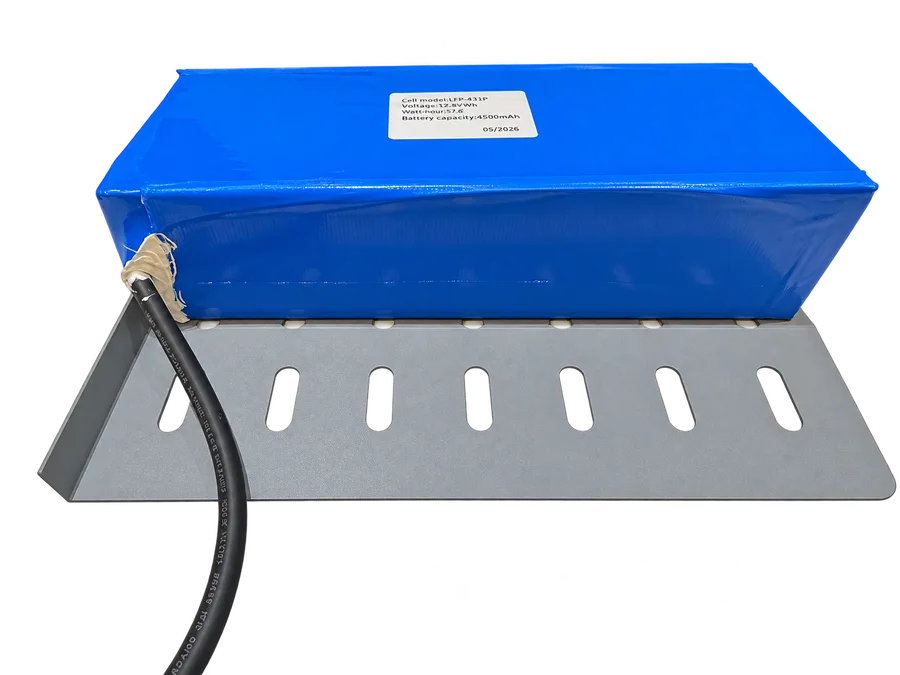
Do not mix cells of different models, batches or internal resistance in one pack, and do not assemble a replacement from loose cells in the field. Published cell specifications require matched cells, controlled clamping force and a BMS designed for that configuration; those are factory conditions. For a field swap, specify a complete, tested pack.
The sequence below assumes a serviceable drawer-type compartment. Follow the manufacturer's isolation procedure and local working-at-height rules; the order is the logic of the job, not a substitute for the site's safety method statement.
The last step is the one most often skipped. A pack that charges correctly at noon but drops out before dawn has either a capacity mismatch or a control profile that nobody re-checked. Log the date, the pack serial and the observed autonomy so the next replacement is a planned purchase rather than a complaint.
Cold does not usually destroy a LiFePO4 pack. Charging it while cold does. A peer-reviewed review of low-temperature LiFePO4 performance describes lithium plating on the graphite anode as the primary degradation mechanism at sub-zero temperatures: metallic lithium deposits instead of intercalating, consuming active lithium and, in severe cases, forming dendrites that can short the cell (Wiley, Carbon Neutralization, review of low-temperature LiFePO4 performance). Battery University's BU-410, Charging at High and Low Temperatures gives the practical rule: discharge in the cold is possible, but charging below 0 °C at normal rates is not.
This is why a datasheet that lists −20 °C to +60 °C can still be misleading. That range is normally the discharge window. The charge window is narrower, and a BMS with a low-temperature cutoff will refuse charge current until the cells warm up. On a solar street light there is no grid-powered heater, so in a cold snap the pack simply stops accepting charge for part of the day.
For a replacement, that means two things. Commission the new pack when cell temperature is inside the permitted charge window, and treat a winter "no charge" complaint as a temperature question before it becomes a warranty claim. It also means the sizing exercise that produced the original autonomy figure should be re-run for sites that have since added shading or changed their operating profile.
A used lithium battery is a regulated transport item, not scrap metal. The UN Manual of Tests and Criteria, Part III, subsection 38.3 defines the type tests — altitude simulation, thermal, vibration, shock, external short circuit, impact, overcharge and forced discharge — that a cell or battery design must pass before transport; ICAO's dangerous-goods documentation lists the same T.1–T.8 sequence (ICAO DGP working paper on secondary lithium batteries). Ask the supplier for the test summary that covers the pack type you are returning, and keep it with the shipment documents. The practical paperwork trail for a battery crossing a border is set out in more detail in What It Actually Takes to Ship a Lithium Battery Street Light Overseas.
Tape the terminals, keep the pack in a non-conductive outer container, and hand it to a licensed recycler or take-back scheme. Do not put it in a general waste stream, and do not store a damaged pack next to a new spare.
Not as a field repair. Cells in a pack are matched by model, batch, capacity and internal resistance, and the assembly needs controlled clamping and a BMS configured for that set. A complete tested pack is the replaceable unit; cell-level rebuilding belongs in a factory with the test equipment to verify it.
On a drawer-type compartment, the physical swap is short — the time goes into access, isolation and the verification night afterwards rather than into dismantling the luminaire. On a sealed housing the same job includes opening and re-sealing the body at height, which is why the design question is worth asking at purchase.
Only if the charger, the BMS and the compartment were designed for it, and only after re-checking the charging time. A larger Ah figure with the same panel and the same charge window can leave the pack undercharged in winter. Work from the sizing calculation, not from the biggest number in a catalogue.
It can, if the gasket is pinched, the cover is cross-threaded or the cable nut is not re-seated. The AIOX backside uses a waterproof cable nut and a one-piece die-cast structure instead of manual glue, which makes the closure repeatable — but the rating still depends on the cover being closed correctly. Inspect the gasket on every swap.
A ten-year lighting project will outlive at least one battery. The useful question at specification stage is not whether the pack will eventually need replacing, but whether replacing it requires a crane. A design that separates the consumable part from the optical and structural parts turns one expensive outage into a short, planned visit.
If you are writing a maintenance clause into a tender, ask for the battery and controller replacement procedure, the spare part numbers, and the UN 38.3 test summary in the same document as the photometric file. Send us your project parameters and we will return the matching spare part list and service sequence.
Our 25-engineer team provides free project consultation and fast, accurate quotations.
Get a Quote