
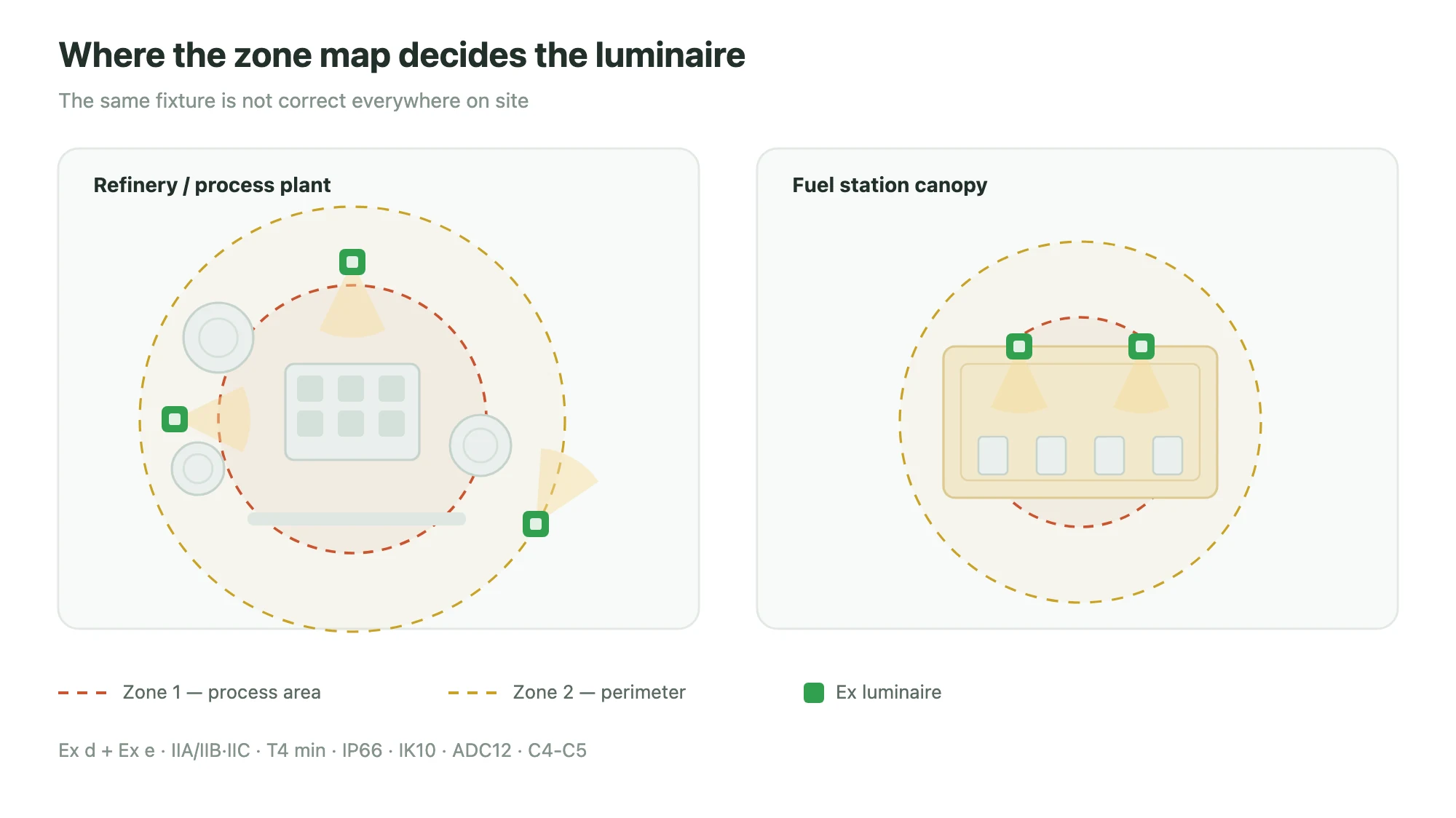
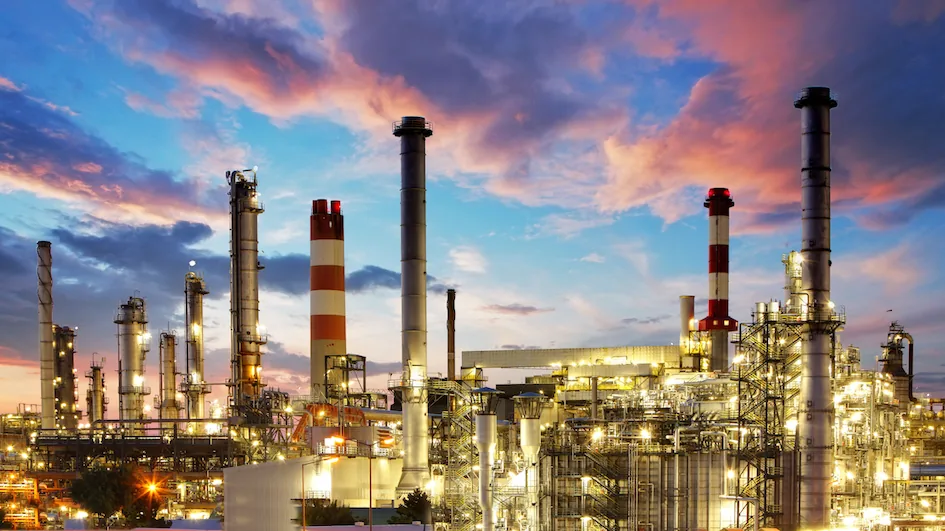
In a refinery, the light is not decoration. It hangs above hydrocarbons, vapour, pumps and tanks, and if the surface temperature or the seal fails, the consequence is not a dark walkway. It is a fire.
That is why selection here starts with the area classification and the process data, not with a catalogue page.
In hydrocarbon installations the pattern is fairly consistent:
A fuel station dispenser island and its immediate surroundings are normally assessed as a gas zone, and the inside of the dispenser or the tank pit can be more severe than the forecourt. In Europe, Zone 2 is often the working assumption unless a study says otherwise, but that assumption has to be written down somewhere before it becomes a purchase order.
For petrol and its derivatives:
The surface of the luminaire must never exceed the auto-ignition temperature of the product. T4 means 135 °C or less, T5 is 100 °C, T6 is 85 °C.
If the station is going to dispense hydrogen, the requirement is IIC plus T6. A IIA fixture at T4 is not a near miss there, it is the wrong product.
For outdoor industrial positions:
At a marine terminal or on a coastal site, corrosion takes out more luminaires than explosion risk does. A housing that survives the zone and fails the salt air is still a maintenance contract you did not budget for.
Do not buy more watts. Buy a beam distribution that matches the geometry:
Ask for a DIALux simulation of the layout before the order. Uniformity is not a comfort feature in a plant. A yard full of dark patches is an operational risk, and a tender that cannot show the calculation is a tender that has not done the work.
In a hazardous area, changing a luminaire is expensive: permit, isolation, shutdown of the surrounding unit. Design for fewer interventions:
A standard luminaire with a commercial battery pack inside breaks the certification of the whole assembly. The battery is part of the Ex assessment, not an accessory.
Explosion-proof LED luminaire
Zone: 1 (process) / 2 (perimeter)
Gas group: IIB or IIC per area
T-class: T5 minimum
Protection: Ex d + Ex e
IP66 / IK10
ADC12 housing, C4-C5 coating
Isolated driver, LM-80 LEDs
DIALux of the layout included
Certificate for the exact modelThree families cover most of these layouts:
Cast ADC12 housings, tempered glass, 4 to 6 kV surge protection, and lighting simulation support before the order is fixed. Each model is documented separately, so the certificate number on the quotation can be checked against the exact item on the order.
For the dust side of the same decision, the food processing guide covers Zone 20 to 22 and the hygiene requirements that come with them, and the range overview lists the three formats side by side.
Does every canopy light at a fuel station have to be explosion-proof? It depends on the mounting height and the zone boundary. Close to the dispenser and below a certain height, yes. Inside the shop or the convenience area, no. The zone study decides, and it should be in the project file.
Is IP65 enough? In a refinery or on a coastal site, no. IP66 is the working minimum and IP67 is better anywhere with washing or splash.
Can I use a standard high bay in Zone 2? Not without Ex certification. A standard high bay can produce an internal arc or a hot surface, and Zone 2 reduces the probability of a flammable atmosphere — it does not remove the ignition source.
What if the project has no area classification yet? Then the specification cannot be finished. Ask for the study first. A supplier who quotes a zone number without one is guessing on your behalf.
Our 25-engineer team provides free project consultation and fast, accurate quotations.
Get a Quote