
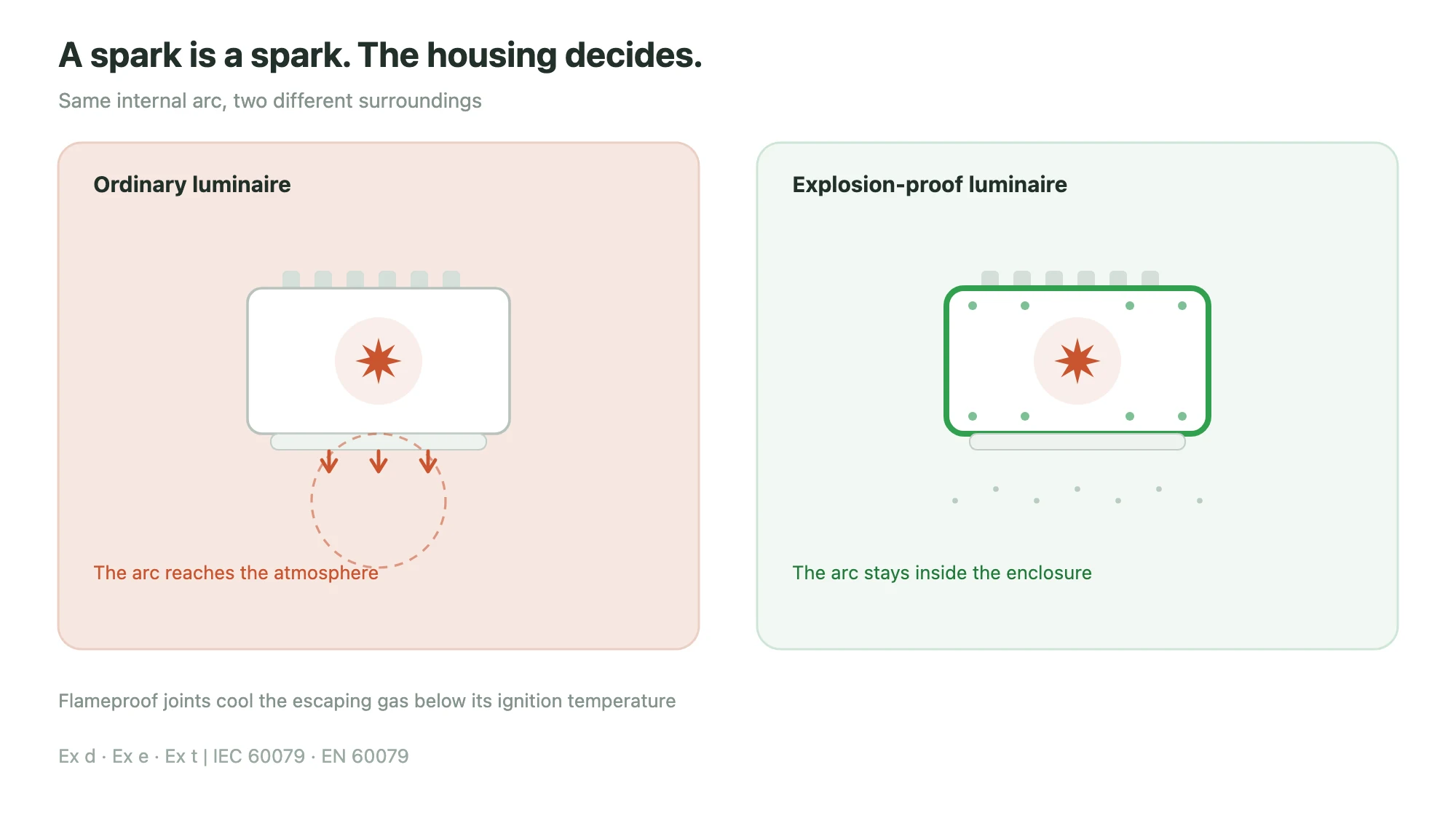
An explosion-proof luminaire is not a brighter light. It is a light built so that a spark, an arc or a hot surface inside its housing cannot ignite the atmosphere outside it.
The distinction sounds academic until you are standing under the canopy of a fuel station or on a walkway between two process towers. In those places a standard high bay is not a lighting choice. It is an ignition source with a warranty attached.
This same fixture answers to several names, and the name on the tender is not always the one you searched for. English datasheets say explosion-proof; Spanish ones say antideflagrante or, more formally, luminaria para atmósferas explosivas; and the certificate prefix used across Europe, ATEX, is short for the French ATmosphères EXplosibles. Three labels, one product, one set of test reports.
Explosion-proof lighting is specified where at least one of three things is present:
If any of those applies, the luminaire stops being part of the fit-out and becomes part of the safety case. The question is no longer how many lumens, but what has to happen inside the housing before the outside air can ignite.
Before a single fixture is quoted, the site should have a hazardous area classification. It splits into two families that are not interchangeable: gas and dust.
| Zone | How often the risk is present | Typical minimum EPL |
|---|---|---|
| 0 | Continuously, or for long periods | Ga |
| 1 | Likely during normal operation | Gb |
| 2 | Rare, and only briefly, during a fault | Gc |
| Zone | How often the risk is present | Typical minimum EPL |
|---|---|---|
| 20 | Continuously, or for long periods — inside a silo | Da |
| 21 | Likely during normal operation — filling points | Db |
| 22 | Rare, and only during abnormal accumulation | Dc |
A luminaire rated for Zone 2 is not automatically acceptable in Zone 1. A luminaire certified for gas does not always cover dust. Read the full marking, not the word "ATEX" on the box.
This is where most procurement mistakes start. A buyer asks for a price on "an ATEX light", gets three quotes, and compares them as if they were the same product. They are not. One may be Zone 2 gas only, another Zone 1 gas plus Zone 21 dust, and the third may be a Zone 2 fixture inside a Zone 1 area with a certificate that does not mention it.
Industrial LED floodlights and high bays usually combine several of these. Ex d plus Ex e is the common pairing: the enclosure contains the arc, while the increased-safety terminals and wiring remove the everyday sources of heat and spark.
If the site cannot answer the first two, no supplier can give you a correct fixture. Asking for "an explosion-proof light" without the zone number is like asking for "a fast car" without saying whether you drive in a city or on a motorway.
A datasheet that does not carry the full marking is not a technical document, it is a brochure:
The certificate has to match the model that will actually arrive. Changing the driver, the emergency battery or the terminal box can take the fixture outside the scope of its certification — and the paperwork will still look fine until an inspector reads the suffix.
Explosion-proof lighting is not a premium feature or a marketing word. It is the barrier between a spark and an explosion, and it only works if the barrier matches the specific risk on that specific site.
Lock the zone, the gas group and the temperature class before you look at a catalogue. Everything after that is arithmetic.
If you are turning this into a specification: the explosion-proof range is organised by housing format and by the zone each one is documented for, and the certification comparison covers what each mark actually proves.
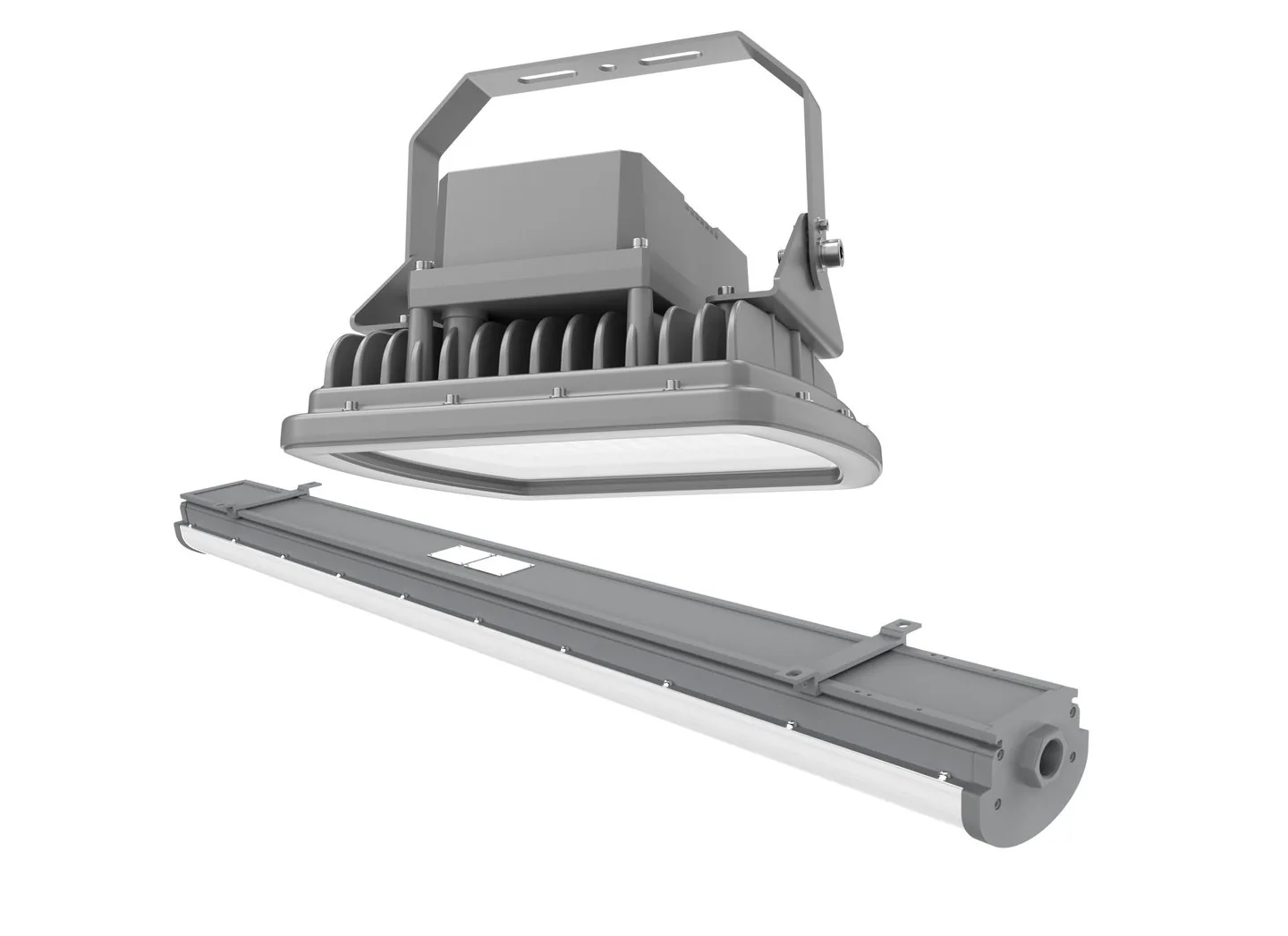
Does an explosion-proof light work in any zone? No. The certification names the zone, the atmosphere, the gas group and the temperature class. A Zone 2 fixture does not cover a Zone 1 area, and a gas-only certificate does not cover dust.
Is ATEX the same as explosion-proof? ATEX is the European legal framework. Explosion-proof is the commercial description. What matters on a purchase order is the full Ex marking and the certificate behind it.
Can one luminaire serve both gas and dust areas? Only when the certificate says so explicitly with a dual marking. Many fixtures carry gas marking alone, and assuming otherwise is one of the most expensive shortcuts in the category.
Do I need a hazardous area study before buying? Yes, if the answer is not already in the project documentation. The study defines the zone, the gas or dust group and the temperature class. Without it, every quotation is a guess dressed as a specification.
Is IP65 enough outdoors? For a dry inland site it can be. For a coastal terminal, a fuel station or any position that gets washed down, IP66 is the working minimum and IP67 is the safer specification.
Our 25-engineer team provides free project consultation and fast, accurate quotations.
Get a Quote