
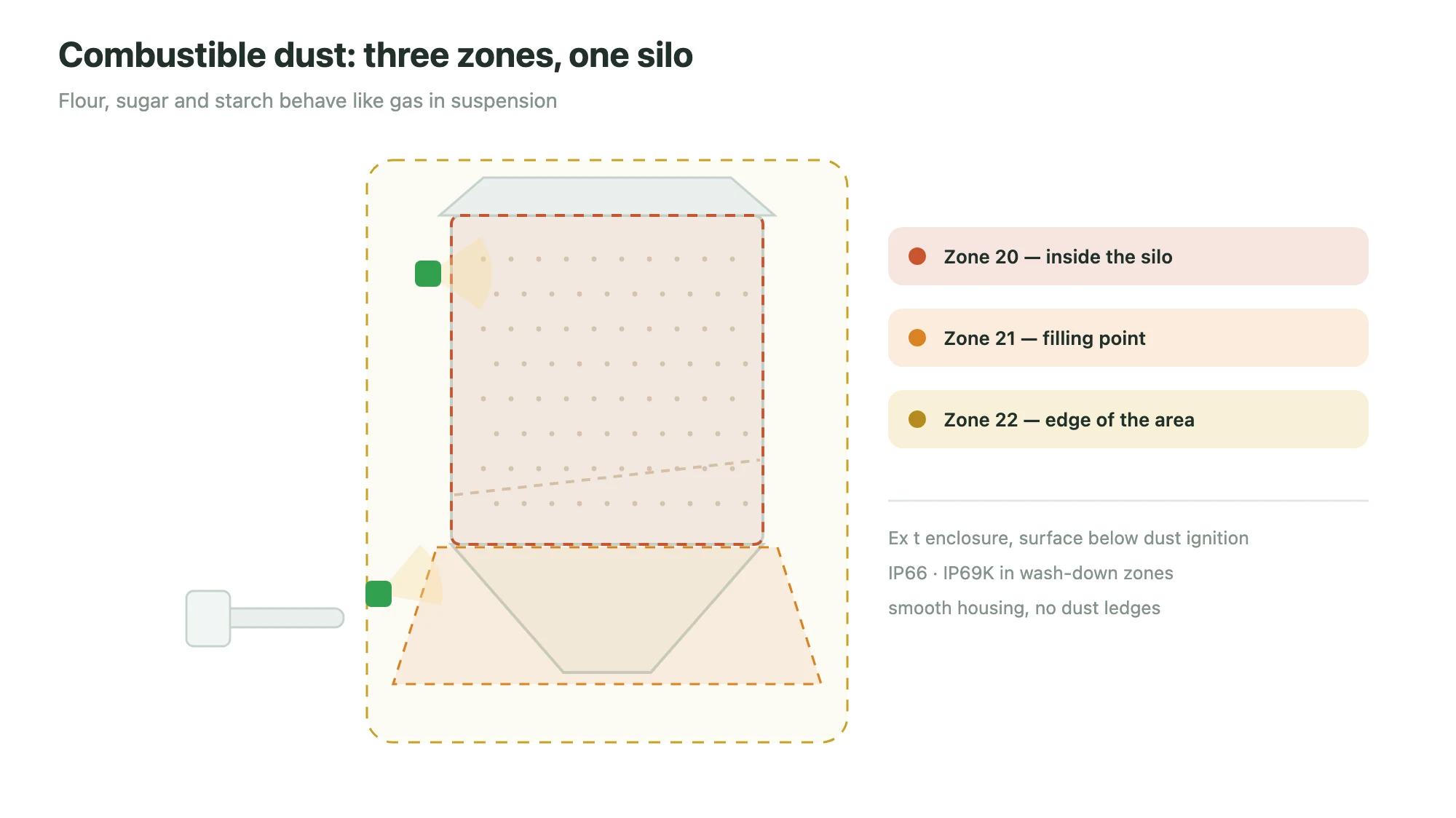
When people picture a hazardous area they picture a refinery. In food processing the risk hides in places nobody flags on a drawing: the mill room, the sugar bagging line, the silo roof, the starch dryer, the pneumatic conveying run.
Fine dust in suspension burns the way gas does, and the surfaces around it collect a static charge that a standard polycarbonate diffuser is happy to hold.
None of those rooms looks dangerous. That is exactly the problem: the dust layer on a beam is invisible until it is airborne, and a luminaire that was chosen for its price is the ignition source that starts the secondary explosion.
| Zone | Real example |
|---|---|
| 20 | Inside a silo, inside a cyclone or filter housing |
| 21 | Hoppers, filling stations, flour transfer points |
| 22 | Edge of the area, occasional accumulation on beams |
Here the dominant protection is Ex t, protection by enclosure, combined with control of the surface temperature. The enclosure keeps dust out in quantities that could burn, and the thermal design keeps the outside of the housing below the ignition temperature of the layer.
In a food plant the luminaire has two enemies:
That is why the specification asks for more than an Ex marking:
A fixture that meets Zone 21 and cannot be cleaned has simply moved the problem from safety to quality assurance.
Flour and sugar dust ignite at low temperatures, so the thermal design matters more than the lumen output:
A well-designed LED luminaire does not only save energy. Running cooler than the HID fixture it replaces, it also lowers the ignition risk on the same mounting point.
For process lines and production halls:
And yes, the fixture has to be certifiable for Zone 21 or 22 dust, and for Zone 1 or 2 gas as well where there are alcohol vapours, essential oils or solvent-based flavourings in the same room.
A flour mill replaces conventional fixtures with linear Ex luminaires over the bagging line. The expected outcome:
The economics are not usually sold on energy. They are sold on the fact that the line can be cleaned properly and the insurance inspector stops writing findings.
For the formats themselves, the range overview covers linear, high bay and floodlight; the zone basics explain how Zone 20, 21 and 22 are defined before a fixture is chosen.
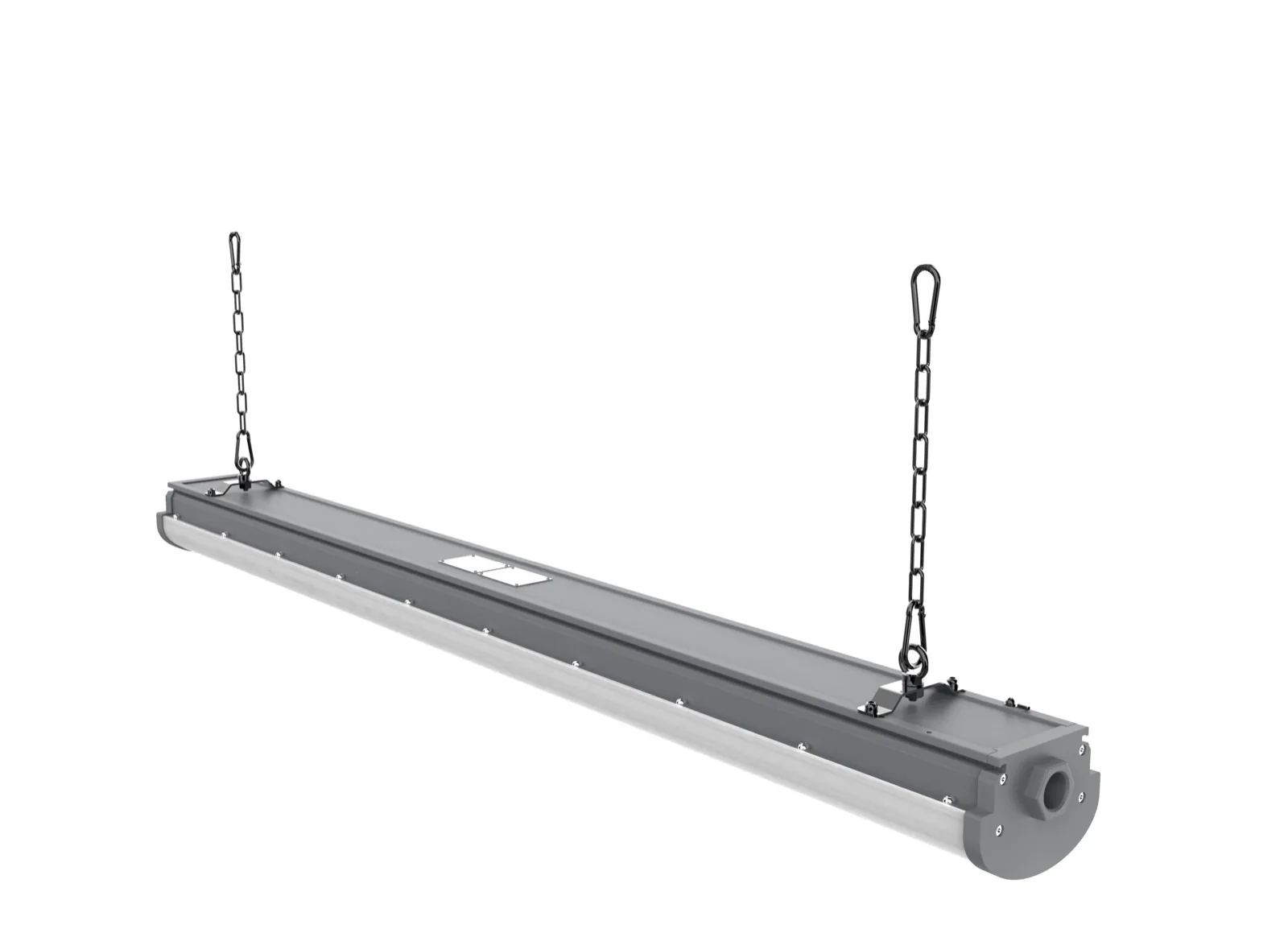
Does the whole food plant need ATEX lighting? No. Only the areas where combustible dust is in suspension or accumulates: milling, sifting, filling, silos, transfer points. The rest of the plant needs good hygiene lighting, not Ex lighting.
Is IP65 enough for a food plant? For dust ingress it can be. For a room that is washed down with pressure, IP66 or IP69K is the realistic specification, and the difference shows up in the first year of cleaning.
Does a standard LED fixture with a sealed housing count as Ex? No. Sealing addresses dust ingress, not ignition. The driver, the internal temperature and the enclosure design all have to be assessed together for the Ex marking to mean anything.
Can one fixture cover both the dust zone and the gas zone in the same room? Only with a dual marking on the certificate. Plants that handle alcohol-based flavourings or solvent extraction often need exactly that, and it is worth writing into the RFQ before the quotes arrive.
Our 25-engineer team provides free project consultation and fast, accurate quotations.
Get a Quote