
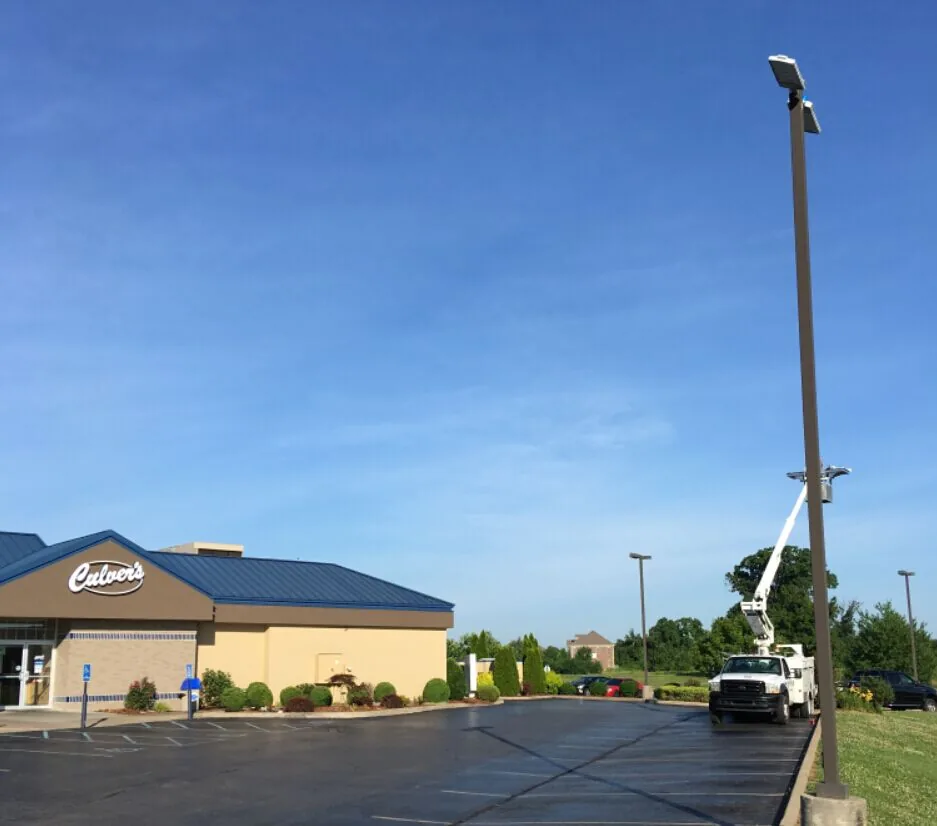
Last month we wrote about how to audit a 220 lm/W datasheet. A fair follow-up is: why does Luxey sell a 200 lm/W series at all? If 220 is the ceiling, isn't 200 just the cheap seat?
It isn't. The AIOH series is not a stripped-down flagship. It is a different product for a different job — a line built around the three numbers a buyer actually lives with after the order ships: how much light lands on the road, how many rainy nights it survives, and how long before someone has to climb the pole.
AIOH comes in six levels, 30 W to 120 W, covering 5 m to 16 m mounting heights:
| Model | Power | Luminous Flux | Solar Panel | LiFePO4 Battery | LED Chips | Mounting Height |
|---|---|---|---|---|---|---|
| LUX-AIOH-30W | 30 W | 6,000 lm | 18 V / 50 W | 3.2 V 72 Ah | SMD3030 ×96 | 5–7 m |
| LUX-AIOH-40W | 40 W | 8,000 lm | 18 V / 60 W | 3.2 V 100 Ah | SMD3030 ×144 | 6–8 m |
| LUX-AIOH-60W | 60 W | 12,000 lm | 18 V / 80 W | 12.8 V 30 Ah | SMD3030 ×192 | 8–10 m |
| LUX-AIOH-80W | 80 W | 16,000 lm | 18 V / 105 W | 12.8 V 45 Ah | SMD3030 ×240 | 10–12 m |
| LUX-AIOH-100W | 100 W | 20,000 lm | 18 V / 130 W | 12.8 V 60 Ah | SMD3030 ×288 | 12–15 m |
| LUX-AIOH-120W | 120 W | 24,000 lm | 18 V / 150 W | 12.8 V 75 Ah | SMD3030 ×336 | 14–16 m |
Every row divides to 200 lm/W. We publish it as a flat 200 across the line, not as a "best case" for the top model, so the number you audit is the number you get at every wattage.
The SMD3030 light engine is the workhorse of this category, and for good reason. It trades the last few points of chip efficacy for something that matters more over a 10-year street: thermal headroom and proven reliability. A line that runs a little cooler, year after year, keeps its output longer — which is why we back every AIOH unit with a 3-year warranty.
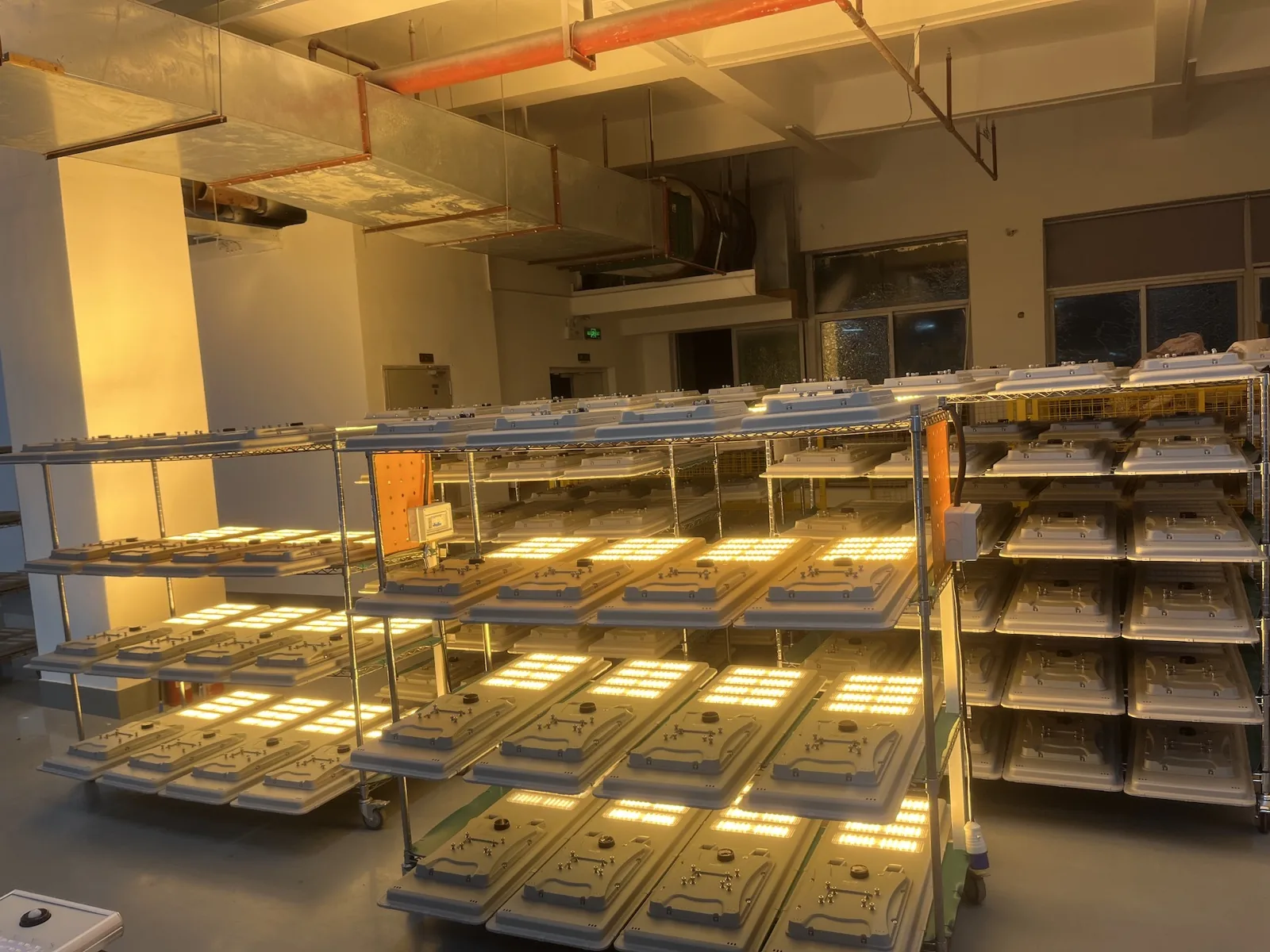
The spec that separates a working solar street light from a paper one is not lumens, it is rainy-day autonomy. AIOH is sized for 3–5 consecutive overcast days — not the optimistic two you see on cheaper all-in-ones. The LiFePO4 pack, paired with an MPPT controller, keeps charging efficient on grey days and protects the battery from overcharge and over-discharge.
A 120° microwave sensor holds the road at full brightness the moment someone passes, then drops to 30% fifteen seconds after they leave. In practice that is a full 12 hours of light per night from a single charge — the difference between a road that stays lit at 2 a.m. and one that goes dark after a long evening.
This is the question we get, and it deserves a straight answer rather than an upsell.
One flagship family for peak performance. One workhorse family for everything else. That is the whole logic of running two lines — and why "Why the AIOH series?" has a simpler answer than most people expect: because not every road needs a race car; most need a truck that starts every morning.
Is 200 lm/W noticeably dimmer than 220 lm/W? At the same wattage, about 9% fewer lumens. On an 80 W unit that is roughly 1,600 lm — a difference an optical lens and correct mounting height absorb in practice. What you feel on the road is driven by lens distribution and pole layout more than the last few points of chip efficacy.
What battery does AIOH use? Lithium iron phosphate (LiFePO4) cells — thermally stable, long cycle life, and safe through the 3–5 rainy days the series is sized for.
How long does an AIOH light run each night? Up to 12 hours from a full charge, with the motion sensor holding full brightness when traffic is present and dropping to 30% after the area clears.
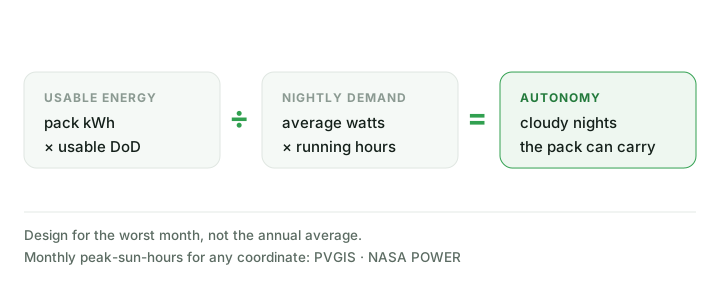
What is the warranty on the AIOH series? 3 years on every unit, backed by a 24-hour pre-shipment aging test on each fixture.
Where is AIOH best suited? Rural and municipal roads, highways, scenic spots, outdoor courts, parks and communities — anywhere from 5 m to 16 m mounting height.
How is AIOH different from the AIOAS flagship? AIOAS is the high-efficiency line (220 lm/W, SMD5050, up to 33,000 lm, 5-year warranty, remote + IoT). AIOH is the practical line (200 lm/W, SMD3030, up to 24,000 lm, 3-year warranty) — same LiFePO4 and MPPT core, fewer control features, workhorse wattages.
Get a quote for a free DIALux simulation of your road, or browse the full specification.
Our 25-engineer team provides free project consultation and fast, accurate quotations.
Get a Quote