
A high mast is the one outdoor lighting product where the fixture is the smallest part of the decision. The pole is 25 to 40 metres tall, the foundation is measured in cubic metres of concrete, and the only way to service anything at the top is to bring a crane or a lowering device to the site. Get the luminaire wrong on a car park and you change a lamp. Get it wrong here and you re-engineer a structure.
That is also why "energy-efficient" is such a slippery word in this category. A 200 lm/W chip on a badly aimed fixture can deliver fewer usable lux on the ground than a 150 lm/W fixture with the right optic — and it will do it while producing more glare for the neighbours. Efficiency at height is a system property: luminaire, optic, aiming, pole height, and the maintenance plan that keeps all of it working in year eight.
This guide covers what actually decides that outcome, in the order a project should decide it.
High mast is expensive per lux, so it belongs where the alternative is worse: places where you cannot put poles in the middle of the working area. Container terminals need the yard clear for straddle carriers. Interchanges need the merge and diverge points lit without a forest of 12 m columns. Logistics yards need even light across a manoeuvring area that trucks cross in every direction.
| Area | Typical mast height | What the lighting has to solve |
|---|---|---|
| Container terminal, port | 25–35 m | Even horizontal light across stacks, low glare into crane cabins, salt-air corrosion |
| Highway interchange, toll approach | 20–30 m | Legibility at speed, no glare to oncoming traffic, spill control at the boundary |
| Logistics and industrial yard | 18–25 m | Uniformity across manoeuvring lanes, tolerance of vehicle impact at the base |
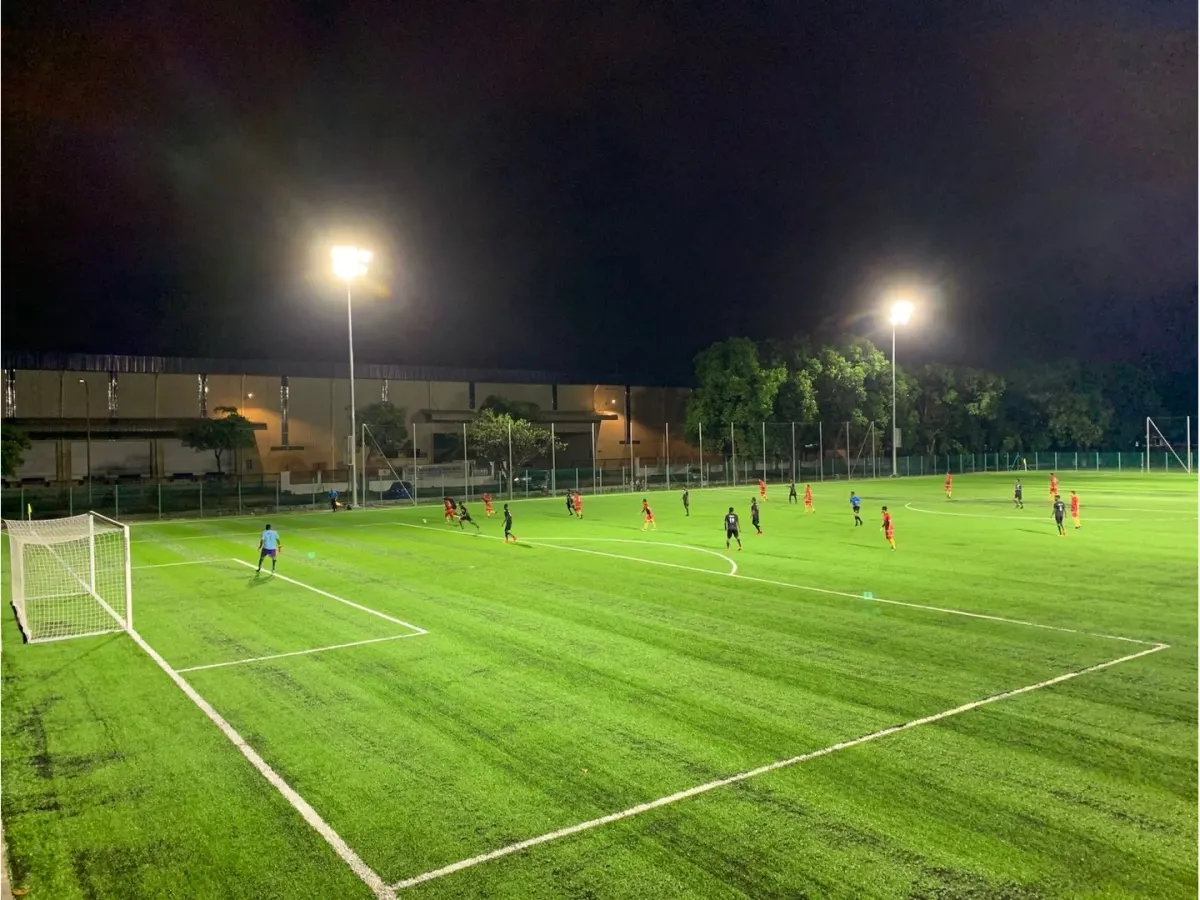
| Stadium apron, training field | 25–35 m | Vertical illuminance for players and cameras, tight spill control toward housing |
| Rail yard, marshalling area | 20–30 m | Colour rendering for signal recognition, dark-sky compliance |
Two things unify that table. First, the cost of getting light to the ground grows with the square of the distance, so every extra metre of height costs output. Second, at those heights the fixture is no longer a lamp you look at — it is a source of glare for anyone within a few hundred metres.
The height is usually fixed by the site: crane clearance, the setback from the boundary, the geometry of the area being lit. Once it is fixed, it sets the aiming angle, and the aiming angle sets both the glare and how far the beam has to throw.
A practical rule used across high mast design is to keep the mounting height at least a quarter of the distance from the mast to the far edge of the lit area. Below that ratio the fixtures have to be tilted up to reach, and an up-tilted high-output fixture is a glare source pointed at drivers, players, or neighbours.
For sports and large open areas, the target illuminance comes from the class the venue has to hold. EN 12193 is the reference cited in most international tenders, and it sets both the maintained horizontal illuminance and the uniformity that goes with it.
| EN 12193 class | Typical use | Maintained horizontal illuminance | Uniformity U0 |
|---|---|---|---|
| Class III | Training, recreational, local play | around 75 lx | ≥ 0.5 |
| Class II | Regional competition | around 200 lx | ≥ 0.6 |
| Class I | National competition | around 500 lx | ≥ 0.7 |
| Broadcast | Televised events | 750 lx and above, plus vertical illuminance | Per broadcaster specification |
The uniformity column is the one that decides the design. It is easy to hit an average lux target by adding fixtures; it is hard to hit it without dark bands between masts, and a scheme that fails uniformity fails the class no matter how bright the average is.
For non-sports areas there is no single class table, so the target should be written into the specification by the designer: maintained lux on the task plane, uniformity ratio, and the maintenance factor assumed. A maintenance factor of 0.8 is a common starting point for a well-maintained installation, but it has to be stated, because it changes the installed lumen requirement by 25%.
Efficacy figures in this category are quoted in three different ways, and mixing them up is how projects end up under-lit.
A current high-power LED high mast luminaire typically lands between 130 and 170 lm/W at the luminaire level, with the best products at or above 190 lm/W in the middle of their range. First-generation LED retrofits sat near 110–130 lm/W, and the metal halide and high-pressure sodium fixtures they replaced were typically 80–110 lm/W including ballast losses.
Those ranges matter less than the direction of the comparison. Replacing a 1,000 W metal halide head with a 400 W LED head usually cuts connected load by around 60%, and the delivered illuminance stays level or improves — but only if the optic is matched to the new, smaller light source. A 400 W LED package is physically smaller than the 1,000 W lamp it replaces, so the same reflector geometry no longer produces the same beam.
A high mast luminaire is an optical instrument with a structural housing around it. The optic controls three things at once: how wide the beam is, how sharp its cut-off is, and where the light lands relative to the mast.
Ask for the IES or LDT photometric file and a point-by-point calculation in DIALux or AGi32 against your actual mast layout. A supplier who cannot produce the file cannot be evaluated on optics, only on price.
Glare is the failure mode that generates complaints, and it is almost always an aiming problem rather than a wattage problem. Two metrics carry the argument in a specification:
Both are calculated from the installation, not from the fixture alone, so they belong in the lighting design — but the fixture has to make them achievable. That means a recessed or shielded emitter, a flat glass lens rather than an open reflector, and an aiming angle that keeps the beam inside the area being lit.
Upward light matters separately. Most outdoor lighting specifications now cap the upward light ratio, and the strictest environmental zones require it to be effectively zero. A high mast head aimed horizontally, or one with a wide uncontrolled beam, will fail that requirement even if its GR looks acceptable.
At 30 metres, the cost of a failure is not the fixture. It is the crane, the lane closure, the safety permit and the crew. That changes what "long life" has to mean.
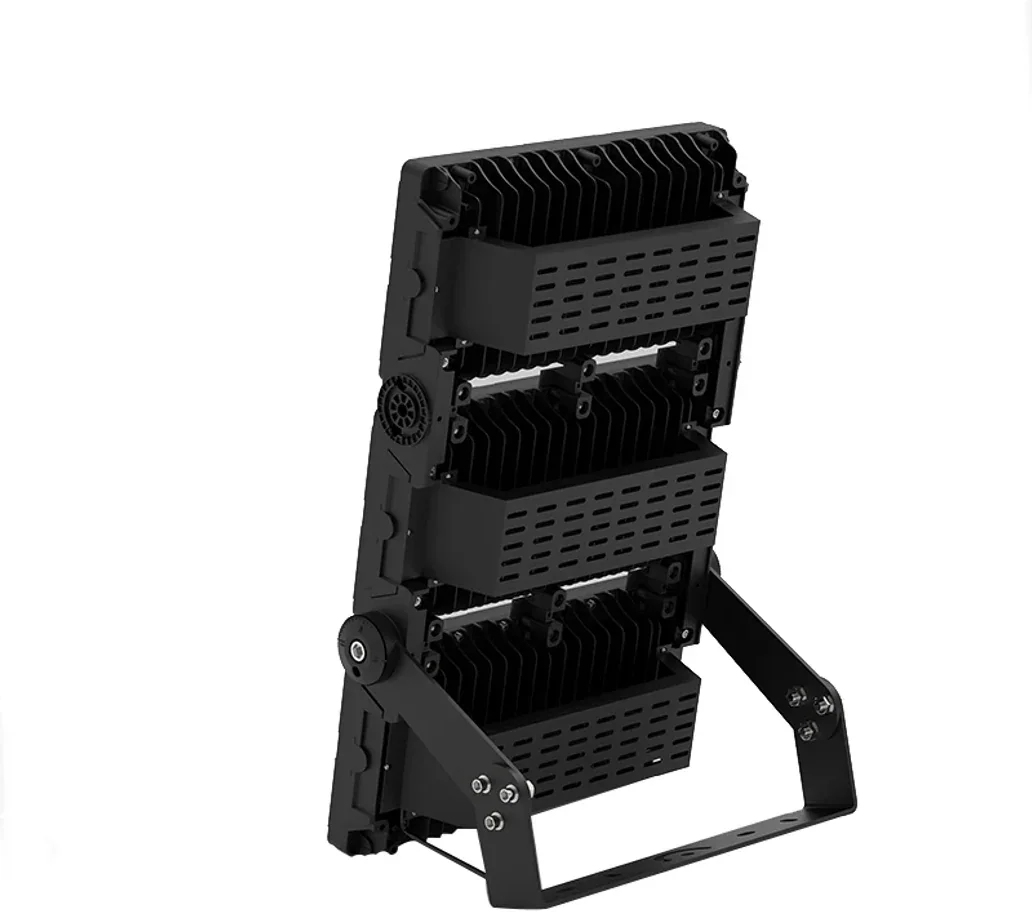
A high mast head is a sail at the top of a lever arm. Every luminaire has an effective projected area (EPA) — the area the wind sees — and the pole, the bracket and the foundation are designed against a total EPA at a design wind speed, usually according to EN 1991-1-4 or the local equivalent.
Replacing a compact HID head with a larger LED head can increase EPA by 30% or more. If the pole was sized for the original head and nobody re-checks, the installation is out of its structural envelope even though every photometric number is correct. The fix is procedural: give the pole designer the EPA, weight and centre of pressure of the new luminaire before the order is placed, not after.
Two maintenance models exist, and they should be chosen deliberately.
Either way, the energy case should include the maintenance line. A fixture that saves 60% of the electricity but needs a crane call every 18 months can lose the whole saving in one intervention. Remote monitoring — driver-level fault reporting over a wireless node — changes that arithmetic, because it turns a site-wide inspection into a targeted call.
| Item | What to ask for |
|---|---|
| Luminaire efficacy | LM-79 report, lm/W at the drive current specified |
| Photometrics | IES or LDT file plus a DIALux/AGi32 calculation for your layout |
| Colour | CCT and CRI, plus consistency tolerance across the order |
| Lifetime | L70 and L90 with case temperature and TM-21 projection |
| Ingress and impact | IP66 optical chamber, IK08 minimum, IK10 for exposed public sites |
| Surge | Protection level in kV, and whether it is at the driver or the input |
| Structure | Weight, EPA and centre of pressure for the pole designer |
| Thermal | Housing material, driver compartment design, operating temperature range |
| Controls | Dimming protocol (0–10 V, DALI, or wireless) and scheduling options |
| Warranty and spares | Years, what is covered, and lead time on replacement heads |
What is the difference between a high mast light and a floodlight? A high mast light is a floodlight system engineered for mounting above roughly 18–20 m, with the optics, thermal design and structural ratings that height requires. A floodlight mounted at 8 m is a different product with a different beam.
How many lumens do I need for a 30 m mast? There is no single number, because the answer depends on the area, the target illuminance and the beam angle. A 30 m mast lighting a container yard to 30 lx might use four to six 400–600 W heads aimed in different directions; the same mast lighting a stadium apron to 200 lx needs considerably more. The calculation, not the lumen package, produces the answer.
Is 200 lm/W realistic for a high mast luminaire? At the luminaire level, the best current products reach roughly 190–200 lm/W in the middle of their power range, and 140–170 lm/W is typical across the category. A 200 lm/W claim should come with an LM-79 report at the exact drive current being quoted.
How do I reduce glare from an existing high mast? Re-aim first: most complaints come from heads tilted above the horizontal or aimed outside the lit area. If re-aiming is not enough, add shields or visors, and replace open reflectors with flat glass optics.
What maintenance factor should I use? 0.8 is a common starting point for a maintained outdoor installation, but it must be stated in the specification. A lower factor requires more installed lumens and therefore more fixtures, so it changes the budget.
Do I need a lowering device? It depends on the failure rate you expect and the cost of access on your site. For ports and interchanges where a lane closure is expensive, a lowering device usually pays for itself over the pole's life.
If you are specifying a high mast scheme now, send us the mast layout and the target illuminance — we will run the point-by-point calculation and return the fixture schedule with the photometric file. Start from the HFL high mast and flood light specification, or compare the stadium and large-area range if the project includes a playing surface. For projects where the energy case has to be signed off internally, the TCO calculator turns the wattage difference into a five-year number.
Standards referenced: EN 12193 (sports lighting), IES LM-79 and LM-80/TM-21 (photometric and lumen-maintenance measurement), IEC 60529 (IP), IEC 62262 (IK) and EN 1991-1-4 (wind actions).
Luxey Lighting has manufactured high mast and large-area flood lights in Shenzhen since 2007. The HFL series uses ADC12 die-cast aluminium housings, LUMILEDS LEDs and MEAN WELL drivers, rated IP66 and IK10, with 26 kV surge protection and a 5-year warranty.
Our 25-engineer team provides free project consultation and fast, accurate quotations.
Get a Quote