
"Send me the price of an ATEX luminaire."
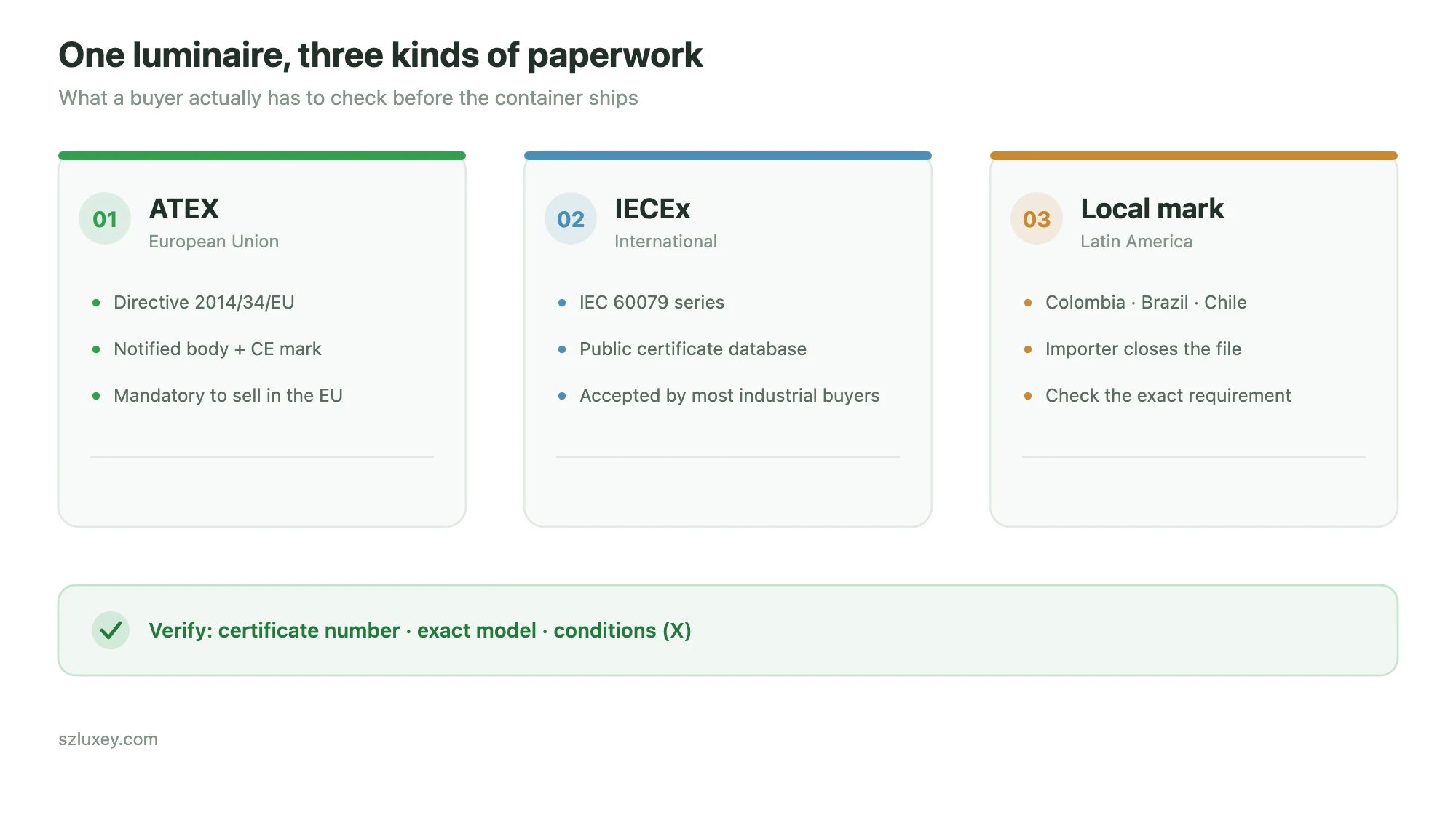
It reads like a complete request. It is not. ATEX and IECEx are different systems with different legal weight, and neither of them automatically clears the import file in the country where the fixture will be installed.
If the project is in Spain, France or anywhere in the EEA, ATEX is the baseline. If you are exporting from Asia into Europe, the same applies at the port of entry.
For Latin America, IECEx is usually the practical choice: one certificate travels across several countries, and any buyer can check it without asking the supplier for anything.
IECEx helps. It does not always replace a national requirement, and the gap is where shipments wait at customs.
| Country | What is actually required |
|---|---|
| Colombia | RETILAP covers public lighting; for Ex equipment, confirm with the authority how IECEx is accepted for the specific application |
| Brazil | INMETRO may require national certification; IECEx speeds up the review but does not always substitute for it |
| Peru, Chile, Ecuador | Technical evaluation case by case; IECEx makes the import file easier to assemble |
| Argentina | IRAM and OAA, through a local process |
IECEx is not a pass for every border. It is proof that the product meets the international baseline. The importer of record still has to close the file with the authority in that country.
None of this is a reason to avoid IECEx. It is a reason to ask who signs the import declaration, and to put that person's requirement into the RFQ before the price is fixed.
A certificate that looks convincing in a catalogue but does not match the delivered model does not only fail the inspection. It can void the installation's insurance.
Do not write "ATEX luminaire" and stop there. Write this instead:
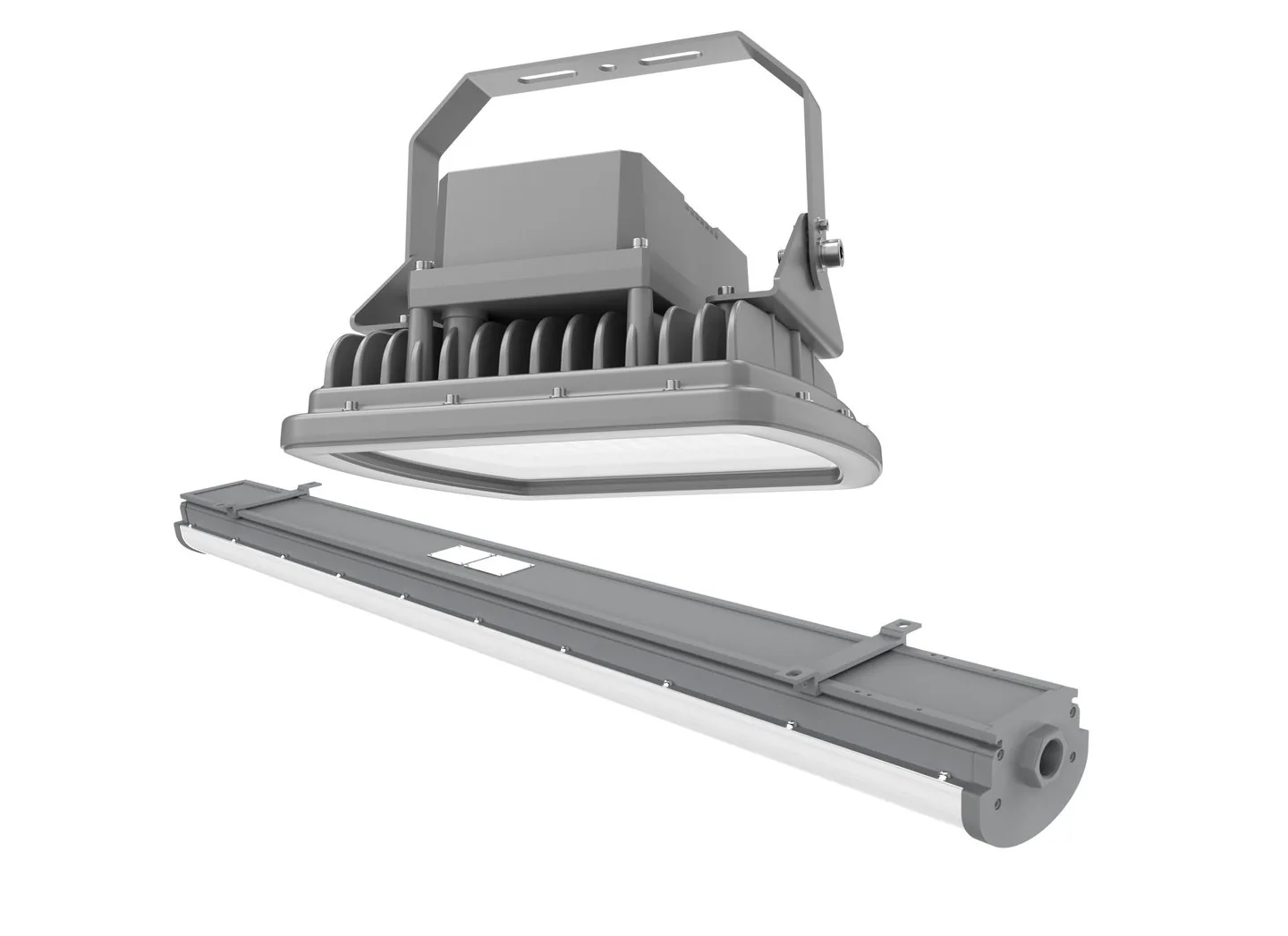
Explosion-proof LED luminaire, IECEx certified (plus ATEX where applicable), for Zone 1 and Zone 21, gas group IIC, temperature class T5 or T6, IP66, IK10, with a certificate number that can be verified and that is valid on the day of installation.
That sentence removes most of the suppliers who are only selling labels. Our own explosion-proof range is documented per model, and we would rather you check the certificate number against the exact item on your purchase order than take a catalogue page as proof.
If the zone is already fixed and the open question is which housing to put in it, the range overview is shorter than this article, and the refinery and fuel station guide covers the step after this one.
Does IECEx work in Brazil without INMETRO? IECEx makes the national review much easier, but INMETRO can still require national certification. Ask the importer of record before the order is placed, not after the container arrives.
Does ATEX work in South America? As technical evidence, yes. As the only import document, sometimes not enough. Check what the customs broker needs in that specific country.
Can I install a luminaire whose certificate has expired? No. Certificates can be suspended or withdrawn, and the check has to be valid on the installation date, not on the date the datasheet was printed.
Which one should a public tender ask for? Write the requirement so it can be verified: IECEx or ATEX for the exact model, a certificate number, and a database that anyone on the evaluation committee can query. Requirements that cannot be checked are usually written to fit one bidder.
Our 25-engineer team provides free project consultation and fast, accurate quotations.
Get a Quote